The 5 Largest NYSE Companies Based in Miami: Founding Stories, Growth, and Where They Stand Today
Stock prices and market data in this article are as of the market close on Monday, July 6, 2026, and fluctuate daily.
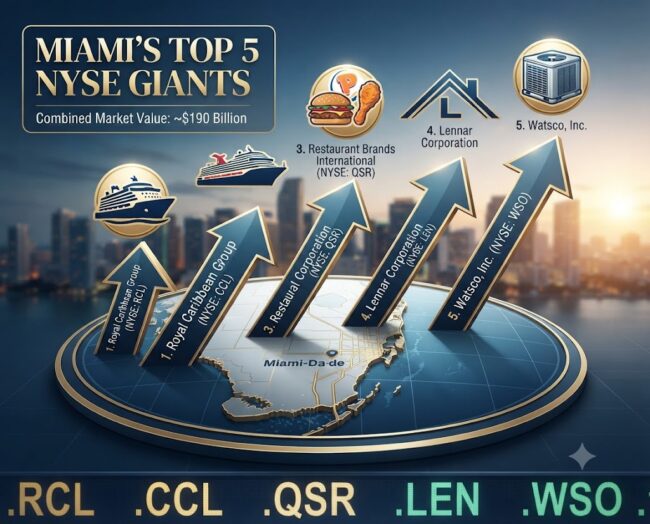
Miami has long been dismissed by outsiders as a tourism town — a place of beaches, cruise terminals, and cafecito, but not a corporate capital. That characterization has never been less accurate. The Magic City is today the headquarters of a remarkable roster of publicly traded giants whose combined market value approaches $190 billion, spanning cruising, fast food, homebuilding, and industrial distribution. What’s more striking is how deeply local these stories are: nearly every company on this list was either born in Miami-Dade County or grew up here, built by founders who saw opportunity in South Florida decades before the rest of corporate America caught on.
Below, we profile the five largest companies traded on the New York Stock Exchange that call Miami home, ranked by market capitalization — how they were founded, how they’re growing today, where their headquarters sit, and what their stock is doing right now.
1. Royal Caribbean Group (NYSE: RCL)
Headquarters: 1050 Caribbean Way, Miami, FL 33132 Stock price: approximately $287.78 at Monday’s close Market capitalization: roughly $80 billion
Fittingly, the most valuable company headquartered in Miami is a cruise line — and its address, perched at the edge of PortMiami on a street literally named Caribbean Way, could not be more on brand.
Royal Caribbean Cruises Ltd. was founded in 1968, when a group of Norwegian shipping families joined forces to build cruise ships designed specifically for warm-weather Caribbean vacationing out of Miami, rather than converting old ocean liners as competitors had done. The company’s first purpose-built ship, Song of Norway, arrived in 1970, and the business never looked back. Over the following decades Royal Caribbean pioneered the modern mega-ship era, introducing innovations — rock-climbing walls, ice rinks, entire neighborhoods at sea — that transformed cruising from a retiree’s pastime into a mass-market vacation category.
Today Royal Caribbean Group operates three global brands — Royal Caribbean International, Celebrity Cruises, and Silversea — and holds an interest in Germany’s TUI Cruises, which operates the TUI Cruises and Hapag-Lloyd Cruises brands. As of the end of 2025, the company operated 69 ships, supported by a workforce of roughly 108,000 people.
The company’s recent growth has been nothing short of spectacular. Royal Caribbean posted 2025 revenue of $17.94 billion, up 8.8 percent from the prior year’s $16.48 billion, while earnings surged 48 percent to $4.27 billion. The momentum has continued into 2026: the company beat Wall Street’s most recent quarterly expectations, delivering earnings of $3.60 per share against estimates of $3.24. In June, Royal Caribbean took official handover of its newest Icon Class vessel at a shipyard ceremony in Turku, Finland, ahead of a July 2026 European debut, and announced a partnership to raise funds for specialist children’s nurses during the ship’s inaugural European season.
Wall Street has taken notice. Citi recently raised its price target on the stock to $362, Wells Fargo lifted its target to $361, and the average 12-month analyst target sits near $337, with 19 analysts rating the shares a buy. The stock has traded between $232.10 and $366.50 over the past 52 weeks, and the company pays a quarterly dividend of $1.50 per share. Not every initiative has gone smoothly — the company recently withdrew plans for a large “Perfect Day” water park development on Mexico’s Caribbean coast after environmental objections from Mexican authorities — but with record demand and disciplined industry capacity, Royal Caribbean enters the back half of 2026 as one of the strongest stories in all of travel.
2. Carnival Corporation (NYSE: CCL)
Headquarters: 3655 NW 87th Avenue, Miami, FL 33178 Stock price: approximately $27.52 at Monday’s close Market capitalization: roughly $37.7 billion
If Royal Caribbean is Miami’s most valuable company, Carnival is arguably its most iconic. Founded in Miami in 1972 by Ted Arison, an Israeli-American entrepreneur, Carnival Cruise Line began with a single secondhand ship, the Mardi Gras — which famously ran aground on a sandbar during its maiden voyage out of the Port of Miami. From that inauspicious start, Arison built the self-proclaimed “Fun Ships” into the largest cruise operator on Earth, taking the company public in 1987 and using the proceeds to assemble a portfolio of brands through acquisition.
Today, Carnival Corporation’s headquarters campus in western Miami-Dade houses the parent of a global fleet of nearly 100 ships sailing under some of the most storied names in the industry: Carnival Cruise Line, Princess Cruises, Holland America Line, Seabourn, Cunard, AIDA Cruises, Costa Cruises, and P&O Cruises. The company employs approximately 160,000 people worldwide, making it one of the region’s most consequential employers.
Carnival’s post-pandemic comeback has evolved into a genuine growth story. The company has been reporting record financial results, with its most recent quarter delivering a gross margin of 48.1 percent and results that beat the company’s own guidance by roughly $100 million. Booking trends have been at record levels, and the company is expanding its Caribbean itineraries for the 2027–2028 seasons, anchored by its wildly successful private destination strategy. In a notable corporate milestone this month, Carnival completed the unification of its dual-company structure and redomiciled the combined entity to Bermuda — a simplification that ends the two-headed corporate arrangement dating to its 2003 combination with P&O Princess, while day-to-day operations remain run from Miami under CEO Josh Weinstein.
Analysts have responded to the momentum with a wave of price-target increases in recent weeks: Tigress Financial raised its target to $42, Wells Fargo to $38, and Argus to $35, and 23 analysts rate the stock a buy with none recommending a sale. Shares have traded between $23.45 and $34.03 over the past year, and the company has restored a dividend yielding roughly 1 percent. Carrying billions in pandemic-era debt, Carnival remains a leverage-reduction story as much as a growth story — but with cruising still underpenetrated relative to land-based vacations, the runway from here is long.
3. Restaurant Brands International (NYSE: QSR)
Headquarters: 5707 Blue Lagoon Drive, Miami, FL 33126 Stock price: approximately $73.53 at Monday’s close Market capitalization: roughly $33.5 billion
The newest mega-cap name on Miami’s corporate roster is also, in a sense, one of its oldest. Restaurant Brands International — the parent of Burger King, Tim Hortons, Popeyes, and Firehouse Subs — traces its founding to Miami in 1954, when James McLamore and David Edgerton opened the first Burger King restaurant here. Three years later they introduced the Whopper, then priced at 37 cents, and built the flame-grilled burger into one of the most recognizable food brands in the world.
The modern corporate entity was formed in 2014 through the $12.5 billion merger of Burger King and Canadian coffee-and-doughnut giant Tim Hortons, engineered by Brazilian investment firm 3G Capital, which remains the company’s largest shareholder with roughly a 32 percent stake. The company expanded again with the acquisitions of Popeyes Louisiana Kitchen in 2017 and Jacksonville-born Firehouse Subs in 2021. While the company maintains a Toronto office alongside its Tim Hortons brand and dual-lists its shares in New York and Toronto, its principal executive offices — listed in its SEC filings — sit at 5707 Blue Lagoon Drive in Miami’s Waterford business district near Miami International Airport, the same campus Burger King has called home for decades. Company press releases now carry a Miami dateline, cementing the Magic City as RBI’s corporate home.
The scale of the enterprise is staggering: RBI’s four brands span more than 30,000 restaurants across some 100 countries. Growth remains healthy — the company reported quarterly revenue of $2.3 billion with net income of $445 million in its most recent report, and management told shareholders at June’s annual meeting that it plans to return $1.6 billion to shareholders in 2026, citing strong operating income and earnings growth. Burger King’s multi-year “Reclaim the Flame” turnaround plan continues to invest in remodeling U.S. restaurants in a bid to retake the top spot among American burger chains.
The stock has traded between $61.33 and $81.96 over the past 52 weeks and offers one of the more attractive dividends on this list, yielding roughly 3.4 percent. Analysts see room to run: the average 12-month price target stands near $86 — about 17 percent above current levels — and Guggenheim recently lifted its target to $85 with a buy rating. For a company born at a Miami hamburger stand seven decades ago, RBI’s return of its corporate flag to Blue Lagoon Drive feels like a homecoming.
4. Lennar Corporation (NYSE: LEN)
Headquarters: 5505 Waterford District Drive, Miami, FL 33126 Stock price: approximately $87.54 at Monday’s close Market capitalization: roughly $21.1 billion
Just down the street from RBI in the Waterford district sits the headquarters of America’s second-largest homebuilder — and in a delightful piece of Miami corporate trivia, Lennar’s current home is Burger King’s former headquarters building, which the homebuilder moved into in 2018 and purchased outright in 2023 for $68 million.
Lennar’s origins are pure Miami. The company dates to 1954, when Gene Fisher and developer Arnold Rosen founded F&R Builders in Miami-Dade County. In 1956, a 23-year-old entrepreneur named Leonard Miller — who owned 42 building lots in the county — invested $10,000 to partner in the business. By 1971 Miller and Rosen renamed the company Lennar, a portmanteau of their first names, took it public, and listed it on the New York Stock Exchange in 1972. Miller would become one of Miami’s great philanthropists; the University of Miami’s Miller School of Medicine bears his name. His son, Stuart Miller, serves as the company’s executive chairman today.
From those 42 lots, Lennar has grown into a colossus that operates in roughly 30 states and 75 markets, generating trailing-twelve-month revenue of about $32.7 billion and ranking 126th on the Fortune 500. The company has grown through bold acquisition — including the transformative CalAtlantic Homes deal in 2018 and the November 2024 purchase of Rausch Coleman Homes, which pushed Lennar into half a dozen new markets. In February 2025, Lennar executed one of the most closely watched strategic moves in the industry, spinning off Millrose Properties, a first-of-its-kind land-banking platform, as part of its shift toward an asset-light, “land-light” manufacturing model. Beyond homebuilding, the company operates financial services, multifamily development, and a venture arm, LenX, that invests in construction technology.
Candidly, 2026 has been a challenging year for the housing sector, and Lennar has not been immune. Elevated mortgage rates and affordability pressures have softened demand, forcing the company to lean on sales incentives that compressed its most recent quarterly gross margin to 15.6 percent, and several analysts have trimmed price targets. The stock, which traded as high as $137.39 in the past year, now sits near its 52-week low of $79.50. Yet the long view favors patience: America remains structurally underbuilt by millions of homes, Lennar holds a fortress balance sheet with billions in cash and low debt, and the company pays a $2.00 annual dividend yielding about 2.3 percent while it waits for the cycle to turn.
5. Watsco, Inc. (NYSE: WSO)
Headquarters: 2665 South Bayshore Drive, Miami, FL 33133 Stock price: approximately $399.06 at Monday’s close Market capitalization: roughly $16.2 billion
The least famous name on this list may be its most quietly brilliant business. From a modest office tower in Coconut Grove overlooking Biscayne Bay, Watsco runs the largest distribution network for heating, air conditioning, and refrigeration (HVAC/R) products in North America — an empire built on a product no Floridian can live without.
Watsco’s roots reach back to 1945 as a small manufacturer of tools and parts, incorporated in 1956 as Wagner Tool & Supply by founder William Wagner. The company’s defining moment came in 1972, when Albert H. Nahmad acquired control. Nahmad — who remarkably still serves as chairman and CEO more than five decades later — engineered one of the great strategic pivots in American business history, exiting manufacturing in the late 1980s to consolidate the highly fragmented business of distributing air conditioning equipment to contractors. Through more than 60 acquisitions, Watsco assembled a network of hundreds of locations serving the contractors and dealers who install and replace HVAC systems across the United States, Canada, Latin America, and the Caribbean, employing roughly 7,000 people.
The growth engine is still running. In June 2026, Watsco closed its acquisition of Jackson Supply Company, a leading Sunbelt distributor with annual sales of $230 million. The company’s first quarter showed stabilizing markets and 2 percent U.S. sales growth, with its e-commerce and digital platforms outpacing overall performance — the fruit of a decade-long, industry-leading investment in technology that management believes will carry it toward long-term targets of $10 billion in sales and 30 percent gross margins. Watsco is also a dividend machine beloved by income investors: the board recently raised the quarterly payout 10 percent to $3.30 per share, an annualized $13.20 that yields north of 3 percent. An investor who bought the stock at its 1997 NYSE listing price of $16.46 has earned an annualized return of roughly 12 percent before dividends. Shares have traded between $323.05 and $494.94 over the past 52 weeks, and the average analyst target of about $421 implies modest upside from here.
The Takeaway
An honorable mention goes to Norwegian Cruise Line Holdings (NYSE: NCLH), the third leg of Miami’s cruise triumvirate, whose roughly $10 billion market value narrowly misses this list. But the five companies above tell the larger story: Miami’s biggest public companies were not lured here by tax incentives or pandemic-era relocation trends. They were founded here — on the docks of the port, at a 1954 hamburger stand, on 42 empty lots in unincorporated Dade County — and grew into national and global champions worth a combined $188 billion. For a city still sometimes underestimated as a business town, the ticker tape tells a different story.
This article is for informational purposes only and does not constitute investment advice. Stock prices referenced reflect the market close of July 6, 2026, and change constantly; readers should consult current quotes and a licensed financial advisor before making investment decisions.
About the Author