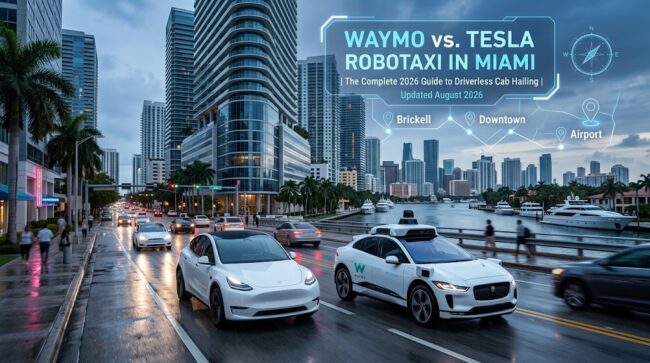
The Complete 2026 Guide to Driverless Cab Hailing
MiamiBusinessNews.com | Updated August 2026
Quick Answer: Miami now has two driverless ride-hailing services competing for riders. Waymo, which began mapping and testing in Miami in early 2025, opened public rides through the Waymo One app and is the more established operator, with an estimated 150–225+ vehicles in the metro area. Tesla’s Robotaxi service entered Miami later, scaling quickly off its Austin playbook with an estimated 90–160+ vehicles. Waymo currently leads on coverage area and track record; Tesla competes on price and fleet growth speed.
Editor’s note on data: Neither company publishes official per-city fleet counts. All fleet figures in this guide are editorial estimates compiled from public reporting, permit filings, and analyst trackers, and should be treated as directional. We update this page as new disclosures emerge.
What driverless cab services operate in Miami right now?
Two fully driverless (no safety driver) robotaxi services are active in Greater Miami:
- Waymo One — Alphabet’s autonomous ride-hailing service. Waymo announced its Miami expansion in December 2024, began driving Jaguar I-PACE vehicles in the city in early 2025, and opened rides to the public via the Waymo One app in 2026. Miami was Waymo’s first East Coast/Florida market and a deliberate test of heavy rain performance.
- Tesla Robotaxi — Tesla’s camera-only autonomous service, first launched in Austin in June 2025 and expanded to additional Sun Belt metros afterward. Tesla named Miami among its expansion targets, and service is hailed through the Tesla Robotaxi app using Model Y (and eventually Cybercab) vehicles.
Traditional rideshare (Uber, Lyft) still dominates total trip volume, and Uber has partnerships to carry autonomous vehicles on its platform in some markets — worth watching as a third channel for AV rides in Miami.
How do I hail a Waymo in Miami?
Download the Waymo One app (iOS/Android), create an account, set your pickup and drop-off inside the service area, and confirm the ride. The car arrives with no driver; you unlock the doors from the app. Pricing is dynamic and generally comparable to UberX/Lyft standard tiers. Waymo’s Miami operations are supported by its fleet partner Moove, which manages depots, cleaning, and charging.
How do I hail a Tesla Robotaxi in Miami?
Download the Tesla Robotaxi app, join (early access has historically been invite/waitlist-based in new cities before opening broadly), and request a ride inside the geofenced service area. Tesla has used aggressive flat or low per-mile promotional pricing in new markets — its Austin launch famously started at $4.20 per ride — so expect introductory pricing designed to undercut Uber, Lyft, and Waymo.
What is the fleet size and growth rate for each service in Miami?
Estimated active fleets (Greater Miami, mid-2026):
| Metric | Waymo (est.) | Tesla Robotaxi (est.) |
|---|---|---|
| Active vehicles | ~150–225 | ~90–160 |
| Time in Miami market | Since early 2025 (testing), public 2026 | Later entrant, scaling in 2026 |
| Approx. quarter-over-quarter fleet growth | ~40–50% | ~80–120% (from a small base) |
| Vehicle platform | Jaguar I-PACE; Zeekr/Ioniq 5 platforms rolling in | Model Y; Cybercab planned |
| Coverage focus | Miami core, Miami Beach, airport corridors expanding | Dense urban core, expanding geofence |
Growth picture: Waymo’s growth is steady and infrastructure-led — it scales as depots, charging, and mapped territory expand. Tesla’s growth is faster in percentage terms because it starts from a smaller base and can flip existing Model Y inventory into service quickly, but its geofence and rider access have historically opened more cautiously than its fleet numbers suggest. Nationally, Waymo surpassed 100 million driverless miles and roughly 250,000+ paid rides per week across all markets in 2025, while Tesla’s robotaxi program was still measured in the low millions of miles.
Fleet growth chart
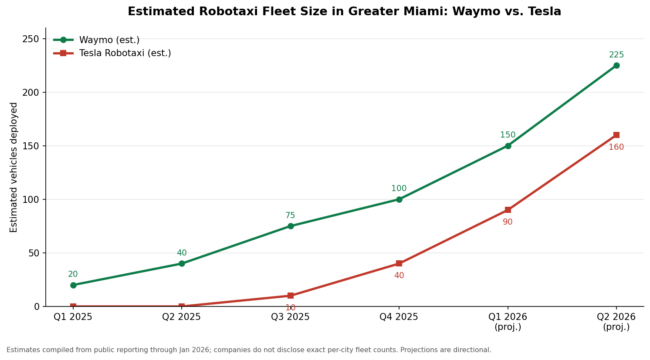
Estimates compiled from public reporting; projections are directional, not official company figures.
Which is cheaper: Tesla Robotaxi or Waymo in Miami?
Tesla is typically cheaper — for now. Tesla has used promotional flat-rate and below-market pricing to seed demand in new cities. Waymo prices dynamically, usually landing near or slightly above UberX for equivalent trips. Expect Tesla’s prices to normalize as its Miami fleet utilization rises.
Which is safer?
Both operate under Florida’s permissive AV statute (Fla. Stat. § 316.85), which allows fully driverless operation without a human onboard. Waymo has the longer public safety record, publishing peer-reviewed safety data showing large reductions in injury-causing and pedestrian-involved crashes versus human benchmarks. Tesla’s approach relies on cameras and neural networks without lidar; its program is newer, launched with safety monitors in early markets, and has less published third-party safety data. Riders should also note NHTSA has had open inquiries into both companies’ AV operations at various points — standard scrutiny for this industry.
Where can each service take me?
- Waymo: Core Miami service area with expansion toward Miami Beach and airport corridors (airport service typically requires separate agreements — verify current status in-app).
- Tesla: A tighter urban geofence at launch that expands in waves, mirroring its Austin rollout pattern.
- Neither offers highway-speed intercity trips to Fort Lauderdale or West Palm Beach yet; Brightline remains your driverless-adjacent option for that.
What does this mean for Miami businesses?
- Hospitality & tourism: Driverless rides are becoming a destination amenity; hotels near service-area boundaries have a marketing edge.
- Parking & real estate: Sustained robotaxi growth pressures parking revenue models in Brickell and Downtown over the long term.
- Fleet & mobility ventures: Waymo’s partnership with Moove for Miami fleet operations shows the local jobs story is in depot operations, cleaning, charging, and maintenance — not driving.
- Insurance & legal: Florida’s AV-friendly statutes make Miami a live laboratory; expect growing demand for AV-literate insurance and liability counsel.
Brian’s Take
Brief remarks from our mobility columnist:
“Miami is the first market where these two are truly going head-to-head in a rain-soaked, chaotic-traffic, international-tourist city — and that’s the point. Waymo picked Miami to prove weather robustness; Tesla picked it because it’s a brand town with Cybertruck energy. My read: Waymo wins the next 12 months on trust and coverage, Tesla wins the price war and the headlines. The real loser is anyone who just signed a long-term parking garage lease. Watch the airport — whoever locks in MIA pickup first takes a massive share of high-value trips.”
FAQ
Is there a driver in the car?
No. Both services operate fully driverless in their Miami service areas, though Tesla has used onboard safety monitors during early phases in some cities.
Can I hail these from the airport?
Airport access depends on agreements with Miami-Dade Aviation Department. Check each app’s live service map before relying on it for MIA trips.
Do they operate in the rain?
Yes — Miami was specifically chosen by Waymo to validate heavy-rain driving. Extreme weather (tropical storm conditions) can pause service.
How many people can ride?
Waymo’s I-PACE seats up to 4 passengers. Tesla’s Model Y robotaxis seat up to 4 in ride configuration.
Can minors ride alone?
No. Both services require an adult account holder in the vehicle.
Resources
- Waymo One: https://waymo.com/waymo-one/ — service areas, app download, safety reports
- Waymo Safety Hub: https://waymo.com/safety/
- Tesla Robotaxi: https://www.tesla.com — robotaxi program updates and app info
- Florida Autonomous Vehicle Law: Fla. Stat. § 316.85 — http://www.leg.state.fl.us
- Miami-Dade County Transportation & Public Works: https://www.miamidade.gov/global/transportation/home.page
- NHTSA Automated Vehicles: https://www.nhtsa.gov/technology-innovation/automated-vehicles
- FLHSMV Autonomous Vehicles: https://www.flhsmv.gov
Fleet figures are editorial estimates as of publication and change quickly. Verify current service areas and pricing in each company’s app.
About the Author