Quick Answer: Miami is the main U.S. business, financial and cultural bridge to South America. About 70% of Miami-Dade residents are Hispanic, roughly 1,200 multinationals run Latin American headquarters there, and Brazil, Colombia, Chile and Argentina are top trade partners, so South American growth flows directly to Miami companies.
Why Miami Is Different From Every Other U.S. City
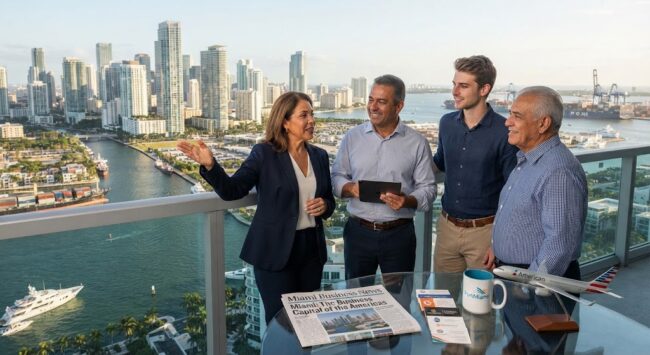
Most American cities trade with Latin America. Miami lives with it. The region’s banks, airlines, ports, media companies and family businesses are tied to South America through language, migration, capital and daily commerce in a way no other U.S. metro can match.
The numbers show the depth of the connection. Hispanic or Latino residents make up 70.3% of Miami-Dade County’s population, compared with 20% nationally. More than half of county residents, 54.5%, were born outside the United States. About 66% speak Spanish at home.
That population makes Miami a natural headquarters for anyone doing business in the hemisphere. With no state income tax and strong connections to Latin America and the Caribbean, Greater Miami hosts about 1,200 multinational companies’ Latin American headquarters. Roughly 30% of Miami-Dade businesses are Hispanic-owned.
Miami at a Glance
| Metric | Figure |
|---|---|
| Miami-Dade population | 2.8 million |
| Hispanic share | 70.3% |
| Foreign-born residents | 54.5% |
| Spanish spoken at home | ~66% |
| Latin American HQs | ~1,200 multinationals |
| Customs District trade (2025) | ~$148.6 billion |
The Trade Engine: South America Comes First
Miami’s trade is weighted toward South America more than most people realize. The Miami Customs District, covering Miami-Dade, Broward and Palm Beach counties, recorded $84.5 billion in exports and $64.0 billion in imports in 2025, a combined total of about $148.6 billion and a surplus of more than $20 billion.
Brazil is the anchor. In 2024, Brazil remained the district’s top trading partner with $19.38 billion in total trade, including $15.3 billion in exports from Miami. Colombia followed at $10.03 billion. Remarkably, Canada and Mexico, the top U.S. trading partners overall, plus Central America and the Caribbean combined still trail Miami’s trade with South America by $10 billion. The four South American countries in Miami’s top 10 account for $40 billion in trade, more than five times the trade with China.
Top South American Trade Partners
| Country | Total Trade With Miami District |
|---|---|
| Brazil | $19.38B (2024) |
| Colombia | $10.03B (2024) |
| Chile | $7.26B |
| Argentina | $4.18B |
What moves through Miami is high value. Aircraft parts, the district’s top export, rose 35.7% to $2.99 billion in the third quarter of 2024, with Brazil taking 59.4% of the total. Telephones added $6.06 billion in 2024, fueled by Latin American demand.
The Gateway Infrastructure: MIA and PortMiami
Miami International Airport
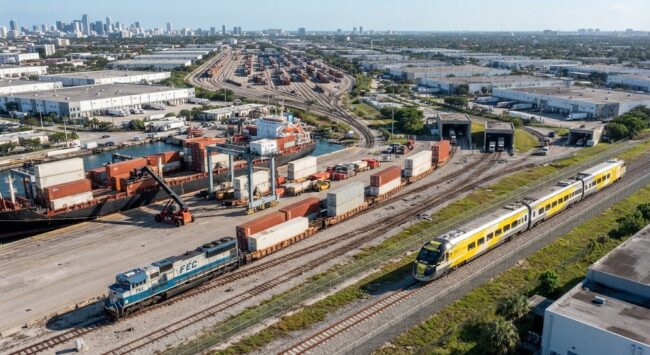
Miami International Airport is the hemisphere’s dominant air cargo link. MIA is America’s #1 airport for total freight and international freight, handling a record 3.4 million tons in 2025, up 13.2% from 2024, with $89 billion in trade value. Some 83% of U.S. air cargo imports from Latin America and the Caribbean move through MIA, along with 79% of U.S. air exports to the region.
The airport is a transshipment hub, not just a destination. In 2025, freight passing through MIA en route elsewhere surpassed origin-and-destination freight for the first time in more than a decade. MIA also has the country’s most extensive air links to Latin America, especially Colombia and Ecuador, the top two sources of flowers sold in the U.S.
The broader economic impact is large. MIA’s cargo operations generated $181.4 billion in statewide business revenue in 2024 and supported about 843,000 Florida jobs, according to Martin Associates.
PortMiami
By sea, PortMiami leans just as heavily south. Latin America and the Caribbean made up 46.8% of all PortMiami trade in fiscal 2025, 376,065 TEUs worth $58.2 billion, and the port trades with 28 Latin American nations. South American partners such as Colombia, Ecuador and Peru rank among its top import sources.
Brickell: The Wall Street of the South
Miami’s financial district exists largely because of South American capital. Brickell’s rise began in the 1970s, when international banks, especially from Latin America, opened offices along Brickell Avenue, attracted by its location and relative stability compared with many Latin American capitals. Today, Brickell hosts more than 60 international banks, the largest concentration outside New York City, and Miami-Dade’s financial sector employs more than 150,000 workers and generates $27.7 billion in annual output.
The wave of new arrivals keeps building in 2026:
- KKR opened a permanent office at 600 Brickell Avenue to serve institutional and private-wealth clients across Latin America.
- Banco Santander broke ground in April 2026 on a 50-story Brickell tower to serve as its Miami hub, with county filings pointing to roughly 250 high-paying jobs.
- BBVA is planning a Miami investment banking office, building on its existing Global Wealth Advisors unit that serves wealthy Latin American clients.
- Allianz Commercial opened a Miami Latin America Hub in February 2026, focused on reinsurance for Argentina, Brazil, Colombia and Mexico.
The pattern is clear: when global firms want to manage South American clients and deals from U.S. soil, they choose Miami.
The Cultural Capital of the Hispanic World
Miami’s influence runs beyond money. It is where much of the Spanish-speaking world’s entertainment is made, broadcast and celebrated.
TelevisaUnivision, the world’s leading Spanish-language media company, produces from Miami, and the Latin Grammys have been staged there three times, including the 25th anniversary in 2024. That broadcast drew 283 million engagements across TV, social, digital and streaming. Miami-Dade Mayor Daniella Levine Cava has called the county the cultural capital for Latinos in the United States. Telemundo’s Billboard Latin Music Awards were also held in Miami in October 2025.
This cultural weight matters for business. Brands launching across Latin America often test campaigns, cast talent and produce content in Miami first. Music labels, streaming services, advertising agencies and production companies cluster there for the same reason banks do: it’s where the talent, audience and decision-makers meet.
Miami’s Leaders on the Hemispheric Stage
Miami’s leadership carries unusual weight across the Spanish-speaking world, because so many of the region’s business owners, investors, journalists and political figures live there or pass through regularly.
Political leadership. The most prominent example is Miami native Marco Rubio, who became U.S. Secretary of State in January 2025, putting a Cuban-American from South Florida at the center of U.S. foreign policy toward the hemisphere. Locally, the city’s leadership reflects its bilingual reality. Eileen Higgins became Miami’s first female mayor in December 2025, taking the oath in both English and Spanish. Though not Hispanic herself, she is a Spanish speaker who represented Little Havana for years on the county commission, and she won with substantial Hispanic support in a city that is about 70% Hispanic.
Economic leadership. Miami’s business institutions act as connectors for the entire region. The Miami-Dade Beacon Council reported a record $1.2 billion in new capital investment announced in early 2026. Its pitch to global firms rests on Miami’s role as a trading partner and diplomatic link and on migrant histories that make Latin Americans feel at home.
Convening power. Miami is where the hemisphere’s deals get discussed. In March 2026, Venezuela’s acting president, Delcy Rodríguez, addressed investors at the FII PRIORITY Miami Summit to promote her country’s new pro-business reforms. In April 2026, Miami hosted the second Startup Venezuela Summit, connecting global Venezuelan founders with capital. When Latin American leaders want to reach U.S. investors, Miami is the stage.
A diaspora that shapes home countries. Miami’s communities from Venezuela, Colombia, Argentina, Brazil, Peru and elsewhere maintain deep ties to their countries of origin. Their remittances, investments, opinions and media consumption influence politics and business back home. That makes Miami’s business and civic leaders voices that are heard well beyond South Florida.
How South American Growth Lifts Miami Companies
Because so much of Miami’s economy runs through South America, growth there translates directly into revenue here. When Brazilian airlines expand fleets, Miami aircraft parts exporters sell more. When Colombian and Chilean families grow wealthier, Brickell wealth managers gain assets. When Argentine companies expand, Miami becomes their U.S. beachhead.
The 2026 Outlook
Forecasts call for steady, if moderate, growth. The IMF now projects 2.4% growth for Latin America and the Caribbean in 2026, up from its April estimate of 2.3%.
| Country | 2026 Growth Forecast | Source |
|---|---|---|
| Argentina | 3.5% | IMF, April 2026 |
| Colombia | 2.3% | IMF, April 2026 |
| Brazil | 1.9% | IMF, April 2026 |
| Paraguay | 4.2% | IMF, April 2026 |
Each major market tells its own story for Miami business:
Brazil. Brazil’s growth forecast was raised to 1.9% because it is a net energy exporter that benefits from higher oil prices. As Miami’s largest trading partner, even modest Brazilian growth moves large volumes of aircraft parts, electronics and machinery through South Florida. Brazil also holds a presidential election in October 2026, which will shape the outlook for 2027.
Argentina. Argentina is advancing through a broad reform program and is projected to grow 3.5% in 2026 and 4% in 2027. Stabilization tends to bring Argentine capital, real estate buyers and tech talent to Miami.
Colombia. Colombia is Miami’s second-largest trade partner and a major source of flowers, gold and perishables. Colombia held presidential elections in May 2026.
Venezuela. The biggest wild card is Venezuela. After the removal of Nicolás Maduro in early 2026, Venezuelan authorities began rewriting laws to allow private investment in previously state-controlled sectors, including oil and mining, and Washington restored diplomatic ties while allowing some investors to operate despite ongoing sanctions. On April 30, 2026, American Airlines flew the first direct commercial flight between the United States and Venezuela in seven years, departing Miami.
The opportunity is real but uncertain. Larger corporations remain cautious because implementation of Venezuela’s new policies is untested. For Miami, home to one of the largest Venezuelan communities in the U.S., even a gradual reopening could revive a trade corridor that once ranked among the city’s largest.
Which Miami Sectors Benefit Most
| Sector | How South American Growth Helps |
|---|---|
| Logistics and freight | More cargo through MIA and PortMiami |
| Banking and wealth | Rising assets from Latin American families |
| Aviation services | Parts, maintenance and leasing demand |
| Real estate | Buyers and tenants from the region |
| Media and entertainment | Larger Spanish-language audiences and ad budgets |
| Professional services | Law, accounting and consulting for cross-border deals |
| Tech and fintech | Startups scaling into Latin American markets |
The Risks Miami Businesses Should Watch
Miami’s concentration in South America is its strength and its exposure. Trade analysts have warned that with most of Miami’s top partners in Latin America and the Caribbean, economic decline or instability there is pushing businesses to diversify into other economies.
Key risks for 2026 and beyond include:
- Energy shocks. The IMF warns of significant downside risk for most countries outside Brazil if the Middle East conflict continues.
- Elections. Peru, Colombia and Brazil all held or are holding presidential elections in 2026, which can shift trade and investment policy.
- Competition. Houston has overtaken Miami as the top U.S. customs district for trade with several South American countries in some years, a reminder that Miami’s position must be earned.
- Venezuela execution risk. Legal, sanctions and title questions remain for investors entering Venezuela’s reopening market.
Brian’s Take
Miami’s tie to South America is not a marketing slogan; it shows up in every major number, from Brazil being the top trade partner to MIA handling more than four of every five tons of U.S. air imports from the region. That makes Miami a leveraged bet on South American growth. When Brazil, Argentina and Colombia expand, Miami companies feel it first in freight volumes, bank deposits and condo sales. When the region stumbles, Miami feels that too, which is why I’d tell any Miami business to know exactly how much of its revenue depends on which countries. The 2026 setup is constructive but not euphoric: growth around 2% to 2.5%, a reform story in Argentina, election uncertainty in Brazil, and a potential Venezuela reopening that could be the biggest new corridor in a generation if it holds. Miami’s real edge is people. No other U.S. city has the bilingual workforce, the diaspora networks and the convening power that make Latin American deals happen. That human capital, more than the port or the airport, is what makes Miami’s leaders voices that matter from Bogotá to Buenos Aires.
Frequently Asked Questions
Why is Miami called the gateway to Latin America?
Miami handles the majority of U.S. air trade with Latin America, hosts about 1,200 multinational Latin American headquarters, has more than 60 international banks in Brickell, and has a population that is about 70% Hispanic and largely bilingual.
What is Miami’s largest trading partner?
Brazil is the Miami Customs District’s largest trading partner, with $19.38 billion in total trade in 2024. Colombia ranks second.
How much of Miami-Dade’s population is Hispanic?
About 70.3% of Miami-Dade County residents are Hispanic or Latino, and about 54.5% were born outside the United States.
How does South American economic growth affect Miami businesses?
Growth in South America increases cargo through Miami’s airport and port, adds assets to Miami banks and wealth firms, boosts demand for Miami real estate, and expands markets for Miami-based logistics, aviation, media and professional services companies.
What is the economic outlook for South America in 2026?
The IMF projects Latin America and the Caribbean will grow about 2.4% in 2026, with Argentina at 3.5%, Colombia at 2.3% and Brazil at 1.9%.
Is Venezuela open to investment from Miami businesses?
Venezuela began reopening to private investment in 2026 after Nicolás Maduro’s removal, and direct Miami–Caracas flights resumed in April 2026. Sanctions, legal and implementation risks remain, so businesses should get specialized legal and compliance advice.
Why do international banks locate in Brickell?
Brickell offers proximity to Latin American clients, a bilingual workforce, Florida’s tax advantages and a large cluster of banks, law firms and wealth managers focused on cross-border business.
Sources and Further Reading
- Miami-Dade Matters, Demographics Dashboard – https://www.miamidadematters.org/demographicdata
- Miami-Dade Beacon Council, Demographics – https://www.beaconcouncil.com/demographics/
- Miami-Dade Beacon Council, Robust Economy – https://www.beaconcouncil.com/robust-economy/
- Miami-Dade Beacon Council, Global-First Market – https://www.beaconcouncil.com/global-first-market/
- Miami-Dade Beacon Council, Home and 2026 News – https://www.beaconcouncil.com/
- Miami-Dade County, International Trade Resources – https://www.miamidade.gov/global/government/international-trade/resources.page
- Global Miami Magazine, The State of Trade 2025 – https://globalmiamimagazine.com/2025/07/18/the-state-of-trade-2025/
- Global Miami Magazine, Miami Customs District Q3 Trade – https://globalmiamimagazine.com/2025/02/07/miami-customs-district-q3-trade/
- Global Miami Magazine, 2023 Annual Trade Report – https://globalmiamimagazine.com/the-2023-annual-trade-report-south-floridas-trade-with-the-world-country-by-country/
- Miami International Airport, Cargo Service Development – https://www.miami-airport.com/home-cargo.asp
- Air Cargo Week, Miami: Gateway to the Americas – https://aircargoweek.com/miami-gateway-to-the-americas/
- Limco Logistics, Freight Forwarders in Miami Trade Lane Guide 2026 – https://limcologistics.com/freight-forwarders-florida-miami-how-to-evaluate-partner-trade-lane/
- PortMiami, Latin America and the Caribbean Statistics 2025 – https://www.miamidade.gov/resources-port/documents/portmiami-main-latin-caribbean-statistics.pdf
- Hoodline, BBVA Plots New Miami Investment Banking Office – https://hoodline.com/2026/09/bbva-plots-new-miami-investment-banking-office-in-deepening-us-bet/
- Hoodline, KKR Opens Miami Hub – https://hoodline.com/2026/03/brickell-snags-kkr-as-finance-giant-opens-miami-hub/
- Manhattan Miami, Brickell Guide 2026 – https://www.manhattanmiami.com/blog/miami/brickell-ultimate-guide-2026
- Business Wire, Allianz Commercial Miami Latin America Hub – https://www.businesswire.com/news/home/20251121162713/en/Allianz-Commercial-to-launch-hub-for-Latin-America-in-Miami-in-2026
- TelevisaUnivision, Latin Grammys 25th Anniversary Sponsors – https://corporate.televisaunivision.com/press/televisa-content/2024/11/11/televisaunivision-the-latin-recording-academy-unveil-official-sponsors-for-25th-anniversary-of-latin-grammys/
- TelevisaUnivision, Latin Grammys 2024 Engagement – https://corporate.televisaunivision.com/press/2024/11/25/televisaunivisions-broadcast-of-the-latin-grammys-dominates-2024-with-283-million-engagements-across-platforms/
- Latin Recording Academy, Latin Grammys Return to Miami – https://www.latingrammy.com/en/news/the-latin-recording-academy-announces-the-25th-annual-latin-grammy-awards-return-to-miami
- Wikipedia, 2025 Billboard Latin Music Awards – https://en.wikipedia.org/wiki/2025_Billboard_Latin_Music_Awards
- NBC Miami, Eileen Higgins Sworn In as Miami Mayor – https://www.nbcmiami.com/news/politics/local-politics/eileen-higgins-miami-mayor-sworn-in/3737130/
- FIU Caplin News, Higgins Swings Hispanic Vote – https://caplinnews.fiu.edu/eileen-higgins-swings-hispanic-vote-in-tightly-watched-miami-mayor-election/
- BNamericas, IMF Revises Latin America Forecast – https://www.bnamericas.com/en/analysis/imf-revises-latin-america-forecast-upwards-and-sees-brazil-and-mexico-heading-in-opposite-directions
- bne IntelliNews, IMF Raises Latin America Growth Forecast – https://www.intellinews.com/imf-raises-latin-america-growth-forecast-but-warns-of-uneven-impact-from-middle-east-war-437334/
- Boz Substack, IMF Outlook for Latin America, Spring 2026 – https://boz.substack.com/p/imf-outlook-for-latin-america-spring
- KPMG, Latin America Q1 2026 Outlook – https://kpmg.com/us/en/articles/2026/latam-q1-2026-outlook.html
- The World (PRX), Investors Explore Venezuela’s Economic Opening – https://theworld.org/stories/2026/05/01/investors-rush-to-explore-venezuelas-economic-opening-but-big-bets-remain-elusive
- Venezuelanalysis, Rodríguez Lobbies Foreign Investors in Miami – https://venezuelanalysis.com/news/venezuelas-rodriguez-lobbies-foreign-investors-touts-pro-business-reforms/
- Startup Venezuela Summit Miami 2026 – https://www.startupvenezuelasummit.com/miami-2026
- Miami Today, South Florida’s Latin America Trade – https://www.miamitodaynews.com/news/121011/story4.shtml
About the Author