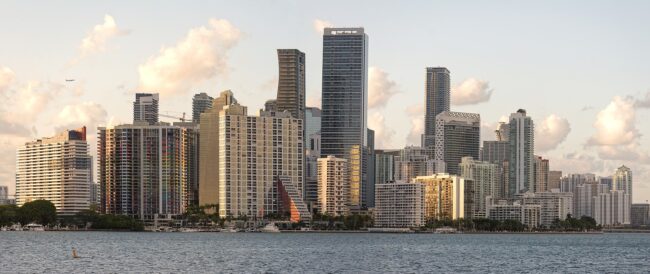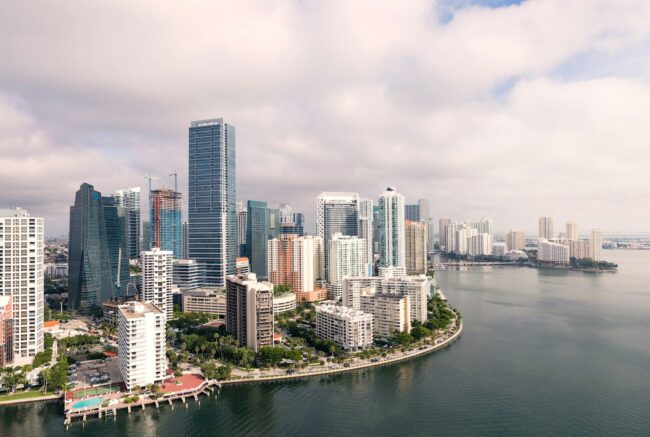
A high-rise residential tower in Miami. Photo: Adam Thomas / Unsplash, Unsplash License.
Quick Answer: Miami-Dade recorded 907 existing condo and townhouse sales in October 2026, down 9.6% from a year earlier, at a median price of $397,500 with 12.7 months of supply, according to MIAMI Realtors. The market is still adjusting to Florida’s post-Surfside safety laws. The deadline for structural integrity reserve studies was December 31, 2025, the 2026 legislative session left the core condo statutes largely unchanged, and stricter Fannie Mae review rules have applied to loan applications since August 3, 2026.
More than five years after the Champlain Towers South collapse in Surfside killed 98 people, Miami-Dade’s condo market is shaped by two things: state rules that require older buildings to be inspected and their reserves funded, and a sales market that favors buyers. This analysis is written for lenders, managers, contractors, engineers, buyers and investors. It is not investment advice.
What does the latest Miami-Dade condo data show?
How many condos sold in Miami-Dade in October 2026?
MIAMI Realtors’ detail report for Miami-Dade townhouses and condos shows 907 closed sales in October 2026, the most recent month available, down 9.6% from October 2025. New pending sales, a gauge of future closings, fell 14.0% to 875. The median price slipped 0.6% to $397,500, while the average rose 8.7% to $709,992. Active listings fell 5.3% to 11,989, and months of supply dropped to 12.7. MIAMI Realtors classifies roughly 12 months of condo supply as a buyer’s market.
| Metric (Oct. 2026) | Value | Year-over-year change |
|---|---|---|
| Closed sales | 907 | -9.6% |
| Cash sales (share of closings) | 439 (48.4%) | -13.9% |
| Median sale price | $397,500 | -0.6% |
| Average sale price | $709,992 | +8.7% |
| Dollar volume | $644.0 million | -1.7% |
| Median % of original list price received | 93.9% | +1.1% |
| Median days to contract / to sale | 70 / 110 | -2.8% / 0.0% |
| New listings | 2,037 | -4.3% |
| Active listings | 11,989 | -5.3% |
| Months supply of inventory | 12.7 | -9.3% |
Source: MIAMI Association of Realtors, Miami-Dade County Townhouses and Condos, October 2026 detail report.
How has the Miami-Dade condo market trended through 2026?
Sales rose 5.4% year over year in May 2026 and 11.4% in July, when listings posted their sixth straight annual decline. September was flat, at 909 closings against 904, and October turned negative. The median stayed between about $397,000 and $417,000, slightly below 2025 levels each month.
| Month (2026) | Condo sales (YoY) | Median price (YoY) | Months supply |
|---|---|---|---|
| May | 1,022 (+5.4%) | $415,000 (-2.35%) | 12.9 |
| July | 1,026 (+11.4%) | $400,000 (-1.48%) | 12 |
| September | 909 (+0.6%) | $417,090 (-0.7%) | 12.3 |
| October | 907 (-9.6%) | $397,500 (-0.6%) | 12.7 |
Source: MIAMI Association of Realtors, monthly news releases (May and July 2026) and Miami-Dade townhouse and condo detail reports (September and October 2026).
Inventory shows the biggest shift. In September 2025, MIAMI Realtors counted 12,620 active condo listings and 14 months of supply. By September 2026, those figures were 11,706 and 12.3, and median time to contract had fallen from 75 days to 67.
What do Florida’s post-Surfside condo laws require?
What did SB 4-D establish in 2022?
Governor Ron DeSantis signed SB 4-D on May 26, 2022. The law created two requirements that still anchor the system. The first is a milestone inspection: a structural inspection done in two phases. Phase two is required only when phase one finds substantial structural deterioration. Under current law, as described in the House staff analysis of HB 913, covered residential condo buildings must complete a milestone inspection by December 31 of the year the building turns 30, and then on a recurring schedule. Buildings that turned 30 before July 1, 2022, had a December 31, 2024, deadline for their first inspection.
The second is the structural integrity reserve study, or SIRS, required at least every 10 years. It covers the roof, structure, fireproofing, plumbing, electrical, waterproofing, and windows and exterior doors. A licensed engineer, architect or certified reserve specialist must perform or verify the visual inspection, and the study must set out remaining useful lives, replacement costs and a funding schedule. Reserves for these items can no longer be waived.
What did HB 913 change in 2025?
CS/CS/HB 913 passed the Senate 37-0 and the House 112-0. Florida Realtors reported that the governor signed it in June 2025, and it took effect July 1, 2025. According to the Florida Senate’s bill summary, its main changes were:
- Milestone inspections and SIRS now apply to buildings of three or more habitable stories, rather than three or more stories.
- The SIRS completion deadline moved from December 31, 2024, to December 31, 2025.
- Associations that completed a milestone inspection may delay the SIRS for the two budget years after that inspection.
- For budgets adopted on or before December 31, 2028, owner-controlled associations that completed a milestone inspection in the prior two years may pause or reduce reserve contributions for up to two annual budgets, with approval of a majority of the total voting interests. A new SIRS must be done before contributions resume.
- Associations required to have a SIRS may fund reserves through a special assessment, a line of credit or a loan, with majority approval of the voting interests.
- Counties must adopt ordinances requiring repairs to begin within 365 days after a phase two inspection report is received.
- Local enforcement agencies must report milestone data to the Department of Business and Professional Regulation (DBPR).
- Board and owner meetings may be held by video conference. Those meetings must be recorded and kept as official records.
According to a Withum summary, the act also bars managers with revoked licenses from management firms for 10 years. Florida Realtors noted that buyers now have seven days to cancel after receiving the governing documents.
Did the 2026 Legislature change the condo laws?
Not in any major way. Becker’s review of the 2026 session concluded that it “did not result in significant changes” to Chapters 718, 719 and 720, the condominium, cooperative and homeowners’ association statutes. Florida Realtors’ final legislative report says HB 657, a broader association reform package, passed the House but died without a Senate companion. Other proposals were filed, among them SB 722, which would have limited mandatory reserve studies to buildings of six or more stories. The session’s most significant condo-related act was a nonprofit-corporation law, HB 797, which took effect July 1, 2026. The 2026-27 budget carried forward unspent money for the My Safe Florida Condominium program, which Florida Realtors put at $27 million.
| Key facts | Detail |
|---|---|
| SB 4-D signed | May 26, 2022 |
| First milestone inspection | By Dec. 31 of the year a covered building turns 30 |
| SIRS frequency | At least every 10 years |
| SIRS completion deadline | Dec. 31, 2025 (extended by HB 913) |
| Reserve pause window | Budgets adopted through Dec. 31, 2028; up to two annual budgets |
| Repair start after phase two | Within 365 days (county ordinance) |
| 2026 session result | No significant changes to Ch. 718 |
Source: Florida Senate, CS/CS/HB 913 bill summary; Florida House staff analysis; DBPR, SIRS reporting page; Becker, 2026 session review.
What does state inspection data show about Miami-Dade buildings?
In July 2026, OPPAGA published Milestone Inspection Reporting Data, 2024 and 2025, the first statewide compilation of what local building officials reported to DBPR. Across both years, 11,657 phase one inspections were required and 8,736 completed. Nearly all of the 1,587 extensions were granted in coastal areas, and the 903 repair permit applications ranged in value from under $1,000 to $30 million.
| Statewide measure | 2024 | 2025 |
|---|---|---|
| Phase one inspections required | 8,777 | 2,880 |
| Phase one inspections completed | 6,952 | 1,784 |
| Phase two inspections required | 1,899 | 636 |
| Phase two inspections completed | 1,301 | 274 |
| Extensions granted | 818 | 769 |
| Repair permit applications | 671 | 232 |
| Unsafe or uninhabitable buildings | 30 | 24 |
| Jurisdictions reporting | 277 (71%) | 250 (64%) |
Source: OPPAGA, Report 26-04, Milestone Inspection Reporting Data, 2024 and 2025.
Miami-Dade accounts for a large share of the 2025 activity. OPPAGA reported 308 required phase two inspections in the county that year, which is nearly half of the statewide total of 636, and 23 buildings reported as unsafe or uninhabitable. Nineteen of the 23 were reported by the City of Aventura. Aventura disputes that count: a city spokesperson told WLRN the city “has zero unsafe structures,” called the classification an error, and said the city has asked OPPAGA to revise the report. OPPAGA also found that 21% of Miami-Dade’s municipal building officials did not submit 2025 data.
OPPAGA warned that the totals undercount activity. Reporting was incomplete, and state law does not define “unsafe” or “uninhabitable.”
How many associations have completed their reserve studies?
Compliance with the reserve-study requirement has been hard to measure. CCFJ, a Florida condo news site, reported that DBPR Secretary Melanie Griffin told House lawmakers in February 2025 that most associations had missed the original December 31, 2024, deadline. At that point, 4,096 of more than 11,270 associations subject to the requirement, about 36%, had self-reported completing a study. DBPR now requires a SIRS reporting form within 45 days of completing a study and required every association to open an online account with the division by October 1, 2025. Completed submissions appear in a public database.
How are special assessments and reserve funding being handled?
When a reserve study finds underfunding, HB 913 leaves boards three tools: higher regular assessments, a special assessment, or, with majority owner approval, a loan or line of credit, which must be disclosed to later purchasers. The temporary pause for recently inspected buildings defers contributions but does not remove the obligation, because a new SIRS is required before funding resumes. MIAMI Realtors Chairman Alfredo Pujol said in August 2026 that well-managed buildings with strong reserves are performing particularly well.
How are mortgage lenders responding?
Federal mortgage rules are adding to the state requirements. Fannie Mae’s Lender Letter LL-2026-03, issued March 18, 2026, eliminated “limited review” for established condo projects. Loan applications dated on or after August 3, 2026, require a full project review, or a waiver for projects of ten or fewer units. If a lender relies on a reserve study, it must confirm that the association’s budget uses the highest recommended reserve allocation. Baseline funding no longer qualifies. Starting with applications dated January 4, 2027, the minimum replacement-reserve allocation rises from 10% to 15% of budgeted assessment income. MIAMI Realtors reported that Freddie Mac made a parallel change.
FHA financing reaches very few buildings. Citing HUD figures, MIAMI Realtors reports that only 21 of 2,397 condo buildings in Miami-Dade, Broward and Palm Beach counties, about 0.9%, are FHA-approved. The association says this is holding the market back. Cash purchases made up 48.4% of Miami-Dade condo closings in October 2026, and 82% of the area’s $1 million-plus condo sales in 2025 were all-cash.
What does this mean for Miami-Dade businesses?
Lenders and mortgage brokers
Full project review requires inspection reports, reserve studies and budgets for each building. Buildings with gaps or baseline-funded budgets may not qualify for conventional loans, which leaves those sales to cash buyers or portfolio lenders.
Property managers
Managers now handle DBPR reporting, video-meeting recordkeeping, licensure-account updates and the documents lenders request. Coordinating SIRS updates with annual budgets is now a routine part of the job.
Contractors and engineers
The 308 phase two inspections required in Miami-Dade in 2025, along with county rules requiring repairs to begin within 365 days of a phase two report, create steady demand for structural engineers, concrete restoration crews, waterproofing firms and roofers. Because a SIRS must be redone at least every 10 years, demand for that work recurs.
Buyers and investors
With 12.7 months of supply, sellers accepting about 94% of their original asking price, and median time to sale at 110 days, buyers in October 2026 had room to negotiate and time to review a building’s records. The key documents are the milestone inspection, the SIRS, the reserve schedule, any line of credit and any pending special assessment.
Frequently Asked Questions
Is Miami-Dade a buyer’s market for condos?
By MIAMI Realtors’ measure, yes. Supply was 12.7 months in October 2026, above the roughly 12 months the association treats as a buyer’s market.
When was the structural integrity reserve study deadline?
HB 913 extended the deadline from December 31, 2024, to December 31, 2025, for buildings of three or more habitable stories. Associations must report completed studies to DBPR within 45 days.
Did Florida change its condo laws in 2026?
Not significantly. A broad reform bill, HB 657, passed the House but not the Senate. The core milestone and reserve rules from SB 4-D and HB 913 remain in force.
How many Miami-Dade condo buildings were found unsafe?
OPPAGA’s July 2026 report lists 23 unsafe or uninhabitable buildings in Miami-Dade for 2025. Aventura reported 19 of them, and the city disputes the designation. OPPAGA notes that its data is incomplete.
Sources and Further Reading
- Miami-Dade County Townhouses and Condos, October 2026 Detail Report — MIAMI Association of Realtors
- Miami-Dade County Townhouses and Condos, September 2026 Detail Report — MIAMI Association of Realtors
- Miami-Dade Total Home Sales Rise for 11th Consecutive Month (July 2026 data) — MIAMI Association of Realtors
- Miami-Dade Home Sales Rise for Ninth Consecutive Month (May 2026 data) — MIAMI Association of Realtors
- Miami-Dade Real Estate Registers Best Sales Month of the Year (September 2025 data) — MIAMI Association of Realtors
- CS/CS/HB 913 Bill Summary, Condominium and Cooperative Associations — The Florida Senate
- CS/CS/HB 913 Staff Analysis — Florida House of Representatives
- Milestone Inspection Reporting Data, 2024 and 2025 (Report 26-04) — OPPAGA
- Condominiums and Cooperatives SIRS Reporting — Florida Department of Business and Professional Regulation
- Lender Letter LL-2026-03, Updates to Project Standards and Property Insurance Requirements — Fannie Mae
- 2026 Legislative Final Report — Florida Realtors
- Realtor-Supported Condo Bill Becomes Law — Florida Realtors
- Review of the Outcome of the 2026 Legislative Session — Becker
- Florida Condo Inspection Report Finds Unsafe Buildings and Reporting Gaps — WLRN
- Budget Conference: Condo Safety Compliance Gaps Are Back in Lawmakers’ Sights — CCFJ
- Key Changes From Florida House Bill 913 Explained — Withum
- DeSantis Signs Condominium Reform Bills Into Law (SB 4-D) — The Capitolist
About the Author