By Brian French | Miami Business News | October 4, 2026
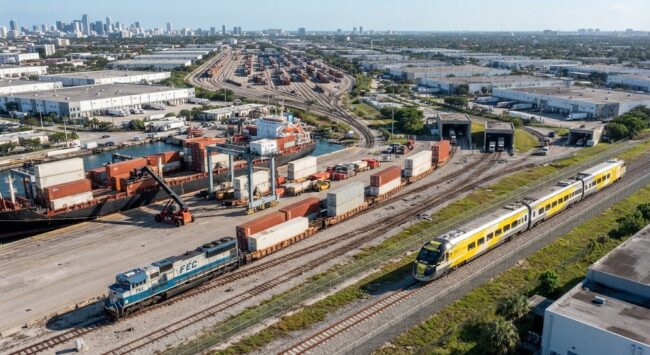
Quick Answer: PortMiami connects to regional rail through Florida East Coast Railway’s on-dock intermodal terminal, which moves containers to the Hialeah rail yard and north to Jacksonville, where they transfer to CSX and Norfolk Southern. Brightline carries passengers only. It shares FEC’s tracks but moves no freight.
The Short Version: Brightline Doesn’t Haul Freight
Many logistics searches pair Brightline with PortMiami because both run on the same historic rail corridor. The distinction matters for anyone planning a supply chain.
Brightline runs on about 235 miles of double track: 195 miles shared with Florida East Coast Railway between Miami and Cocoa, plus about 40 miles of passenger-only track to Orlando. The freight on that shared corridor belongs to FEC, which is the exclusive rail provider for PortMiami, Port Everglades and the Port of Palm Beach and connects to the national rail network in Jacksonville.
So the real comparison for logistics managers is not Brightline versus PortMiami. It is FEC rail versus trucking for moving port cargo, with Brightline as a corridor neighbor that affects capacity and scheduling.
Why This Question Matters This Week
Brightline’s parent companies just entered bankruptcy. Brightline Holdings and certain other parent entities filed for Chapter 11 in New Jersey on September 24, 2026, but the filing excludes the operating company, so trains keep running during the restructuring. Stakeholders led by Assured Guaranty agreed to provide $490 million of new capital to Brightline Trains Florida once the entities exit bankruptcy.
For freight shippers, the key point is simple. The FEC freight railway that Brightline partly shares keeps operating regardless of Brightline’s finances.
How PortMiami Connects to the National Rail Network
The rail link runs in four steps:
- On-dock loading. FEC’s on-dock intermodal facility at PortMiami offers 9,000 feet of track in three 3,000-foot segments, with daily double-stack port trains moving containers directly from ship to rail.
- Hialeah rail yard. Trains run from the port to FEC’s Hialeah intermodal yard, which Miami-Dade County restored in 2013 with a $50 million project.
- Jacksonville interchange. The 351-mile FEC line links Miami and Palm Beach with St. Augustine and Jacksonville, where it interchanges with CSX and Norfolk Southern.
- National distribution. The PortMiami and FEC connection reaches 70 percent of the U.S. population in up to four days.
FEC also offers direct interline service with the ports of Charleston and Savannah, giving shippers a rail alternative to trucking for moving containers between South Florida and those gateways.
Data Comparison: Rail, Truck and Brightline
| Factor | FEC Freight Rail | Truck (I-95/I-75) | Brightline |
|---|---|---|---|
| Carries freight | Yes | Yes | No |
| Capacity per trip | ~200 containers | 1 container | Passengers only |
| Miami to Orlando | 1 day | ~4 hours | ~3.5 hours (riders) |
| Miami to Atlanta | 2 days | ~14 hours | N/A |
| Miami to Nashville | 3 days | ~1–2 days | N/A |
| Best use | Volume, reliability | Speed, flexibility | Business travel |
Rail times from PortMiami; truck times are typical single-driver estimates.
Rail wins on volume. According to PortMiami’s director, one locomotive can move 200 containers. Transit times run one day to Orlando, two days to Atlanta and Charlotte, and three days to Memphis and Nashville. A single truck reaches Atlanta in about 14 hours over 788 miles, which is why time-sensitive cargo still moves by road.
How Much PortMiami Cargo Actually Moves by Rail
Not much yet, and that is the story. In 2024, PortMiami’s CEO said about 5 percent of the port’s cargo moves by rail, which she described as room for future growth.
That growth is funded. PortMiami received a $16 million federal RAISE grant to expand rail from three tracks to five and add hybrid electric equipment in the FEC yard, with completion targeted for 2027 within the existing footprint.
For context, PortMiami handled 1,115,058 TEUs in fiscal 2025, up 2.35 percent and its 11th straight year above one million. Its top 10 trade partners account for 64.5 percent of volume, with Latin America, the Caribbean, Asia and Europe as primary regions. Port Everglades, served by the same railroad, handled about 1,167,552 TEUs in the same fiscal year.
Economic Impact on Miami’s Warehousing Market
Port cargo drives Miami-Dade’s industrial real estate. The port contributes an estimated $61 billion a year to the local economy and supports more than 340,000 jobs, according to the county.
The warehouse market is in transition in 2026. According to Colliers, Miami-Dade industrial vacancy rose 60 basis points to 7.7 percent in the second quarter as new space delivered, while asking rents climbed to $17.19 per square foot NNN. Demand has not collapsed. Leasing hit 3.0 million square feet in the quarter and net absorption turned positive at 782,677 square feet.
Brokerage estimates vary by method. Newmark put second-quarter vacancy at 6.4 percent, while another report cited 8.0 percent with negative 12-month absorption. The consistent theme is a split market. Large big-box distribution buildings are leasing slowly, while small-bay and flex warehouses under 100,000 square feet remain tight.
What This Means for Rail-Served Warehousing
As PortMiami doubles rail track capacity, the most valuable industrial land will be near the Hialeah intermodal yard and along the Medley, Hialeah Gardens and Doral corridors. More rail volume means more containers terminating at Hialeah rather than being trucked from the port, shifting drayage demand westward.
The Shared Corridor Question
Brightline and FEC share infrastructure, which creates both cooperation and friction. Federal and state money is helping replace a 100-year-old bridge that carries both Brightline and FEC freight traffic with a new double-track structure. At the same time, FEC formally denied approval for a proposed Brightline station in Stuart in May 2026.
Logistics managers should watch two things in the Brightline restructuring: any change in passenger train frequency on the shared corridor, and whether planned South Florida commuter rail expansion adds more trains to track that freight also uses. The entity holding the rights to develop commuter service in Miami-Dade, Broward and Palm Beach is not part of the Chapter 11 process.
Brian’s Take
The Brightline headlines are loud, but for freight they are mostly noise. FEC owns the railroad, runs the freight and holds the exclusive port connection. Brightline pays for access. Its restructuring changes who owns its debt, not whether containers leave PortMiami on time.
The bigger story is the number almost nobody talks about: roughly 5 percent. PortMiami built a deep-water, big-ship port with on-dock rail more than a decade ago, and rail still moves only a sliver of its cargo. The Southeast markets rail serves best, such as Atlanta in two days, are also within easy truck range. Short-haul economics favor trucks unless volume is steady and large.
That makes the 2027 track expansion the real test. If PortMiami can push rail share meaningfully higher, the winners will be industrial landlords near Hialeah and shippers moving steady volume to Atlanta, Charlotte and Tennessee. If it can’t, the added track becomes expensive insurance. My view: warehouse investors should watch rail share numbers more closely than Brightline’s bankruptcy docket.
Frequently Asked Questions
How does PortMiami connect with regional rail freight systems?
Through Florida East Coast Railway’s on-dock intermodal terminal. Containers move by rail to FEC’s Hialeah yard, then north on FEC’s 351-mile line to Jacksonville, where they interchange with CSX and Norfolk Southern for national delivery.
Does Brightline carry freight from PortMiami?
No. Brightline is a passenger railroad. It shares about 195 miles of track with FEC between Miami and Cocoa, but FEC handles all freight.
Will Brightline’s bankruptcy affect PortMiami freight?
Not directly. The Chapter 11 filing covers Brightline parent companies, not its train operator, and FEC’s freight operations are separate from Brightline’s finances.
How long does rail freight take from PortMiami to Atlanta?
About two days by FEC intermodal rail. Rail reaches Orlando in one day and Nashville and Memphis in three.
How much PortMiami cargo moves by rail?
About 5 percent, according to the port’s 2024 estimate. A federally funded expansion from three to five on-port tracks is targeted for completion in 2027.
What is Miami-Dade’s warehouse vacancy rate?
Between about 6.4 and 8.0 percent in the second quarter of 2026, depending on the brokerage. Colliers reported 7.7 percent with asking rents of $17.19 per square foot NNN.
Resources and Further Reading
- Miami-Dade County – PortMiami On-Dock Rail
- Miami-Dade County – PortMiami Overall Statistics FY2025
- Miami-Dade County – PortMiami Cargo
- Port Technology International – PortMiami Handles 1.1 Million TEUs in FY2025
- Capital Analytics Associates – PortMiami Sets Cruise and Cargo Records
- Miami Today – PortMiami Expanding to Double Freight Rail (April 2024)
- Railway News – Brightline Train Florida: 2026 Expansion and Financial Update
- Colliers – Miami-Dade County Industrial Market Report, Q2 2026
- Newmark – Miami Real Estate Market Reports, Q2 2026
- Agora Real Estate Group – Miami Industrial Market Q2 2026 Report
- WareCRE – Miami Industrial and Warehouse Market Report, Q1 2026
- Direct Fleet Dispatch – Miami to Atlanta Freight Shipping
About the Author