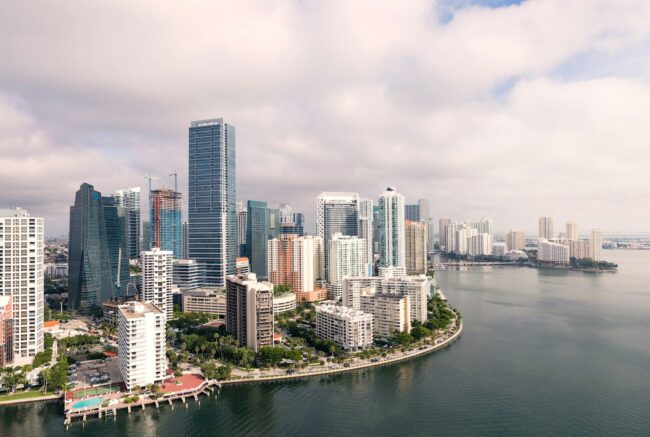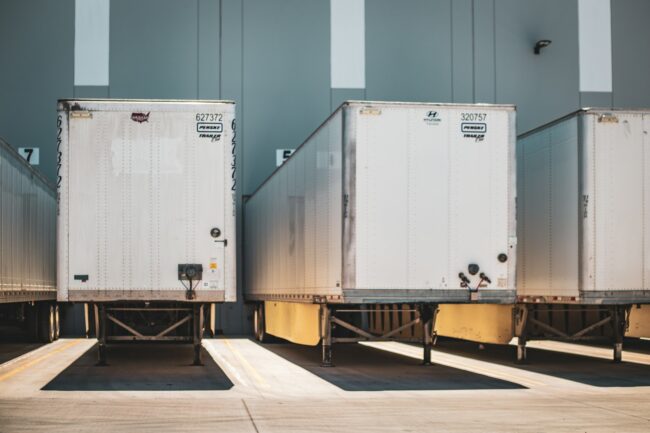
Photo: Tom Jackson via Unsplash (Unsplash License).
Quick Answer: Coral Gables-based Ryder System reported third-quarter 2026 total revenue of $3.43 billion, up 8%, and comparable earnings of $4.33 per share, up 21% from a year earlier. Fleet Management drove the gain on better used-truck pricing and rental utilization. Ryder raised its full-year comparable EPS forecast to $14.85 to $15.05, after also raising it in July.
Ryder System, Inc., the truck leasing and logistics company founded in Miami in 1933, reported results on October 22, 2026, for the quarter ended September 30, and later filed its Form 10-Q. The quarter combined higher revenue, wider margins in its largest segment and a guidance increase with a shrinking fleet, steady buybacks and a large pension charge ahead.
What did Ryder report for the third quarter of 2026?
Total revenue rose 8% to $3.433 billion from $3.171 billion in the third quarter of 2025. Operating revenue, a non-GAAP measure Ryder uses that strips out fuel and subcontracted transportation passed through to customers, rose 6% to $2.759 billion from $2.611 billion.
Earnings before taxes from continuing operations climbed 19% to $226 million, and net earnings reached $162 million compared with $138 million a year earlier. On a per-share basis, GAAP diluted earnings from continuing operations were $4.16, up 25% from $3.33. Comparable EPS, which excludes items Ryder does not consider part of ongoing operations, was $4.33, up 21% from $3.57. In the earnings release, Chief Executive Officer John Diez said, “Ryder delivered double-digit earnings growth in the third quarter,” and the release described it as the company’s eighth consecutive quarter of EPS growth.
A smaller share count helped: weighted average diluted shares fell about 7%, to 38.8 million from 41.6 million. Comparable EBITDA was nearly flat at $749 million versus $742 million.
| Metric | Q3 2026 | Q3 2025 | Change |
|---|---|---|---|
| Total revenue | $3,433M | $3,171M | +8% |
| Operating revenue (non-GAAP) | $2,759M | $2,611M | +6% |
| Earnings before taxes (GAAP) | $226M | $190M | +19% |
| Net earnings | $162M | $138M | +17% |
| Diluted EPS, continuing ops (GAAP) | $4.16 | $3.33 | +25% |
| Comparable EPS (non-GAAP) | $4.33 | $3.57 | +21% |
| Comparable EBITDA | $749M | $742M | +1% |
| Diluted shares (weighted avg.) | 38.8M | 41.6M | -7% |
| Dividend declared per share | $1.01 | $0.91 | +11% |
Source: Ryder System third-quarter 2026 earnings release and Form 10-Q.
How did each Ryder business segment perform?
Ryder reports three segments: Fleet Management Solutions (FMS), which leases, rents, maintains and sells trucks; Supply Chain Solutions (SCS), which runs warehouses and logistics programs; and Dedicated Transportation Solutions (DTS), which supplies trucks and drivers under contract. All three grew total revenue, but profits diverged.
Why did Fleet Management lead the quarter?
FMS total revenue rose 10% to $1.616 billion, and operating revenue rose 5% to $1.344 billion. Segment earnings before taxes jumped 21% to $177 million. As a share of operating revenue, FMS pre-tax earnings rose to 13.2% from 11.4%, a gain of 180 basis points.
Fuel pass-through revenue rose 48% to $272 million, which lifts revenue but carries little margin. The profit driver was used vehicles: tractor prices rose 19% year over year and truck prices 5%, after declines of 6% and 15% a year earlier. Ryder sold 5,100 used vehicles, and its net gain on those sales was $17 million versus $3 million.
Rental also tightened. The average rental fleet shrank 12% to 29,400 units, yet power-unit utilization climbed to 77% from 70% and rates rose 4%. The ChoiceLease lease fleet ended the quarter at 139,800 vehicles, down 2%.
What happened in Supply Chain Solutions?
SCS total revenue rose 9% to $1.504 billion, and pre-tax earnings rose 7% to $91 million. Ryder credited new business, higher volumes and pricing, and optimization of its omnichannel retail network, offset by weaker automotive results and start-up costs at new sites. By industry, the 10-Q shows omnichannel retail was the largest piece at $560 million, followed by automotive at $394 million and consumer packaged goods at $305 million.
Why did Dedicated Transportation slip?
DTS total revenue rose 6% on pass-through costs, but operating revenue dipped 1% and pre-tax earnings fell 5% to $34 million. The dedicated fleet ended the quarter at 16,800 vehicles, down 8%, and a prior-year workers’ compensation benefit did not repeat.
| Segment | Total revenue Q3 2026 | Operating revenue Q3 2026 | Pre-tax earnings (vs. Q3 2025) | EBT % of operating revenue |
|---|---|---|---|---|
| Fleet Management Solutions | $1,616M (+10%) | $1,344M (+5%) | $177M vs. $146M (+21%) | 13.2% vs. 11.4% |
| Supply Chain Solutions | $1,504M (+9%) | $1,126M (+9%) | $91M vs. $86M (+7%) | 8.1% vs. 8.3% |
| Dedicated Transportation Solutions | $606M (+6%) | $455M (-1%) | $34M vs. $36M (-5%) | 7.5% vs. 7.8% |
Source: Ryder System third-quarter 2026 earnings release. Segment revenue figures include intersegment amounts and do not sum to the consolidated total.
What is Ryder’s outlook for the rest of 2026?
Ryder raised its full-year 2026 comparable EPS forecast to a range of $14.85 to $15.05. That compares with $14.40 to $14.80 in the outlook issued with second-quarter results in July, and $13.45 to $14.45 in the initial outlook issued with fourth-quarter 2025 results. The new midpoint, $14.95, would be about 16% above 2025 comparable EPS of $12.92. For the fourth quarter alone, Ryder forecast comparable EPS of $4.25 to $4.45.
Ryder now expects total revenue of roughly $13.3 billion, and operating revenue growth of 3%, driven primarily by Supply Chain Solutions. It said it is on track for more than $70 million in earnings benefits from strategic initiatives this year. It also lifted planned 2026 rental fleet investment to $500 million, $300 million more than previously forecast, a bet that short-term truck demand will hold up.
| Full-year 2026 item | Initial (Feb. 2026) | July 2026 | October 2026 |
|---|---|---|---|
| Comparable EPS | $13.45–$14.45 | $14.40–$14.80 | $14.85–$15.05 |
| Total revenue growth | 1% | 3% | 5% |
| Return on equity (non-GAAP) | 17%–18% | 18% | 18%–19% |
| Free cash flow (non-GAAP) | $700M–$800M | $700M–$800M | $700M–$800M |
| Capital expenditures | $2.4B | $2.4B | $2.4B |
Source: Ryder System fourth-quarter 2025, second-quarter 2026 and third-quarter 2026 earnings releases.
Why will Ryder’s GAAP earnings drop in the fourth quarter?
Ryder forecast fourth-quarter GAAP EPS of negative $0.15 to positive $0.05, and full-year GAAP EPS of $9.75 to $9.95, because of a non-cash pension settlement charge of about $4.30 per share. Per the 10-Q, Ryder is transferring its remaining U.K. and Canadian pension obligations, about $299 million and $39 million, to insurers, with roughly $240 million in pre-tax charges and no effect on equity or cash flow.
How is Ryder using its cash?
Nine-month free cash flow was $992 million, double the $496 million a year earlier, as capital spending fell to $1.375 billion from $1.730 billion. Because the full-year target of $700 million to $800 million is below that total, the guidance implies fourth-quarter spending will outpace cash generation. Ryder repurchased about 1.7 million shares for $372 million through nine months. Total debt was $7.205 billion at September 30, and debt-to-equity was 242%, down from 250% at the end of 2025.
How big is Ryder’s footprint in Miami-Dade?
Ryder’s principal executive office is at 2333 Ponce de Leon Boulevard in Coral Gables, according to its 10-Q. The company announced the move in May 2023, saying it would occupy two floors of the Ryder Colonnade, an 11-story office tower, and that about 800 South Florida-based office employees would work from the Coral Gables location, many in hybrid or remote arrangements. In that announcement, then-CEO Robert Sanchez said it was important for the company to remain headquartered in Miami-Dade County in its 90th year.
The move freed up a large industrial site. Ryder sold its former 16.8-acre headquarters campus at 11690 Northwest 105th Street in unincorporated Miami-Dade, which included a 248,989-square-foot building, to Bridge Industrial for $42.1 million. Bridge later secured a $53 million construction loan to redevelop the site as Bridge Point Flagler Station, two warehouse buildings totaling about 326,400 square feet. The former corporate office of a logistics company is now itself being turned into logistics space.
John Diez, a Ryder veteran of more than 20 years and former chief financial officer, became CEO on March 31, 2026, when Sanchez became executive chair.
| Ryder snapshot | Detail |
|---|---|
| Headquarters | 2333 Ponce de Leon Blvd., Coral Gables (Miami-Dade) |
| Founded | 1933, Miami |
| CEO | John Diez (since March 31, 2026) |
| Employees (Dec. 31, 2025) | 51,600, including 12,700 professional drivers and 4,600 technicians |
| FMS operating locations | 789 |
| SCS warehouses | 319 (254 in the U.S.) |
| 2025 total revenue | $12.67 billion |
| Q3 2026 U.S. revenue | $3.18 billion of $3.43 billion total (Canada $157M, Mexico $94M) |
Source: Ryder System 2025 Annual Report and Form 10-K, third-quarter 2026 Form 10-Q, and Ryder news releases.
Ryder’s filings do not break out employment by state, so its Miami-Dade payroll beyond headquarters staff is not disclosed.
What does Ryder’s quarter signal for South Florida logistics?
Ryder’s results are national, not a direct read on the local market, but several trends line up with what brokers reported for Miami-Dade industrial space.
Is Miami-Dade warehouse demand picking up?
CBRE reported that Miami industrial vacancy fell 40 basis points to 6.9% in the third quarter of 2026, the first decline after three straight quarterly increases. Net absorption reached 1.27 million square feet in the quarter, the third consecutive quarter of acceleration, bringing the year-to-date total to 2.63 million square feet. Excluding buildings delivered since 2025, vacancy was 5.4%, the lowest in at least 18 months. CBRE noted that about 1.9 million square feet of signed leases are scheduled to move in during the fourth quarter, while 3.4 million square feet, including 808,000 square feet of sublease space, is set to come available.
Savills, which measures differently, put vacancy at 7.7%, up 10 basis points, with asking rent of $16.18 per square foot, down 2.8% from the prior quarter, and 3.3 million square feet delivered year to date. It said new supply still limits landlords’ pricing power.
How do Ryder’s numbers connect to local conditions?
Ryder’s SCS growth came largely from new business and omnichannel retail, a major category of warehouse tenant. Its 10-Q cites strong contractual sales across all three segments and increasing demand for capacity from quality carriers. And firmer used-truck prices and rental utilization point to better trucking conditions, which matters for the small carriers serving South Florida distribution centers. On the caution side, the 10-Q lists fuel costs, inflation, interest rates and changes in tariff, trade or tax policies as risks.
Brian’s Take
What I like about this quarter is where the improvement came from. Ryder did not grow its lease fleet; it shrank it slightly. It ran a smaller rental fleet harder, sold used trucks into a better market and bought back stock. That is a company squeezing more return out of the capital it already has, and the raised ROE target of 18% to 19% reflects it. For a Miami-Dade headquarters company, steady profitability and repeated guidance increases this year are good news for the local corporate base.
The signal I would watch for South Florida is the rental decision. Adding $300 million to the rental fleet budget is management putting money behind the view that short-term truck demand is firming. Combine that with CBRE’s report of three straight quarters of accelerating absorption in Miami, and the logistics picture looks better than it did a year ago. But Savills’ falling asking rents and Ryder’s own weaker dedicated and automotive results say this is a recovery in progress, not a boom.
Business owners should also read past the fourth-quarter GAAP number. A near-zero GAAP EPS forecast will look alarming in headlines, but the filings show it is a non-cash pension settlement with no effect on equity or cash. Comparable earnings, the figure that tracks the operating business, are guided to rise again.
Frequently Asked Questions
What were Ryder’s third-quarter 2026 revenue and EPS?
Total revenue was $3.433 billion, up 8%. GAAP diluted EPS from continuing operations was $4.16 and comparable EPS was $4.33, up 21%.
Did Ryder raise its 2026 guidance?
Yes. Ryder raised its full-year comparable EPS forecast to $14.85 to $15.05 from $14.40 to $14.80, and raised its ROE outlook to 18% to 19%. It also increased its total revenue growth forecast to about 5%.
Why is Ryder forecasting a near-zero GAAP profit in the fourth quarter?
Ryder expects a non-cash pension settlement charge of about $4.30 per share, roughly $240 million pre-tax, as it transfers U.K. and Canadian pension obligations to insurers. The company says the charge does not affect shareholders’ equity or cash flow.
Where is Ryder headquartered?
At 2333 Ponce de Leon Boulevard in Coral Gables, in Miami-Dade County.
Who is Ryder’s CEO?
John Diez became chief executive officer on March 31, 2026, succeeding Robert Sanchez, who became executive chair of the board.
Sources and Further Reading
- Ryder Reports Third Quarter 2026 Results (Form 8-K, Exhibit 99.1) — Ryder System, Inc. / U.S. Securities and Exchange Commission
- Ryder System, Inc. Form 10-Q for the Quarter Ended September 30, 2026 — U.S. Securities and Exchange Commission
- Ryder Reports Second Quarter 2026 Results — Ryder System, Inc.
- Ryder Reports Fourth Quarter 2025 Results and Provides 2026 Outlook — Ryder System, Inc.
- Ryder 2025 Annual Report and Form 10-K — Ryder System, Inc.
- Ryder Announces CEO Succession Plan — Ryder System, Inc.
- Ryder Announces New Headquarters in Coral Gables — Ryder System, Inc. via Business Wire
- Report on Bridge Industrial loan to redevelop former Ryder headquarters — The Real Deal
- Miami Industrial Figures Q3 2026 — CBRE
- Miami-Dade Q3 2026 Industrial Market Report — Savills
About the Author