Quick Answer
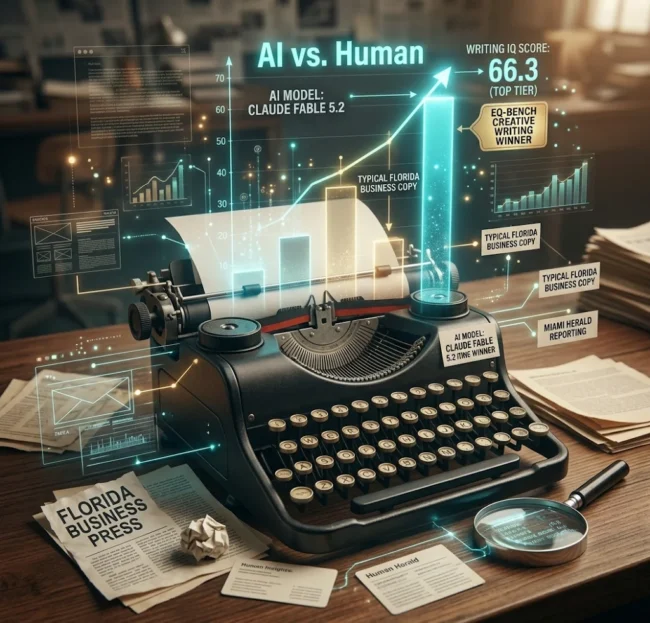
Claude Fable 5.2 is Anthropic’s most capable public AI model. It writes at or near the top of every published AI writing test. No standardized “writing IQ” exists, and no one has tested Fable head-to-head against Miami Herald reporters. On the mechanics of writing, such as structure, clarity, speed and range, Fable now matches or beats typical business copy. Its weak spot is the part of journalism that isn’t writing: getting sources, being on the scene and taking responsibility for a story. The newsroom that pairs human judgment with machine-speed writing will lead the next decade.
What Is Claude Fable 5.2?
Anthropic released Claude Fable 5 on June 9, 2026. It was the first “Mythos-class” model available to the general public. The company says Fable 5 is state of the art on nearly every benchmark it tested, and that its lead grows as assignments get longer and more complex.
The current version, Fable 5.2, launched November 9, 2026, at $8 per million input tokens and $40 per million output tokens. That is 20% below Fable 5.1, with faster output and an optional fast mode. Fable 5.2 runs on the same model as Claude Mythos 5.2, with added cyber and biology safeguards so that anyone can use it. Anthropic describes Fable 5.2 as a step above Opus 5.5 in almost every capability it measured.
Most of the launch headlines were about coding. This article asks a different question, the one Miami business owners, editors and readers care about: how well does it write?
Measuring a Machine’s “Writing IQ”
No one gives AI models an SAT verbal section. Researchers and publishers have instead built a patchwork of tests, each measuring a different part of good writing. Here is what the evidence shows.
The Published Test Results
| Test | What It Measures | Fable Result | Takeaway |
|---|---|---|---|
| Every Writing Benchmark v1.0 | Match to a professional publication’s editorial choices | 66.3 (Opus 4.8: 67.8; GPT-5.5: 65.9) | Top tier, but statistically tied |
| EQ-Bench Creative Writing | Long-form narrative quality (Elo rating) | 2,189, first in its launch week | Strongest sustained voice |
| Blind human preference, Fable 5.2 vs Opus 5.5 | Five 600-word essays judged blind | Fable preferred in 4 of 5 | Readers favored its variety |
| Automated “AI slop” detection | Stock phrases and AI tells | 3 flagged phrases across 5 essays | Far cleaner than earlier models |
| Hands-on technical writing review | Usable technical documents | Detail sometimes buried the structure | Needs editing on dense material |
The Every benchmark scores AI drafts against pieces the digital publication Every actually published, and scores editing tasks against answer keys. Fable 5 scored 66.3, Opus 4.8 scored 67.8 and GPT-5.5 scored 65.9. Every notes that each model’s standard deviation is above 12 points, so the overall ranking is not reliable. The useful point is that every frontier model now lands in the same professional range.
In a blind test of five essays, reviewers preferred Fable 5.2’s essays in four of five matchups. The reviewer noticed that Opus 5.5 reused the same anecdote in every draft, while Fable varied its openings and conclusions. An automated check for AI clichés found the two models effectively tied, with three flagged phrases each across all five essays.
Reviewers did find limits. One tester found Fable’s technical writing hard to use because the detail overwhelmed the structure. Every’s own launch review called Fable 5’s writing “mixed,” saying the model suits long, delegable knowledge work better than fast creative iteration.
How Fable Compares With Florida Business Writers
This comparison has to be stated carefully. No study has tested Fable against working Florida reporters, so what follows is a FAN editorial assessment of writing skill by category, based on the published tests above and on decades of reading Florida business coverage. It is not a lab result.
FAN Writing Scorecard
| Writing Skill | Claude Fable 5.2 | Typical Florida Business Copy | Miami Herald at Its Best |
|---|---|---|---|
| Grammar and mechanics | Near flawless | Good, varies with deadline | Excellent, professionally edited |
| Structure and clarity | Very strong | Mixed | Excellent |
| Speed | Minutes per long feature | Hours to days | Hours to days |
| Range across industries | Very broad | Usually one beat | Specialists on each beat |
| Original sources and interviews | None on its own | Varies | Exceptional |
| Being on the scene | None | Limited | Exceptional |
| Accountability and judgment | Depends on its human editor | Varies | Institutional |
| Cost per long article | A few dollars of compute | Freelance to staff salary | Full newsroom overhead |
Fable wins on mechanics and economics. Florida’s best newsrooms win on everything that requires a person in the room.
The Miami Herald Standard
The Miami Herald sets the bar for this comparison. In 2022 the Herald staff won the Pulitzer Prize for Breaking News for its coverage of the collapse of Champlain Towers South in Surfside. The Pulitzer board cited writing that merged “clear and compassionate” prose with comprehensive news and accountability.
The work behind that prize is what AI cannot do. Herald journalists reported from the collapse site for 25 straight days, built a database to track the missing and lost, and worked with engineers to investigate what led to the deaths of 98 people. The prize was the Herald’s 23rd Pulitzer.
No language model stood outside that building or earned the trust of grieving families. That is the clearest dividing line in this story: writing ability and reporting ability are two different things.
The Herald Is Already Using Claude
The comparison has a twist. The Herald’s parent company now uses Claude. McClatchy Media is encouraging its journalists to use a Claude-powered tool it calls a “content scaling agent.” Editors can use it to rewrite journalists’ stories at different lengths or for specific audiences, including video scripts, bullet-point “What to Know” summaries, and 400- to 800-word explainers designed to rank in Google. AI-assisted articles keep the original reporter’s byline and carry a “produced with AI assistance” note.
The rollout has met resistance. Unions in Miami, Sacramento and Kansas say it violated contracts that require notice of “major technological change.”
Earlier, McClatchy advertised a “Broward AI-Assisted Reporter” position. That reporter would oversee AI-generated real estate news, breaking news and event listings, fact-check AI copy, and train staff on using generative AI responsibly.
In other words, Florida’s most decorated newsroom has already concluded that AI writing is good enough to use. The open question is how to use it honestly.
Why Newsrooms Need Help
The economics explain why. Pew Research Center found that newspaper newsroom employment fell 57% between 2008 and 2020, from about 71,000 jobs to about 31,000. Over the same period, digital-native newsroom jobs grew, but not nearly enough to replace what was lost.
U.S. Newsroom Employment
| Year | Newspaper Newsroom Jobs | Change Since 2008 |
|---|---|---|
| 2008 | About 71,000 | Baseline |
| 2018 | About 38,000 | Down 47% |
| 2019 | About 35,000 | Down 51% |
| 2020 | About 31,000 | Down 57% |
Florida has close to four million businesses, and the shrunken press corps covers only a small share of them. Most business news in Miami-Dade, Broward and beyond never gets written at all. The gap isn’t in talent. There are simply too few reporting hours for the amount of business activity.
The Risk: AI Without Human Judgment
AI journalism has already gone wrong in Miami. In 2024, Miami New Times reported that the news site Hoodline was running AI-written stories under made-up reporter names. One AI “writer” recycled a New Times scoop about a deadly police raid. Hoodline’s disclaimer said its stories were produced with a “human-centric approach,” while the bylines pointed to people who did not exist.
That is the wrong way to do it. Fake bylines, unchecked facts and recycled scoops make news worse, even when the writing is good. A model with a high writing score can still invent a quote, misread a filing or repeat an error at scale. Fluent writing doesn’t make a story true.
Human Insight + Tech Intelligent Curation
The model that works pairs each side with what it does best. Machines gather, organize and draft. Humans verify, judge and take responsibility. At the Florida Authority Network™, we call this Human Insight + Tech Intelligent Curation.
Who Does What
| Task | Best Handled By | Why |
|---|---|---|
| Gathering public records and filings | AI | Speed and breadth |
| Organizing data into tables | AI | Consistency |
| First draft of a long explainer | AI | Minutes instead of days |
| Choosing which story matters | Human | Local judgment |
| Interviews and on-scene reporting | Human | Trust and presence |
| Checking every fact | Human, with AI help | Accountability |
| Final sign-off and byline | Human | Responsibility |
Working journalists are already doing this. University of Miami School of Communication faculty have argued publicly that AI should help journalists rather than replace them, taking routine tasks off reporters’ plates so they can do more reporting on the ground.
How Journalism Will Change
Taken together, the evidence points to five lasting changes.
1. Writing will become a commodity, and reporting will become the scarce skill. When a machine can produce clean prose in minutes, the value moves to what only humans can get: an interview, a document, a tip, a presence on the scene.
2. Coverage will grow from a few businesses to thousands. Long, data-rich coverage of a mid-sized Doral manufacturer or a Coral Gables law firm used to be too expensive to produce. It isn’t anymore.
3. The byline will matter more, not less. When anyone can generate text, readers will trust the named human who stands behind it. Fake bylines will be found out, and real ones will carry more weight.
4. AI answer engines will become the new front page. Readers increasingly ask ChatGPT, Gemini and Claude questions instead of scrolling a homepage. The publishers those systems trust and cite will set the agenda.
5. Disclosure will become standard. The dispute between McClatchy and its unions shows the industry hasn’t settled how AI use should be labeled. Clear labels will become as basic as a correction policy.
Brian’s Take
In 1985 I was a Common Stock Analyst at Independence Securities in Greensboro, North Carolina, writing research reports with a typewriter, a calculator and a stack of annual reports. Gathering the facts took weeks. The judgment took an afternoon. Every analyst I knew wished it were the other way around.
Now it is. Claude Fable 5.2 can assemble in minutes what used to take me a month, and it writes the result more cleanly than most of the business copy I’ve read in forty years. That is not an insult to Florida’s business writers. Many of them are excellent, and the Miami Herald’s Surfside team did work no machine could ever do. It’s simply a description of where the technology now stands.
What the machine can’t do is care whether the story is right. It has no reputation on the line and no community to answer to. It can’t call a source back at 10 p.m. to check a number. That is the human’s job, and I believe it is becoming more valuable, not less.
The newsrooms that win the next decade won’t be the ones with the most reporters or the most AI. They’ll be the ones that get the combination right: human insight to decide what matters and stand behind it, and intelligent curation to cover far more ground than any newsroom could cover alone. Florida’s business community has been badly under-covered for twenty years, and that can finally change.
Disclosure: The Florida Authority Network™ uses Anthropic’s Claude models in its research and drafting process. Every article is reviewed, and published under the byline of Brian French.
Frequently Asked Questions
What is Claude Fable 5.2?
It is Anthropic’s most capable publicly available AI model, released November 9, 2026. It runs on the same model as the restricted Claude Mythos 5.2, with added safeguards.
Does Claude Fable have a measurable writing IQ?
No standardized writing IQ exists for AI or for people. Fable scores at or near the top of every published AI writing test, including Every’s Writing Benchmark, EQ-Bench Creative Writing and blind human preference tests.
Does Claude Fable write better than Miami Herald reporters?
No head-to-head test exists. Fable is very strong on mechanics, structure and speed. Herald journalists excel at original reporting, sourcing and accountability, the work that won the paper its 2022 Pulitzer for its Surfside coverage.
Does the Miami Herald use AI?
Yes. Its parent company, McClatchy, has rolled out a Claude-powered “content scaling agent” that rewrites stories for different formats and audiences, labeled “produced with AI assistance.” Newsroom unions have objected to how it was introduced.
Will AI replace business journalists?
The evidence points to AI changing their jobs rather than eliminating them. AI handles drafting and data, and humans handle reporting, judgment and responsibility for the story.
What is Human Insight + Tech Intelligent Curation?
It is the Florida Authority Network’s editorial method. Technology gathers and structures public data, and a human analyst checks it, adds judgment and stands behind the published story.
Sources and Further Reading
- Every, “Writing Benchmark,” version 1.0, June 2026
- Every, “Vibe Check: Claude Fable 5 Is the Best Coding Model in the World,” June 2026
- Oakgen, “Claude Fable 5.2 vs Opus 5.5: 5 Real Use Case Tests” (summary of Peter Yang’s video review), November 2026
- AI Marketing Insights, “This Fable Is Nonfiction,” June 2026
- ChatPRD / How I AI, “My Honest Review of Claude Fable 5,” June 2026
- ComputingForGeeks, Claude Fable 5.2 pricing and specifications review, November 2026
- Kompozy, “Claude Fable 5.2 Review (2026),” November 2026
- McClatchy via Business Wire, “McClatchy Awarded Two Pulitzer Prizes,” May 2022
- Newspapers.org, “Miami Herald Wins Pulitzer Prize for Breaking News for Surfside Condo Collapse Coverage,” May 2022
- The Post Millennial, “Major Media Group McClatchy Urges Journalists to Use AI to Write Articles,” 2026
- Miami New Times, “Miami Herald to Hire an AI-Assisted Reporter: What to Know,” September 2025
- Miami New Times, “Robo-Reporting: News Site Uses AI Writers With Fake Names for Miami Coverage,” 2024
- Pew Research Center, “U.S. Newsroom Employment Has Fallen 26% Since 2008,” July 2021
- University of Miami News, “The Intersection of Artificial Intelligence and Journalism,” March 2026
About the Author