MiamiBusinessNews.com | South Florida Analysis | September 18, 2026
Quick Answer
South Florida already hosts both versions of the data center story. Downtown Miami’s NAP of the Americas has operated for years as quiet civic infrastructure. Palm Beach County’s Project Tango was rejected in July after neighbors saw it as something closer to a Death Star. The technology is similar. The difference is how openly each one explained what it was and who it served.
Miami Already Has a Library
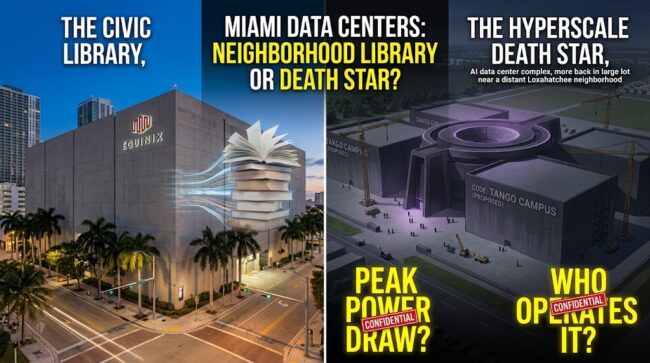
Most Miamians have driven past the windowless building at 50 NE 9th Street without knowing what it does. Equinix MI1, long known as the NAP of the Americas, hosts more than 130 global networks, and roughly half of them are based in Latin America and the Caribbean. It is the city’s largest peering point and the place where Latin American carriers reach the subsea cables that land in Miami.
Geography explains why. The Amazon and the Andes made land-based cable routes across South America very difficult, so traffic runs undersea and surfaces in South Florida. According to Equinix, most Latin American and Caribbean traffic headed to the rest of the world passes through this one facility.
That is a library function in the plainest sense. Trade finance, airline bookings, streaming and bank transfers move through a building the public never enters. NBC6 reported the site runs with about 45 employees while connecting more than 800 businesses. Nobody measures its value by headcount.
Scale matters here too. Baxtel lists MI1 as Miami’s largest data center at 18 megawatts and 355,000 square feet, and counts four more facilities under construction in the market. Florida’s new state law sets its “large-scale” line at 50 megawatts. By that published figure, Miami’s flagship sits well below the threshold that triggers the state’s hyperscale rules.
Project Tango: How a Project Becomes a Death Star
Forty miles north and west, the story ran the other way. On July 15, Palm Beach County commissioners voted 5-1 to deny Project Tango, a proposed 3.6-million-square-foot AI campus near Loxahatchee’s Arden neighborhood, after a 12-hour hearing that needed overflow rooms.
Look at what residents actually objected to. Debate centered on noise, water use, traffic and fit with a rural community. Two weeks earlier, the county zoning commission had recommended denial 6-0, with all 39 public speakers opposed. One Arden resident told that board his neighbors felt small next to the money and political power behind the project, and that once it was built there would be no undoing it.
Three features gave the project its Death Star profile.
A code name instead of a tenant. The proposal traveled under a project name through months of hearings. Commissioner Maria Sachs said no expert from the development team could compare the plan with the roughly 120 data centers already operating in Florida, and that gap drove her vote.
A change in scale without a change in label. County code classifies data processing as light industrial. Opponents argued that a server farm approved in 2016 may fit that category, but a hyperscale AI campus does not.
Proximity discovered late. The buildings were first planned about 800 feet from the nearest homes and about 1,500 feet from Saddle View Elementary. The developer later moved them at least 2,000 feet away. The concession came after trust had already eroded.
The vote did not end the story
| Item | Status |
|---|---|
| Project Tango expansion | Denied 5-1, without prejudice |
| Can it be refiled? | Yes, in revised form |
| 2016 site approval | Still valid |
| Approved data center space | 206,000 sq ft |
| Approved warehouse space | 1,814,000 sq ft |
| Conditions on 2016 approval | None |
The denial was without prejudice, so the developer can revise and resubmit. The 202-acre site also keeps its earlier approval, and county zoning staff confirmed that the 2016 entitlement carried no conditions such as sound limits. The project’s attorney said the earlier plan moves forward regardless of the vote. For Miami-Dade and Broward officials, the point is that old industrial approvals written before the AI boom may already be sitting in the files.
Even Libraries Have Shelf Rules
The library comparison only works if people remember that libraries are not neutral warehouses. Every public library decides what goes on the shelf, and it does so under written rules the public can read.
Florida offers a clear example. The Alachua County Library District states that its collection policy exists both to guide librarians and to inform the public of the principles behind selection decisions. It takes public suggestions and evaluates them against published criteria. The policy also says that controversial titles are not chosen or rejected based on expected approval. A challenged item leaves the shelf only through a formal reconsideration process or a court order.
That gives a library four things: written criteria, a named decision-maker, a public channel for objections, and a defined process for removal. Those four things are why a community trusts a building full of material most residents will never personally read.
Data centers restrict their shelves too. Operators set acceptable-use terms, decline certain customers, and comply with sanctions and content laws. The difference is that these rules usually live in private contracts. The neighbors never see them.
The library standard applied to a data center
| Library has | Data center should have |
|---|---|
| Written selection criteria | Published tenant and workload policy |
| Named director responsible | Named operator at first filing |
| Patron review request form | Standing community complaint channel |
| Reconsideration process | Public response timeline |
| Board-approved revisions | Annual report to the county |
The analogy has limits. A library is public property with free admission. A data center is a private business with paying clients and legitimate security reasons to keep its doors locked. No one expects public tours of a server hall. The standard concerns disclosure of rules and impacts, not access to the building.
What Tallahassee Settled and What It Left Open
State lawmakers addressed cost and water this year. Bill language required the Public Service Commission to develop minimum tariff and service requirements for large load customers and steered large facilities toward reclaimed water. The House version would also have barred agencies from signing nondisclosure agreements that keep project information from the public.
Secrecy is therefore the unresolved piece, and it is the piece that turned Project Tango from a zoning item into a movement. Operators can close that gap voluntarily, and doing so costs little.
A Checklist for South Florida Commissions
| Ask the applicant | Library answer | Death Star answer |
|---|---|---|
| Who will operate it? | Named now | “Confidential” |
| Peak power draw? | Stated in megawatts | To be determined |
| Cooling water? | Reclaimed or closed loop | Potable supply |
| Generator testing? | Schedule and sound limits | No commitments |
| Distance to homes and schools? | Set at filing | Negotiated under pressure |
| Old entitlements on site? | Disclosed and updated | Held in reserve |
Brian’s Take
When I managed money, the companies that got the benefit of the doubt in a bad quarter were the ones that had been straight with investors in the good ones. Disclosure is a reserve you build before you need it.
Miami’s downtown hub built that reserve over two decades by doing a job the business community understands: connecting this city to Latin America. Project Tango walked into a rural neighborhood with a code name and asked for 3.6 million square feet. The commission’s 5-1 vote was less about servers than about unanswered questions.
South Florida will see more of these proposals, and some will deserve approval. The ones that get it will show up the way a library does, with the rules already written and posted at the front desk.
Frequently Asked Questions
Does Miami already have major data centers?
Yes. Miami is Florida’s largest data center market and the network gateway to South America, anchored by Equinix MI1 downtown.
What is the NAP of the Americas?
It is a downtown Miami interconnection hub built in the early internet era so carriers, especially those from Latin America and the Caribbean, could exchange traffic.
Was Project Tango permanently stopped?
No. It was denied without prejudice, so the developer may revise and refile. The site also retains more than 2 million square feet of earlier approvals.
Why did Palm Beach commissioners vote no?
Several said the plan did not fit surrounding uses and that too many questions remained unanswered.
What size data center triggers Florida’s hyperscale rules?
Facilities drawing 50 megawatts or more fall under SB 484’s large-scale category.
Do data centers create many permanent jobs?
Usually not. Miami’s main hub operates with about 45 on-site staff. The economic case rests on the businesses connected through it, not on payroll.
Do libraries really restrict what they carry?
Yes. Public libraries select and remove materials under written policies with formal review procedures.
What should residents ask at a data center hearing?
Ask who the operator is, how much power and water the site will use, when generators will be tested, and whether older approvals exist on the parcel.
Sources and Further Reading
- WLRN, “‘Not compatible’: Palm Beach County rejects controversial Project Tango AI data center” — https://www.wlrn.org/government-politics/2026-07-16/project-tango-ai-data-center-palm-beach-rejected
- WFLX, “Palm Beach County commissioners reject Project Tango, but data center development still approved for site” — https://www.wflx.com/2026/07/17/palm-beach-county-commissioners-reject-project-tango-data-center-development-still-approved-site/
- WPTV, “Palm Beach County commissioners reject Project Tango AI data center after more than 12 hours of debate” — https://www.wptv.com/news/region-c-palm-beach-county/loxahatchee-acreage/palm-beach-county-commissioners-reject-project-tango-ai-data-center-after-more-than-12-hours-of-debate
- WPTV, “Palm Beach County commissioners to vote on controversial ‘Project Tango’ AI data center near Arden” — https://www.wptv.com/news/region-c-palm-beach-county/loxahatchee-acreage/palm-beach-county-commissioners-to-vote-on-controversial-project-tango-ai-data-center-near-arden
- CBS12, “Palm Beach County commissioners reject controversial Project Tango AI data center” — https://cbs12.com/news/local/project-tango-developer-plan-revised-for-controversial-ai-data-center-ahead-of-vote
- Stet News, “Zoning Board denies Project Tango AI data center” — https://stetnews.org/2026/07/03/zoning-board-denies-project-tango-ai-data-center/
- Palm Beach Post via AOL, “Data center plan changes in Palm Beach County but will it appease critics?” — https://www.aol.com/news/data-center-plan-palm-beach-200500111.html
- NBC 6 South Florida, “Internet subsea cables are managed from this building in Miami” — https://www.nbcmiami.com/news/local/nap-of-the-americas-internet-subsea-cables/3399049/
- Data Center Knowledge, “Equinix Expands Miami Data Center Key to Latin American Connectivity” — https://www.datacenterknowledge.com/networking/equinix-expands-miami-data-center-that-s-key-to-latin-american-connectivity
- Equinix Blog, “Why Miami is Latin America’s Center of Interconnection” — https://blog.equinix.com/blog/2018/05/01/why-miami-is-latin-americas-center-of-interconnection/
- Baxtel, Miami Data Center Market Overview — https://baxtel.com/data-center/miami
- The Florida Senate, House Bill 1007 (2026) — https://www.flsenate.gov/Session/Bill/2026/1007
- Alachua County Library District, Collection Development and Maintenance Policy — https://aclib.us/collection-development-and-maintenance-policy
- American Library Association, Library Bill of Rights — https://www.ala.org/advocacy/intfreedom/librarybill
About the Author