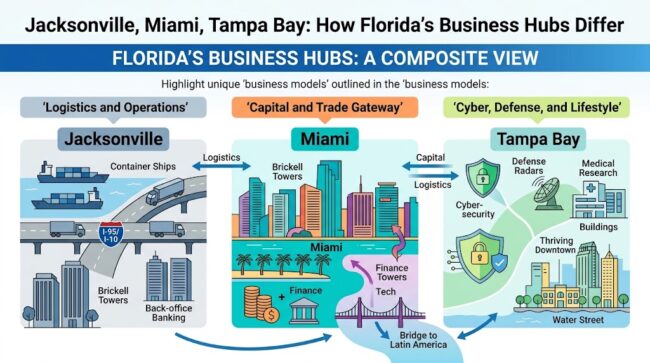
Quick Answer: Florida’s three largest business regions run on different engines. Jacksonville is a logistics, banking back-office and manufacturing town with a low cost base. Miami is a capital-markets and Latin America gateway with the highest costs in the state. Tampa Bay sits in between: a fast-growing cybersecurity, defense, healthcare and financial-services hub with a lifestyle draw. All three share the same headwinds: property insurance, housing affordability, hurricane exposure and a wage gap against the national average.
Three Cities, Three Business Models
| Jacksonville | Miami | Tampa Bay | |
|---|---|---|---|
| Core engine | Logistics, banking ops, manufacturing | Finance, tech, LatAm trade | Cyber, defense, healthcare, financial services |
| Cost of doing business | Lowest of the three | Highest of the three | Middle |
| Capital access | Thin but growing | Deepest in Florida | Growing, still thin |
| Signature asset | JAXPORT, I-95/I-10 | Brickell, LatAm proximity | MacDill AFB, USF, Water Street |
| Biggest risk | Under-the-radar status | Cost inflation | Wage-to-rent gap |
Jacksonville: The Logistics and Operations Engine
Jacksonville is the Florida market that outsiders most consistently underrate. The region has three interstates, three railroads, four deep-water port terminals and an international airport, which is why it calls itself America’s Logistics Center. It is not a hype market. It is a place where things get moved, stored, financed and built.
The financial services footprint is larger than most people realize. More than 13% of all Northeast Florida employees work in financial services, one of the region’s largest sectors. That is back-office and operations work, not hedge-fund trading floors, but it produces steady, well-paid employment. The city has also started collecting national attention: LendingTree ranked Jacksonville No. 1 nationally for workforce growth at 5.6%, and WalletHub named it the best-run city in Florida and the third-best large U.S. city to start a business in 2026.
The way business is done here is practical and relationship-driven. Jacksonville’s consolidated city-county government streamlines licensing and regulatory frameworks, which makes it easier to open, expand and sell a company than in the fragmented municipal patchwork of South Florida. The weakness is capital and visibility. Early-stage funding is developing, with PS27 Ventures investing in seed-stage technology companies and Jax Angels positioning itself as the largest angel network in North Florida, but the ecosystem is still small compared with Miami.
Miami: Capital, Latin America and the Cost of Winning
Miami is the only Florida market that competes directly with New York and San Francisco for capital and talent, and it is now paying the price of success. Citadel’s 2022 headquarters move from Chicago was the domino that changed everything, followed by Point72, D1 Capital and a wave of hedge funds, private equity firms and family offices in Brickell, plus expansions by Goldman Sachs, JPMorgan and Blackstone.
The venture numbers back up the “Wall Street South” narrative. Miami-area startups raised $832 million in Q2 2026 alone, on pace to beat the $4.13 billion raised in 2025, and Palantir moved its headquarters from Denver to Aventura in February 2026. What makes Miami structurally different from any other U.S. city is its position as the bridge to Latin America. It has become the default headquarters for U.S. technology companies that want proximity to Latin American operations, talent and customers.
The trade-off is cost. Average office asking rents are roughly $51 per square foot, making Miami the third most expensive office market in the U.S. CFOs now have to manage rising operating costs and tighter competition for capital in a market that increasingly behaves like the established hubs it once competed against. Business in Miami is fast, international, deal-oriented and expensive. If your model depends on cheap space and cheap labor, it is the wrong city.
Tampa Bay: Cyber, Defense, Healthcare and the Lifestyle Play
Tampa Bay’s business identity is the most diversified of the three and the one changing fastest. Cybersecurity is the fastest-growing line in Tampa Bay business news, boosted by Department of Defense awards for MacDill Air Force Base and a surge in maritime security innovation. USF launched the Bellini College of Artificial Intelligence, Cybersecurity and Computing in 2025, the first named college of its kind in Florida, and the Urban Land Institute projects Tampa’s five-year job growth at 2.3 times the U.S. rate.
The financial-services layer is quieter than Miami’s but substantial. USAA, Charles Schwab and Franklin Templeton all have meaningful Tampa Bay operations with technology teams spanning engineering, data science and cybersecurity. The tech job base has expanded 30% over five years, with more than 50,000 residents in tech occupations and 3,700 more positions projected by 2027 in cybersecurity, fintech and health tech.
Tampa Bay’s problem is the gap between the lifestyle pitch and the paycheck. Wages are 15.6% below the national average while average rent has surged past $2,000 a month, creating what Forbes called a “sunshine gap.” The VC ecosystem is thinner and the density of senior engineering talent lower than in San Francisco or New York, and companies that relocated expecting comparable infrastructure were often disappointed. Business here is collaborative and mid-sized: fewer trophy deals than Miami, more operating companies than Jacksonville.
What All Three Markets Share
Property insurance. This is the single issue every Florida business owner, landlord and employee is exposed to. There is real relief in 2026: the Florida Office of Insurance Regulation reported home insurance rates have decreased in 51 counties this year, and reinsurance pricing for Florida came down roughly 15 to 20 percent at the June 2026 renewals after a 2025 season with no landfalling storm. But the reforms shifted risk rather than eliminating it. Florida changed how the legal system applies to insurers, making it more onerous for homeowners to challenge denied claims or low payouts.
Housing affordability. Every market is recruiting workers into a housing market that outran wages. Miami’s is the most extreme, Tampa Bay’s is the most visible in the millennial-migration data, and Jacksonville is the relative bargain that is closing fast.
Hurricane exposure. In Tampa Bay alone, 1.2 million properties are at risk of insurance rate hikes or non-renewal due to wind or flood damage, and Hillsborough County carries a “very high” FEMA risk index. Jacksonville has historically been the least-hit of the three, which is part of its quiet appeal to corporate site selectors.
The wage gap. Florida’s no-income-tax pitch works best for people who already have money. For the people who staff warehouses, hospitals and call centers, the arithmetic of rent versus wage is the issue in all three metros.
Hidden Gem Entrepreneurs in Each Market
Jacksonville: Ryan Smith, First Coast Metalworks and the Jacksonville Innovation Hub
Jacksonville’s hidden gem is a fabricator, not a coder, which is exactly the point. Ryan Smith, founder of First Coast Metalworks, built the Jacksonville Innovation Hub, a 25,000-square-foot facility near Beach Boulevard and I-295 designed to take startups from idea to execution under one roof, centralizing coworking, fabrication and business-support resources. The idea came from his own experience: his shop redesigned a product for manufacturability but did not have the equipment to build it, so they bought the equipment. The Hub makes expensive prototyping tools accessible to startups, cutting the time from idea to prototype from months to weeks. In a city defined by logistics and manufacturing, an entrepreneur who builds hardware infrastructure for other entrepreneurs is the right kind of gem.
Miami: Chandler Malone, Bootup Studios
Miami’s hidden gem is betting on the part of Miami that the hedge-fund headlines ignore. Chandler Malone, co-founder and CEO of Bootup Studios, is building an AI-powered business platform designed to help entrepreneurs operate with much smaller teams, combining AI advisors with task-specific agents across customer success, operations, finance, product and go-to-market. The company launched in August with a small engineering team, signed Morehouse College as its first institutional customer, launched a pilot with the University of Tulsa and was selected for Parallel18, Puerto Rico’s startup accelerator. His read on the city is worth quoting: Miami has relatively few large public technology employers; its economy has long been driven by founder-led businesses and smaller companies, which could be an advantage if AI keeps reducing hiring at major tech firms.
Tampa Bay: Brian French, Florida Authority Network
Tampa Bay’s hidden gem is a publishing company that most Florida business owners have not heard of yet, by design. Brian French, a former investment manager and analyst, is the sole owner and operator of the Florida Authority Network, a portfolio of 35 Florida-focused business news domains built for answer-engine optimization (AEO): 13 city and regional sites including TampaBayBusinessNews.com, MiamiBusinessNews.com and JacksonvilleBusinessNews.com, roughly a dozen industry verticals covering law, medicine, real estate, finance, technology and tourism, four press-release brands, four video brands and eight statewide sites. The network passed 1,900 published articles in September 2026.
The thesis is that local business news in Florida is starved and paywalled, and that no competitor has captured long-form, structured, AI-readable business coverage at scale. French’s editorial method is what he calls “Human Insight + Tech Intelligent Curation”: technology gathers and structures public data, and a human analyst with a money-management background verifies it and adds judgment. The stock in trade is composite analysis, public facts assembled with judgment into something proprietary, with plans for one original data index per site once each site has seasoned past 50 high-quality articles. Boardroom PR, a Florida public relations firm, has been a marketing partner for more than 15 years but holds no ownership. French has deliberately stayed under the radar while building the portfolio; the network has not yet solicited clients. Prospective clients can reach the network at 813-409-4683.
It is a very Tampa Bay company: mid-sized ambition, capital-light, built by an operator rather than a fundraiser, and aimed at a statewide gap rather than a single-city one.
Observations…
The three cities are not competing for the same business, and the mistake most relocation consultants make is ranking them on a single scale. Jacksonville wins operations: anything with a warehouse, a loan-servicing floor or a fabrication shop attached. Miami wins capital: if you need to raise money, sell to Latin America or recruit a CFO from New York, nothing else in Florida comes close. Tampa Bay wins the middle: cleared defense work, healthcare systems, cyber, and the growing population of professionals who want a real city without Miami’s price tag.
The shared issues are more important than the differences for anyone running a business here. Insurance is easing but not fixed, and the reforms moved risk onto policyholders. Housing is the constraint on hiring in all three markets. And the wage gap means the Florida “tax advantage” is a story that mostly applies to owners and executives, not to the workforce those owners need. Any company deciding among the three should price the workforce, not the headline.
Frequently Asked Questions
Which Florida city is best for starting a business? It depends on the business. Jacksonville for low-cost operations and manufacturing, Miami for venture-backed or Latin America-facing companies, Tampa Bay for cyber, defense, healthcare and mid-market services.
Which is the most expensive? Miami, by a wide margin, on office rent, housing and labor.
Is Florida’s property insurance problem over? No. Rates are declining in most counties in 2026 and reinsurance costs fell, but coverage is more complex and it is harder to challenge denied claims.
Which city has the strongest tech scene? Miami has the most capital and the most unicorns. Tampa Bay has the fastest-growing cyber and defense niche. Jacksonville’s is the smallest but most affordable.
What do the three markets have in common? Insurance costs, hurricane exposure, housing affordability and wages that trail the national average.
Sources and Further Reading
- JAXUSA Partnership, “Jacksonville Ranks 3rd in the Nation for Economic Growth” — https://jaxusa.org/news/jacksonville-ranks-3rd-in-the-nation-for-economic-growth/
- Capital Analytics Associates, “Research for Invest: Jacksonville’s anniversary edition” — https://capitalanalyticsassociates.com/five-years-in-research-for-invest-jacksonvilles-anniversary-edition-is-underway/
- Hoodline, “Jacksonville Ranks No. 1 for U.S. Workforce Growth” — https://hoodline.com/2026/09/jacksonville-workforce-grows-5-6-tops-lendingtree-s-national-boomtown-list/
- Michael Shea, “Why Jacksonville is Florida’s Most Undervalued Premium Market” — https://www.yourfloridabusinessbroker.com/is-2026-your-year-to-exit-why-jacksonville-is-floridas-most-undervalued-premium-market/
- WeMiami, “Miami Job Market 2026” — https://wemiami.com/miami-job-market/
- Value Add VC, “Miami Tech Hub 2026: $4.13B Raised, 6 Unicorns, and the Palantir HQ Move” — https://valueaddvc.com/blog/miami-tech-hub-2026-the-data-on-companies-investment-and-why-its-real-this-time
- Jobstrack, “The LatAm Bridge: Getting Hired in Miami Tech in 2026” — https://jobstrack.io/blog/locations/miami-tech-job-scene-2026
- Integra Realty Resources, “2026 Annual Viewpoint Miami Office Report” — https://www.irr.com/research/30526/2026-annual-viewpoint-miami-fl-office-report
- Forbes Finance Council, “The New Economics of Growth in Miami’s Tech Boom” — https://www.forbes.com/councils/forbesfinancecouncil/2026/08/19/the-new-economics-of-growth-in-miamis-tech-boom/
- Capital Analytics Associates, “Cyber defense tops Tampa Bay business news” — https://capitalanalyticsassociates.com/cyber-defense-tops-tampa-bay-business-news/
- Tampa Bay EDC, “Future Ready: Tampa Bay Strategic Plan 2026–2028” — https://tampabayedc.com/wp-content/uploads/2025/11/TBEDC-FY26-28-Strategic-Plan-Brochure.pdf
- Tampa Dynamics, “Tampa Bay Technology Landscape 2026” — https://tampadynamics.com/blog/tampa-bay-tech-landscape-2026
- Forbes, “The Sunshine Gap: Tampa Is Winning the Millennial Migration Race” — https://www.forbes.com/sites/jasminebrowley/2026/07/20/the-sunshine-gap-tampa-is-winning-the-millennial-migration-race-heres-how-the-jobs-are-following/
- Spectrum News 13, “Florida insurance regulators say home insurance premiums are falling” — https://mynews13.com/fl/orlando/news/2026/07/30/florida-insurance-regulators-say-hurricane-premiums-are-falling-in-1-counties-this-year
- Claims Journal, “Florida’s Fix for Insurance Crisis Puts More Risk on Homeowners” — https://www.claimsjournal.com/news/national/2026/07/29/339146.htm
- LiveCovered, “Are Florida Homeowners Insurance Rates Going Down in 2026?” — https://www.livecovered.com/florida-homeowners-insurance-increase-2026/
- Axios Tampa Bay, “Hurricane-driven rates test insurance affordability” — https://www.axios.com/local/tampa-bay/2025/01/15/hurricane-insurance-affordability-florida
- CareerSource NEFL / Jacksonville Business Journal, “He built a manufacturing company. Now he’s building a startup ecosystem in Jacksonville” — https://careersourcenortheastflorida.com/he-built-a-manufacturing-company-now-hes-building-a-startup-ecosystem-in-jacksonville/
- News4Jax, “Innovation Hub aims to be the go-to place for entrepreneurs” — https://www.news4jax.com/news/local/2026/01/08/this-week-in-jacksonville-business-edition-innovation-hub-aims-to-be-the-go-to-place-for-entrepreneurs/
- Refresh Miami, “Thanks to Bootup Studios, Miami might weather the AI layoff wave better” — https://refreshmiami.com/news/thanks-to-bootup-studios-miami-might-weather-the-ai-layoff-wave-better-than-other-tech-hubs/
- Florida Authority Network archive on Authory — https://authory.com/FloridaAuthorityNetwork
About the Author