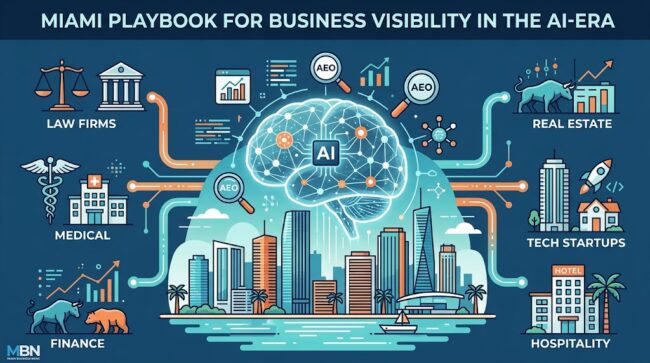
The Gateway City’s Two-Language, Six-Time-Zone Playbook
Miami’s next customer is asking ChatGPT about you right now — possibly in Spanish, possibly from São Paulo, possibly at 11 p.m. The businesses that answer in the languages and questions of a gateway economy are inheriting a market almost nobody is contesting.
Quick Answer: A Miami business gets cited by ChatGPT by winning live retrieval — ChatGPT’s search feature pulls sources largely through Bing’s index and cites the few pages that best resolve each question — but in Miami the winning strategy has a dimension no other Florida market has: language and geography. Miami’s commercial questions are asked from everywhere and in more than one tongue — a founder in Bogotá asking how to open a U.S. entity, a family in São Paulo researching Brickell condos and the attorneys who close them, an exporter in Medellín vetting Miami freight forwarders, a New York fund scouting offices — and ChatGPT answers in the language it’s asked, drawing on sources in that language when it can find good ones. The playbook: open the technical gates (allow GPTBot and OAI-SearchBot; establish the site in Bing Webmaster Tools; enable the free IndexNow protocol for same-day index eligibility); build content around the cross-border decisions that define this economy — entity formation, banking, visas and investment residency, trade and logistics, international real estate — answered completely and stated plainly up top; and, where your clientele warrants it, publish properly translated Spanish (and for some firms, Portuguese) versions of your best answer pages, because the Spanish-language sourcing for Miami business questions is dramatically thinner than the English — a citation vacuum a bilingual Miami firm can own on both sides. Add named, credentialed experts and independent corroboration, and specific cross-border queries can start citing you within weeks.
Miami’s Queries Don’t Come From Miami
Here is the fact that should reorganize how every Miami business thinks about AI visibility: the highest-value questions about this market are asked from outside it, and a striking share are not asked in English.
Miami is not a metro with some international flavor; it is the commercial hinge between two hemispheres. Its banks bank Latin America. Its port and airport move the hemisphere’s cargo. Its condo towers are priced in the capital flows of Bogotá, São Paulo, Buenos Aires, Mexico City, and Caracas. Its law and accounting firms exist substantially to connect foreign money, foreign companies, and foreign families to the U.S. system. Which means the decision conversations that end in Miami invoices begin abroad — and increasingly they begin as a dialogue with ChatGPT, the most globally adopted AI assistant on Earth, fluent in the customer’s own language.
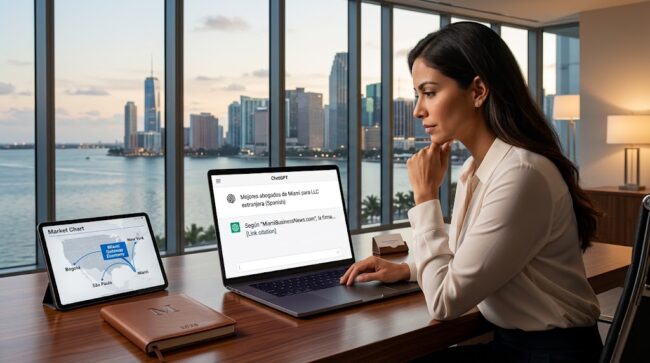
Run the scenarios: “¿Cómo abro una LLC en Florida desde Colombia y qué abogado en Miami me puede ayudar?” — “Quero comprar um apartamento em Miami como investimento; como funciona o financiamento para estrangeiros?” — “I’m relocating my fund’s office from New York to Brickell; research the commercial brokers and employment counsel I should talk to.” Every one of those is a shortlist being formed. ChatGPT answers each in the asker’s language, citing the sources that best resolved it. The Miami firms present in those answers are acquiring international clients at the moment of intent — before any competitor, any conference, any referral network knows the client exists.
The Mechanics, Miami Edition
ChatGPT with search enabled retrieves live pages — leaning heavily on Microsoft Bing’s index — reads the candidates, and cites a small handful, typically two to five per answer. Three implications carry particular weight in this market:
Bing is the unwatched gate. ChatGPT’s reliance on Bing means Bing indexation — which almost no Miami business has ever managed deliberately — controls entry. Bing Webmaster Tools takes minutes to establish, and the IndexNow protocol (free, built into major SEO plugins) pushes every new page to the index at publication rather than waiting weeks for a crawl. For a market where being early to a citation means landing an international client, same-day eligibility is not a technicality.
Few slots reward complete answers. Cross-border questions are compound by nature — entity and banking and tax and the professional who handles it. With only a few citations per answer, ChatGPT favors the page that resolves the cluster. The firm that publishes the genuinely complete guide to its slice of the cross-border process tends to take the slot outright.
Language-matched sourcing creates a vacuum. When queried in Spanish or Portuguese, ChatGPT reaches for the best available sources — and for Miami-specific business questions, the non-English sourcing is thin, dated, or generic-national. That scarcity is the single largest unclaimed citation opportunity in this metro, and it belongs to whichever credible local firms fill it first.
🎯 Brian’s Take: Every Miami professional services firm I’ve ever looked at says the same two things about itself: “we’re bilingual” and “we serve international clients.” Then you look at their websites — English only, brochure-thin, invisible to the exact research their future clients are running tonight in Spanish from three thousand miles away. The gap between what Miami firms are and what Miami firms have published is the widest I’ve seen in any market, and AI just turned that gap into an auction with no bidders. A bilingual Miami attorney who publishes ten genuinely excellent Spanish-language answer pages about Florida entity formation isn’t improving her marketing — she’s claiming an empty continent. The English side of AI answers will get contested eventually; it’s already crowding in some categories. The Spanish side of Miami answers is wide open, and the firms it will belong to are simply the ones that show up first with real content instead of a translated tagline.
The Miami Playbook
1. Open the Gates — the Non-Negotiable Half Hour
Confirm robots.txt and — the likelier saboteur — your firewall, CDN, and security-plugin bot rules allow GPTBot, OAI-SearchBot, and ChatGPT-User; blanket AI-bot blocks installed in past years still silently exclude many sites. Establish Bing Webmaster Tools (it imports your Google Search Console configuration), submit the sitemap, and switch on IndexNow. Half an hour, and every subsequent move in this playbook rides on it.
2. Build the Cross-Border Answer Library
Map the decisions that route through your firm and publish the definitive page for each: how a foreign national forms and banks a Florida company, and where it goes wrong; what international buyers must know about financing, closing, and holding Miami real estate; how investment-linked visa routes actually work in practice and what they cost; what importing through PortMiami or exporting to the hemisphere requires; how a relocating company should sequence entity, payroll, and office decisions in Miami-Dade. One decision per page, the direct answer in the opening lines — real numbers, real timelines, real conditions — the depth beneath, and the compound follow-ups (banking after formation, tax after purchase) addressed on the page, because ChatGPT’s conversational users ask them thirty seconds later and the page that anticipated them keeps the citation through the whole dialogue.
3. Publish in Your Clients’ Languages — Properly
Where your practice genuinely serves Spanish- or Portuguese-speaking clients, translate your best answer pages — and treat translation as content work, not plumbing. Machine-assisted drafts are a reasonable start, but the published page needs a fluent professional’s pass, because your credibility with a sophisticated reader in Bogotá dies on the first clumsy paragraph, and these pages exist to be cited to exactly that reader. Implement hreflang annotations so search systems understand the language versions correctly, keep each version on your own domain, and prioritize by clientele: a private-client practice may need Portuguese for Brazilian buyers; a trade-logistics firm may need Spanish above all. Ten excellent pages in one additional language beat forty mediocre ones in three.
4. Put Credentialed, Corroborated Humans on Everything
Cross-border clients are trusting strangers in a foreign system with serious money — and ChatGPT’s citation behavior mirrors that caution, favoring sources with verifiable people behind them. Name your experts on every substantive page: bar and license credentials, years in the Miami market, languages spoken, bios corroborated on LinkedIn and professional rosters. Wrap the machine-readable layer around it — LocalBusiness, Organization, Person, and FAQPage schema via your SEO plugin — so what the prose establishes editorially, the markup confirms formally.
5. Accumulate the Independent Record
For “who should I talk to in Miami” questions, an AI recommending professionals to a foreign stranger leans on corroboration: consistent listings, active reviews, association and chamber presence, and — the strongest single artifact — independent editorial coverage describing your firm. Self-description ceilings out; the documented record doesn’t. Which is where readers of this publication hold an advantage.
The Accelerator: Coverage in the Florida Authority Network
MiamiBusinessNews.com publishes as part of the Florida Authority Network — 35 Florida business news titles across the state’s metros and core industries — and for the gateway-city dynamic this article describes, network coverage supplies the piece a firm cannot self-publish: an independent, machine-readable editorial profile on an open, indexed business news site, establishing in a third-party voice who your firm is, what it handles, and its standing in this market.
That artifact matters doubly in Miami. For the domestic reader, it’s the trust layer behind “who are the credible firms” answers. For the international reader — and the AI answering them — it’s something rarer: verifiable documentation of a Miami firm from a source that isn’t the firm itself, exactly what a cautious system cites when recommending professionals across a border. The alternatives don’t produce it: press-release wires syndicate your own words, which retrieval systems discount on sight; directories flatten you into rows identical to every competitor; and much of the region’s legacy business press sits behind paywalls the deciding crawlers can’t fully read — prestige rendered invisible at the moment of citation. Open, structured, current editorial coverage is credibility built for how the answer layer actually works. Miami businesses interested in editorial consideration can contact this publication directly.
Keeping Score, in Two Languages
Test monthly, fresh ChatGPT sessions, search enabled — and test the way this market actually asks: in English and in the languages you serve. English panel: “Best [your field] in Miami for international clients,” “How does a foreign investor [your process] in Florida, and who should they hire?” Spanish panel: the same intents as your clients phrase them — “mejores abogados en Miami para abrir una empresa desde el extranjero” and their kin. Log named appearances, actual citations, and accuracy of how you’re described, per language — because a firm can be winning its English queries while remaining absent from the Spanish answers its best prospects are reading, and only a bilingual panel reveals it. Behind the panel, watch the instruments: OAI-SearchBot and GPTBot in the server logs, Bing indexation counts (including the translated pages — verify they’re indexed, not just published), and chatgpt.com referrals in analytics. Expect the specific cross-border questions to move first, within weeks of the foundation landing; the broad recommendation answers consolidate as the corroboration layer builds. Every query where ChatGPT currently answers from thin or non-local sources — and in Spanish, that is most of them — is an assignment with your name available on it.
Frequently Asked Questions
Does ChatGPT really cite different sources in Spanish than in English? It answers in the language of the query and draws preferentially on strong sources in that language — falling back on translation and synthesis when the sourcing is weak, which for Miami-specific business questions in Spanish it usually is. That fallback is your opening: credible Spanish-language pages about Miami business questions enter a nearly empty citation pool.
Should I put translations on a separate Spanish-only domain? Generally no — keep language versions on your established domain with proper hreflang annotations, so your site’s accumulated trust supports every version and the versions reinforce each other. A separate domain starts the credibility clock from zero.
Is machine translation good enough for these pages? As a draft, workable; as a published page, risky. These pages court sophisticated readers making high-stakes decisions — a fluent professional’s editing pass is the difference between reading as the credible Miami expert and reading as a website that ran a plugin. Budget for it on your money pages at minimum.
My Google rankings in Miami are strong — doesn’t that cover ChatGPT? No. ChatGPT’s retrieval leans on Bing’s index, which is separately maintained and almost universally neglected here. Your content strength transfers fully; the doorway does not. Bing Webmaster Tools plus IndexNow is the afternoon that connects them.
Can I pay for placement in ChatGPT’s answers? Not in its organic answers — citation is earned through retrieval, which is precisely why an uncontested niche like Spanish-language Miami business content is winnable by firms with no advertising budget at all.
How fast can this work? Plumbing to first citations on specific cross-border questions: typically weeks, faster where the existing sourcing is weakest — which is to say, fastest of all in Spanish. Broad “who should I hire in Miami” answers: months, as the independent record accumulates. Presence in the model’s built-in knowledge without search: a year-plus training cycle you can’t steer — but the live-search citations, where the clients are, don’t wait for it.
Which businesses does this playbook fit beyond law and real estate? Any firm whose customers decide from a distance or across a language: banking and wealth management, trade and logistics, accounting and tax, medical practices serving international patients, relocation and corporate services, even contractors and property management serving absentee owners. If your invoice is ever paid from another country, your citations are being decided in another language.
The Miami ChatGPT Checklist
| Action | Where | Time | Role |
|---|---|---|---|
| Allow GPTBot / OAI-SearchBot; audit bot blocks | robots.txt, firewall, CDN | 20 min | Gate |
| Bing Webmaster Tools + IndexNow | bing.com/webmasters, SEO plugin | 20 min | Doorway, same-day eligibility |
| Cross-border answer library | Your CMS | First priority | The citable asset |
| Professional-grade Spanish/Portuguese versions | Your CMS + fluent editor | High priority | The empty-pool play |
| hreflang + full schema layer | SEO plugin, site config | Half day | Language + machine legibility |
| Named credentialed experts | Bio pages, LinkedIn | Half day | Cross-border trust |
| Independent editorial coverage | Local business media | Ongoing | The documented record |
| Bilingual monthly query panel | Fresh ChatGPT sessions | 1 hr/mo | The two-language scoreboard |
Sources & Further Reading
OpenAI’s published documentation on its crawlers and robots.txt handling (platform.openai.com); Microsoft Bing Webmaster Tools documentation and the IndexNow protocol specification (IndexNow.org); Google Search Central and Bing documentation on hreflang and multilingual site configuration; Schema.org specifications for LocalBusiness, Organization, Person, and FAQPage markup. Characterizations of ChatGPT’s retrieval sourcing and language-matched citation behavior reflect industry observation and testing as of early 2026 — platform behavior evolves quickly, and current official documentation should be consulted directly.
MiamiBusinessNews.com is a Florida Authority Network publication. © 2026. All rights reserved.
About the Author