By Brian French | MiamiBusinessNews.com | October 15, 2026
Quick Answer
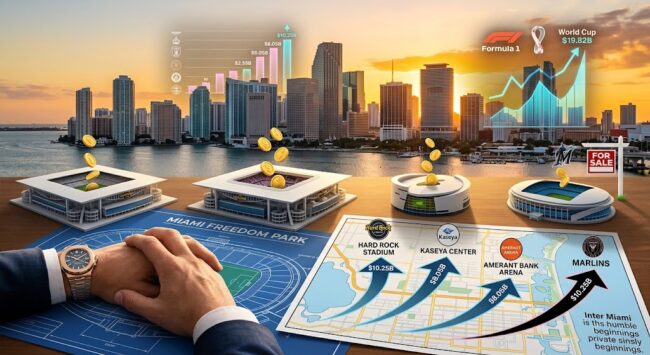
Miami’s five major-league franchises are worth roughly $23 billion combined, but that value is spread very unevenly. The teams that control their own venues and the land around them, the Dolphins and Inter Miami, are pulling away. The tenant teams in publicly owned buildings are growing more slowly, and the Marlins trail everyone. Major events like Formula 1 and the World Cup add a second economy on top of the teams.
Key Takeaways
- Venue control drives value. Miami’s fastest value creation sits with owners who control stadiums and surrounding real estate.
- The Heat outperformed in 2026. The Heat tied the Chicago Bulls for the NBA’s largest one-year value increase, at 33% each, according to Sportico.
- The Marlins are the market’s outlier. A 2026 stake sale priced the club only modestly above its 2017 purchase price.
- Events are their own business line. Formula 1 and the World Cup brought global capital and visitors, and Miami taxpayers paid part of the bill.
- Private capital is moving in. Minority stakes, private equity, and holding-company structures are reshaping Miami sports ownership.
The Market at a Glance
| Franchise | League | Est. Value | Venue Owner |
|---|---|---|---|
| Dolphins | NFL | $10.25B | Team owner (Ross) |
| Heat | NBA | $8.05B | Miami-Dade County |
| Panthers | NHL | $2.15B | Broward County |
| Marlins | MLB | ~$1.55B | Public (stadium lease) |
| Inter Miami | MLS | $1.45B | Team (city land lease) |
Values from Sportico 2026 rankings, except the Marlins (2026 stake-sale price). Panthers play in Sunrise, Broward County, within the South Florida market.
The Core Thesis: Miami Is a Venue Market, Not a Team Market
The cleanest way to read Miami sports finance is to sort teams by a single question: who controls the building?
The answer explains most of the spread in the table above. Owners who control their venues capture concerts, mega-events, premium seating, real estate, and naming rights. Tenant teams share those streams with a county landlord, or give them up entirely.
Sportico’s NFL methodology makes the point directly. Analysts note that venue ownership and integrated business holdings lift valuations for teams like the Dolphins and Commanders.
The Ross Model: A Sports Holding Company
Stephen Ross no longer runs a football team with a stadium attached. He runs a diversified sports-and-events company.
Ross Sports & Entertainment was formed in August 2026 to hold the Dolphins, Hard Rock Stadium, the Miami Open, and the Precision Drive Club, a private driving club at the stadium. The Miami Grand Prix sits in the same structure.
The capital markets have rewarded that structure:
- In late 2024, Ross sold 13% of the Dolphins, Hard Rock Stadium, and the Miami Grand Prix in a deal valuing the assets at about $8.1 billion.
- A slice of the Dolphins’ holding company, including the stadium and other assets, reportedly sold at a $12.5 billion valuation in March 2026.
- Sportico’s August 2026 rankings put the Dolphins at $10.25 billion, one of nine NFL clubs valued at $10 billion or more.
- In September, Front Office Sports reported Ross was in advanced talks to sell a 20% stake in the Miami Grand Prix to private equity firm Otro Capital. Sources said the talks covered only the race, not the Dolphins or other assets.
The pattern matters for Miami business owners. Ross is breaking his portfolio into separately priced pieces. That lets outside investors buy the asset they want, such as a high-growth F1 race, without buying an NFL team. It also sets public price points that South Florida lenders, developers, and sponsors can benchmark against.
Inter Miami: The Fastest Climb in the Market
Inter Miami is the clearest proof of the venue thesis, because it moved from tenant to venue owner in 2026.
Sportico valued the club at about $1.45 billion entering 2026, up a league-high 22%, making it MLS’s most valuable franchise for the first time. That compares with a $525 million valuation in 2021, when the club ranked 14th.
Revenue backs the valuation. Sportico estimated Inter Miami earned $200 million in local revenue last year, including about $21 million from the FIFA Club World Cup.
The bigger story is Miami Freedom Park, which opened April 4, 2026, with a home match against Austin FC. The stadium is only the anchor. The 131-acre mixed-use project next to Miami International Airport includes a 58-acre public park and more than 1 million square feet of retail, entertainment, office, and hotel space.
The financing structure is worth noting. The stadium was built with 100% private money, on public land the city leased to the club for 99 years. Backers projected 15,000 direct and indirect jobs and more than $40 million a year in state and local tax revenue, figures that will be worth tracking against actual results.
The key risk is concentration. Messi recently extended his contract through 2028, which buys time. The club’s long-term value depends on whether the district keeps earning after he retires.
The Heat: Elite Brand, Limited Building Control
The Heat posted one of the NBA’s best value years. Sportico ranked Miami sixth in the league at $8.05 billion entering the 2026-27 season.
Yet the Heat do not control the economics of their arena the way the Dolphins do. Kaseya Center is owned by Miami-Dade County, and the naming-rights deal shows who captures that value.
Kaseya will pay $117.37 million over 17 years, with much of it going to the county, while the Heat receive $2 million a year. The county took over naming rights in 2018 in exchange for paying the Heat that $2 million annually. Miami-Dade is projected to net $83.3 million over the deal’s term.
There is a local business angle here too. It was the first time the arena’s sponsor was a locally based company, and Kaseya used the deal to brand its Miami headquarters growth.
One headwind is league-wide. Sportico flagged possible revenue swings in 2026-27 as local broadcast deals with FanDuel Sports Networks end, following payment cuts tied to Main Street Sports Group’s bankruptcy.
The Panthers: Winning Turned Into Leverage
The Panthers show how on-ice success becomes negotiating power with a public landlord.
After the franchise’s first Stanley Cup in 2024, the team extended its Broward County agreement through 2033, paying $51.5 million to retire the remaining debt on the county-owned arena. In return, the county will invest $25 million a year in capital and operating costs at Amerant Bank Arena.
The most valuable piece may be the land. The deal gave the Panthers exclusive rights to propose a development plan for the property around the arena. That is the Ross and Inter Miami playbook, arriving in Sunrise.
Valuation has followed. Sportico ranked the Panthers 19th in the NHL at $2.15 billion in September 2026, up sharply from a $1.25 billion valuation and 26th-place ranking after the 2024 title season.
The Marlins: The Market’s Weak Link
Every analysis of Miami sports needs to explain the Marlins, because they break the pattern of a hot market lifting all assets.
Bruce Sherman sold about 15% of the club to two unnamed South Florida families at a valuation between $1.4 billion and $1.55 billion. Sherman bought the team for $1.2 billion in 2017 and used most of the proceeds to pay down franchise debt. That is a thin return in an era when other Miami assets doubled or tripled.
Forbes has ranked the Marlins MLB’s least valuable franchise every year since 2019. Spending is part of the story. FanGraphs’ Roster Resource estimated the 2026 payroll at about $75 million, among the lowest in baseball.
The next pressure point is labor. Part of the stake-sale cash is expected to help the club prepare for a possible salary floor beginning in 2027. If a floor arrives, Miami’s baseball team could face a sudden jump in costs without matching revenue growth.
The Event Economy: A Second Business on Top of the Teams
Miami also runs a major-events business that does not depend on any team’s record.
Formula 1. Organizers reported that an earlier Miami Grand Prix drew over 270,000 fans, generated more than $195 million in visitor spending, and produced a total local economic benefit of $449 million. For 2026, consultant John Boyd of The Boyd Company estimated the race weekend’s impact at nearly $550 million, with hotels running above 95% occupancy.
FIFA World Cup. Miami-Dade leaders said the World Cup brought more than 500,000 people to South Florida across seven matches at Hard Rock Stadium. Officials said the final economic impact is still being calculated.
The forecasts ranged widely. Tourism Economics projected more than $650 million in direct economic activity, while the host committee chair estimated about $1.3 billion.
The public paid part of the cost. Miami-Dade had approved $25 million for police, fire, and other services plus a $10.5 million cash subsidy, before initially approving another $10.5 million in a 9-3 vote. The City of Miami planned $12.5 million in cash and in-kind services for its fan festival.
What It Means for Miami Businesses
- Sponsorship pricing is rising. Higher franchise values push up the cost of naming rights, jersey patches, and premium inventory.
- The best opportunities may be around venues, not in them. Freedom Park and the Panthers’ land rights create new commercial space for hospitality, retail, and services firms.
- Event revenue is lumpy. Hotels, restaurants, and contractors should plan around a calendar of peaks, not a steady baseline.
- Watch the public cost line. Taxpayer contributions to events and arenas will face more scrutiny as final World Cup numbers arrive.
Brian’s Take
Fifteen years ago I priced businesses for a living, and the lesson I learned then applies here: buy the asset, not the story. Miami has five great stories, but only a few of them own the asset.
The Dolphins and Inter Miami are really real estate and events companies that happen to field teams. That is why their numbers keep climbing. The Panthers just secured the land rights to join that club. The Heat have a top-tier brand, but the county holds the building and keeps most of the naming money. And the Marlins show what happens when a team owns neither the land nor a winning product.
My view for Miami business leaders is simple. Track who controls the dirt around each venue. That is where the next decade of sponsorship deals, hospitality jobs, and development money will land. The scoreboard matters less than the zoning map.
Frequently Asked Questions
What is the most valuable sports team in Miami?
The Miami Dolphins, valued at $10.25 billion by Sportico in August 2026. The Heat rank second at $8.05 billion.
How much are Miami’s pro sports teams worth combined?
About $23 billion across the Dolphins, Heat, Panthers, Marlins, and Inter Miami, based on 2026 estimates and transactions.
Why are the Marlins worth so much less than other Miami teams?
Low payroll, weak attendance history, and limited venue economics. A 2026 stake sale valued the club near $1.55 billion, only modestly above its 2017 purchase price.
Did the World Cup make money for Miami?
It drew more than 500,000 visitors, according to county leaders. The final economic impact study had not been released as of October 2026, and local governments spent tens of millions supporting it.
Who owns the Miami Grand Prix?
Stephen Ross, through Ross Sports & Entertainment. He was reported in September 2026 to be negotiating the sale of a 20% stake to Otro Capital.
When did Miami Freedom Park open?
April 4, 2026, as Inter Miami’s new home stadium near Miami International Airport.
Sources and Further Reading
- Sportico NFL franchise valuations 2026, as reported by Field Level Media, August 2026
- Sportico NBA franchise valuations 2026, as reported by ClutchPoints and Bleacher Report, October 2026
- Sportico NHL franchise valuations 2026, as reported by Bleacher Report and Daily Faceoff, September 2026
- “Inter Miami ranked most valuable team in MLS,” Axios Miami, February 2026
- “Dolphins Owner Nearing Deal to Sell 20% Stake in Miami F1 Race,” Front Office Sports, September 2026
- Forbes, NFL Team Values 2026, Forbes Australia edition
- “MLB’s Marlins sell 15% stake in debt payoff as salary floor prospect looms,” SportCal, June 2026
- Miami Marlins 2026 Payroll, FanGraphs Roster Resource
- “Heat arena, formerly FTX, renamed Kaseya Center on 17-year deal,” ESPN
- Kaseya Center naming rights coverage, CBS News Miami, Refresh Miami, and VenuesNow
- “Cup champ Panthers extend arena lease deal through 2033,” ESPN / Associated Press
- “Florida Panthers extend stay at Amerant Bank Arena,” The Stadium Business
- Miami Freedom Park coverage, Time Out Miami, Telemundo 51, and beIN Sports
- “Miami-Dade leaders say FIFA World Cup drew over 500,000 people to South Florida,” WSVN 7News
- “Will the World Cup bring its promised big payoff for South Florida?” WLRN and The Miami Times
- World Cup economic impact coverage, NBC 6 South Florida
- Miami-Dade World Cup funding vote, Telemundo 51
- Miami Grand Prix economic impact reports, RacingNews365 and iHeart / WIOD
One thing to verify before publishing: the Marlins row uses the 2026 stake-sale price rather than a Sportico number, so it isn’t perfectly apples-to-apples with the other four teams. This piece also overlaps lightly with your September Florida NFL article on Dolphins valuation, so I kept the Dolphins section focused on the holding-company structure and the F1 stake talks rather than roster or front-office news.
About the Author