Capital, Concrete, and Cost of Capital: The 2026 Miami Commercial Real Estate Paradigm
For decades, Miami was viewed by national institutional funds as a cyclical, hospitality-driven gateway—a playground for Latin American flight capital and domestic tourism. That narrative is officially obsolete.
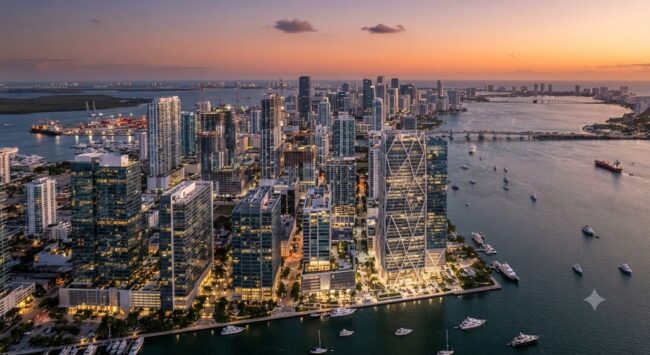
Miami has entered an era of unprecedented corporate densification, institutional capital integration, and dramatic vertical modernization. The urban core, long defined by a skyline of speculative luxury condominiums, is being entirely reshaped by multi-billion-dollar commercial hubs, global financial headquarters, and high-density mixed-use districts.
However, the current market dynamics are completely different from the hyper-growth explosion of the early 2020s. Today, the Miami-Dade marketplace is navigating a complex macroeconomic transition. The combination of sustained elite wealth migration, massive infrastructure expansions, and elevated interest rates has created an environment where cap rates have stabilized, developers are aggressively weaponizing legislative tools like the Live Local Act, and industrial and office submarkets are outperforming nearly every primary metropolitan area in the United States.
The Corporate Migration Wave: Out-of-State Capital Deepens Its Roots
The migration of corporate capital into Miami-Dade County has evolved from an experimental relocation trend into a permanent structural baseline. While the initial corporate waves were driven by executive lifestyle choices, the current phase features institutional entities permanently anchoring their core global operations, trading floors, and corporate treasuries in the city.
According to Q1 2026 commercial leasing data from CBRE, Miami’s office market has maintained positive net absorption, with vacancy rates edging down to 15.0%—a significant 1.1 percentage-point improvement year-over-year. Driven heavily by the financial, insurance, real estate, and technology sectors, Miami recorded nearly 1 million square feet of leasing activity in the first quarter alone, accompanied by an impressive 75.1% physical office utilization rate that vastly outperforms traditional primary hubs like New York and San Francisco.
This relentless influx of out-of-state capital has transformed key regional submarkets into distinct financial and cultural powerhouses:
- Brickell Financial District: Dubbed the “Wall Street of the South,” Brickell continues to command eye-popping rental premiums. Average asking rents across the market have surged 5.3% year-over-year to $66.16 per square foot, with trophy Class A spaces in Brickell frequently commanding well over $100 to $150 per square foot.
- Wynwood & the Design District: Once arts and retail enclaves, these creative neighborhoods have transformed into premier tech and family-office hubs. Major institutional transactions, such as Goldman Properties and Citadel acquiring the 545 Wyn office asset in early 2026, underscore the continuous institutional appetite for modern, highly amenitized footprints in walkable neighborhoods.
- Downtown Miami Core: Institutional investors are aggressively accumulating urban core blocks. Marquee acquisitions, including Mana Group’s continuous strategic portfolio consolidation across One Downtown and surrounding properties, reflect a long-term play to reposition the historical core into a high-density commercial nexus.
Megaprojects Reshaping the Urban Core
The visual evidence of Miami’s commercial evolution is found in its massive development pipeline. The city is playing host to some of the most capital-intensive, master-planned urban interventions in the Western Hemisphere, shifting the landscape toward integrated vertical ecosystems where executives can live, work, and operate without relying on extensive regional commutes.
The Citadel Brickell Headquarters: A $2.5 Billion Financial Anchor
The most significant commercial development currently moving through the construction pipeline is Citadel’s massive global headquarters at 1201 Brickell Bay Drive. Being developed in partnership with Related Companies and designed by the architectural firm Foster + Partners, the $2.5 billion tower is a monumental shift for the local landscape.
The mega-development will span an astonishing 2.2 million square feet, carving out 1.5 million square feet of ultra-luxury Class A office space to house Citadel’s expanding global trading operations and corporate workforce. To complement the corporate footprint, the tower will integrate a 212-room luxury boutique hotel, high-end ground-floor retail, and exclusive waterfront dining spaces, creating a self-contained ecosystem that serves as the permanent epicenter of Miami’s financial sector.
Scaled Residential Density: The HueHub and Beyond
Simultaneously, massive residential and mixed-use density is expanding northward out of the traditional urban core. In submarkets like West Little River, developers have advanced institutional proposals for The HueHub, a multi-tower master-planned community slated to deliver over 4,000 residential units.
By coupling high-density engineering with close proximity to primary transport corridors, these megaprojects are building the necessary structural density required to house the region’s expanding white-collar and logistics workforces.
The Multifamily Paradox: Shifting Interest Rates & Capital Markets
While the long-term economic thesis for Miami-Dade remains remarkably robust, the immediate multifamily sector is navigating a unique macroeconomic paradox. Continuous job growth and inbound population migration provide a steady pool of renters, but the realities of the capital markets have fundamentally altered project underwriting, financing, and transactional velocity.
Interest Rate Volatility and Cap Rate Stabilization
The capital markets in early 2026 have been defined by persistent interest rate volatility. Brief downward movements in long-term treasury yields early in the year sparked brief windows of transactional optimism, but subsequent macroeconomic data locked interest rates back into an elevated, defensive stance.
Consequently, multifamily cap rates across Miami-Dade have plateaued. Following a noticeable upward adjustment throughout 2025, commercial appraisal data indicates that multifamily cap rates flattened in Q1 2026, averaging 5.45% across all combined asset classes.
Miami-Dade Metro Cap Rates (Q1 2026)
- Luxury Brickell/Downtown Class A: 4.95%
- Urban Core Class B: 5.10%
- Urban Core Class C: 5.65%
- Suburban Class A (Doral/Kendall): 5.15%
- Suburban Class B: 5.30%
- Value-Added Acquisition: 6.50%
The Financing Environment: Debt Service Constraints
With institutional apartment loan programs presently ranging from 5.50% to 6.60% for fixed-rate permanent debt, and shorter-term bridge or construction financing hovering between 8.50% and 12.50%, the cost of capital remains historically elevated.
Because the cost of debt financing routinely matches or exceeds prevailing cap rates, developers are experiencing neutral or negative leverage. This structural financial friction has compressed debt-service coverage ratios (DSCR), completely eliminating the viability of short-term, opportunistic “flip” strategies. Institutional capital has instead shifted to a strict long-term hold strategy (typically 7 to 10 years), prioritizing internal operational efficiencies, prop-tech integrations, and aggressive expense management to drive asset value over time.
4. Operational Dynamics: Inventory, Vacancies, and the Rent Ceiling
As capital market realities adjust, the physical supply and demand dynamics on the ground are hitting a critical equilibrium point. The massive wave of construction deliveries that defined the 2023–2025 period is finally compressing, allowing the market to steadily absorb active inventory.
The Inventory Slowdown
According to June 2026 data from Yardi Matrix, South Florida developers added 2,649 units to the multifamily stock during the first four months of the year. While this pace edges slightly above the national average, the total forward pipeline for the remainder of 2026 reflects a noticeable deceleration in new starts due to high construction loan costs.
Miami-Dade is maintaining an inventory growth rate of roughly 1.6% for the year, representing a significantly leaner delivery pipeline compared to overbuilt Sun Belt markets like Atlanta or Austin. This contraction in upcoming supply provides a critical runway for existing properties to systematically absorb vacancies via continuous regional job creation.
The Rent Growth Ceiling and Tenant Concessions
Despite a stabilizing pipeline, multifamily operators are running headfirst into a rigid consumer rent ceiling. High baseline living costs and regional insurance premiums mean local tenants cannot absorb further aggressive rent spikes. To preserve stable cash flows, the primary asset management objective has shifted from pushing raw rent growth to prioritizing occupancy.
The average advertised asking rent in Miami stood at $2,526 per month, marking a flat, highly controlled 0.2% increase on a trailing three-month basis. Stabilized property occupancy across the metro area registered at 95.0%, representing a modest 50-basis-point dip year-over-year. To defend this 95% baseline, Class A and Class B properties are heavily utilizing targeted tenant concessions—such as look-and-lease rent credits and waived parking fees—to lock in stable tenant bases and prevent costly turnover.
Construction Training Resources
OSHA 30 training fort Lauderdale
electrician apprenticeship South Florida
HVAC apprenticeship fort Lauderdale
plumbing apprenticeship Broward County
The Live Local Act: A New Playbook for Density and Capital Stack Structuring
Faced with steep financing rates and high construction costs, developers are turning to state legislation to unlock project viability. Florida’s Live Local Act (LLA)—further fortified by the latest 2026 legislative amendments—has emerged as one of the most powerful and disruptive mechanisms in Miami’s commercial real estate history, completely altering how developers underwrite multifamily capital stacks.
The Live Local Act Core Mechanics: By dedicating a minimum of 40% of a residential project’s total units as workforce housing (targeted to households earning up to 120% of the local Area Median Income) for a duration of 30 years, developers can legally bypass local municipal zoning restrictions regarding density and building height, moving straight to the maximum allowable limits within the county.
Unlocking Feasibility Through Tax Exemptions and Rent Increases
The 2026 updates passed by the Florida Legislature significantly strengthened the long-term predictability of the program by making it incredibly difficult for local municipalities to opt out of the “missing middle” ad valorem property tax exemptions. Furthermore, newly released Florida Housing Finance Corporation (FHFC) rent limits have materially increased the revenue potential for these projects.
In Miami-Dade County, the 120% AMI one-bedroom rent limit experienced a substantial year-over-year jump, increasing from $2,788 to $3,066 per month. This substantial revenue increase, coupled with massive property tax breaks, directly lowers a property’s operating expenses, offsetting high debt-service costs and making high-density development financially viable.
High-profile urban interventions highlight this growing legislative trend. In Allapattah, projects like Anatomia have moved forward with administrative approvals for high-rise residential buildings incorporating major workforce housing components. Even in ultra-exclusive enclaves like Bal Harbour, developers have leveraged LLA preemption authority for proposed redevelopments, with the Florida Attorney General actively intervening to defend the state’s housing preemption laws against local municipal pushback.
Industrial and Marine Logistics: The Supply-Constrained Super-Class
While multifamily and office real estate command the majority of public headlines, Miami’s industrial real estate sector is operating as one of the most structurally sound, supply-constrained asset classes in the entire United States.
The Geography of Scarcity
Miami-Dade’s industrial market is bound by absolute geographic barriers: the Atlantic Ocean to the east and the protected Everglades to the west. This creates a permanent, severe scarcity of developable industrial land.
On the demand side, Miami serves as the undisputed logistics and cold-storage gateway for international trade with Latin America and the Caribbean, while simultaneously servicing a local population of 2.85 million residents. This structural imbalance has kept modern, institutional logistics assets exceptionally well-leased.
Premium Lease Rates and Institutional Activity
According to Agora Real Estate Group’s Q1 2026 market metrics, Miami-Dade holds a massive 282 million square foot industrial inventory, with an elevated $1.8 billion in ongoing sales volume. Despite an active 4.2 million square feet currently under construction, modern, newly delivered logistics assets remain over 96% leased.
Industrial lease rates across primary logistics nodes reflect this premium positioning:
- Miami Airport West: $23.35 per Sq. Ft. NNN | 7.9% Vacancy
- Miami Airport East: $21.42 per Sq. Ft. NNN | 8.8% Vacancy
- Medley Industrial Node: $19.37 per Sq. Ft. NNN | 9.3% Vacancy
- North Miami Beach: $18.45 per Sq. Ft. NNN | 11.5% Vacancy
- Hialeah Industrial Hub: $15.90 per Sq. Ft. NNN | Balanced Vacancy
Note: Base rent figures exclude triple net (NNN) charges, which typically add an extra $3.00 to $6.00 per square foot in local operational costs.
Transactions like Ambient Capital Partners acquiring commercial acreage on Ali Baba Avenue for $11 million ($479 per square foot) and IAG Aero Group’s $16.4 million acquisition in the airport submarket demonstrate that capital continues to aggressively price local industrial land, treating it as an irreplaceable logistical commodity.
The Outlook: Navigating the Next Growth Cycle
The Miami commercial real estate marketplace has officially graduated from a highly speculative, momentum-driven market into a mature, institutional business hub. The continuous influx of out-of-state corporate capital, paired with the structural space requirements of dominant global financial firms, is providing a dependable foundation for the local economy, even amidst broader macroeconomic headwinds.
For real estate developers, investors, and operators navigating this environment, the playbook has changed:
- Underwriting for Reality: Deals must be structured around conservative long-term hold parameters, focusing heavily on solid property fundamentals and operational efficiency rather than counting on rapid rent inflation or immediate interest rate relief.
- Embracing Mixed-Use Density: Successful megaprojects like the Citadel Brickell tower show that the path to high yields lies in creating integrated vertical ecosystems that efficiently match corporate, residential, and retail spaces.
- Leveraging Legislation: Smart developers will continue to utilize tools like the Live Local Act to optimize their capital layouts, tap into workforce housing demand, and bypass traditional zoning constraints.
Miami’s structural growth drivers—including geographic space constraints, vital maritime trade assets like PortMiami, zero state income tax, and an expanding white-collar labor force—are long-term advantages that remain firmly intact. As the current inventory pipeline thins out and capital markets find their footing, Miami is exceptionally well-positioned to command a premier role in the next real estate growth cycle.
Analytical Resources and Market Documentation
The data, economic metrics, and transitional details compiled in this comprehensive marketplace analysis are drawn from the following institutional commercial real estate research filings, economic studies, and regional market reports:
- Avison Young US Commercial Advisory: Miami Office Market Reports & Utilization Index (Q1 2026 data tracking $523.3 million in first-quarter office sales volume, leasing velocity, and the 75.1% physical office utilization metric).
- CBRE Group Inc. (Miami Research Services): Miami Office Figures Report (Q1 2026 data tracking the contraction of vacancy to 15.0%, the 5.3% year-over-year surge in average asking rents to $66.16 PSF, and positive net absorption metrics).
- Yardi Matrix Real Estate Intelligence: Matrix Multifamily Miami Report (June 24, 2026 publication analyzing the $2,526 average advertised asking rent baseline, the 95.0% stabilized occupancy rate, and early 2026 asset transactions).
- BBG Real Estate Advisory Services: Live Local Act Legislative Updates and Development Analysis (Detailed brief outlining the 2026 amendments to Fla. Stat. §196.1978, permit lock-in provisions, and the FHFC rent limit expansion to $3,066 for Miami-Dade County 120% AMI units).
- Agora Real Estate Group: Miami-Dade County Industrial Market Reports (Q1 2026 industrial brief tracking the county’s 282 million square foot inventory, 4.2 million square feet under construction, and submarket NNN pricing metrics across Airport West, Medley, and Hialeah).
- Urbanize Miami Land Use Commentary: Florida’s Live Local Act Enters New Phase With 2026 Amendments (May 2026 documentation tracking large-scale project approvals including The HueHub in West Little River and Anatomia in Allapattah).
For a visual breakdown of how these real estate dynamics play out on the ground, you can watch Fort Lauderdale’s New Ritz-Carlton: The Complete 2026 Update. This video offers a localized perspective on how premium branded residences are being positioned to capture inbound wealth in the current growth cycle.
About the Author