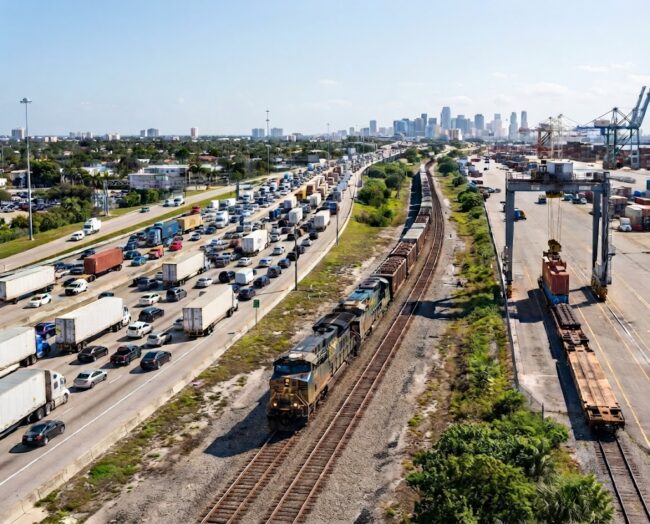
South Florida doesn’t have a trucking problem it can solve with a fancier truck. It has a capacity problem, a congestion problem, and a “we built our entire economy on moving cargo through two ports and onto crowded highways” problem. None of that gets fixed by swapping a diesel engine for a battery pack and calling it innovation.
Yet that’s exactly the pitch being sold up and down I-95: replace the region’s freight trucks with electric semis, and watch congestion, emissions, and costs disappear. It’s a nice story. It’s also wrong on the physics, wrong on the economics, and wrong about what South Florida actually needs, which is a serious commitment to freight rail, not a fleet of experimental big rigs chasing headlines.
Miami-Dade’s Real Bottleneck Isn’t the Engine
PortMiami and Port Everglades together move millions of containers a year, and nearly all of that cargo eventually funnels onto the same handful of arteries: I-95, the Turnpike, I-75, and I-595. Anyone who’s sat in Broward or Miami-Dade rush hour traffic behind a line of container trucks knows the problem isn’t what’s under the hood. It’s the sheer volume of trucks competing for the same lanes as millions of daily commuters.
An electric semi doesn’t take up less space on the Turnpike. It doesn’t move faster through the Golden Glades interchange. It doesn’t reduce the number of trips needed to clear a ship’s worth of containers. All it changes is the fuel source, while leaving the actual bottleneck completely untouched. If South Florida wants fewer trucks clogging the same overloaded corridors, the answer isn’t a cleaner truck. It’s fewer trucks, period, achieved by moving more freight onto rail lines that already run through the region.
The Battery Weight Nobody Wants to Mention
Here’s the inconvenient physics: hauling an electric semi’s battery pack costs cargo capacity. Batteries big enough to move a fully loaded trailer any meaningful distance are heavy, and every pound spent on lithium and cobalt is a pound that isn’t paying customer freight. For an industry that survives on tight margins and maximum payload per trip, that’s not a small tradeoff.
Add hours of charging downtime for a heavy-duty rig, and the math gets worse fast. A truck that carries less and needs to stop longer isn’t solving South Florida’s freight equation, it’s making it more expensive to solve. Meanwhile, a single freight train can move enormous tonnage using a fraction of the fuel a truck fleet would burn covering the same distance. That efficiency gap doesn’t need a technological breakthrough to close. It already exists, right now, on track that runs straight through Hialeah, Fort Lauderdale, and West Palm Beach.
Who’s Paying for All Those Charging Stations?
Running a fleet of electric semis up and down South Florida’s freight corridors means building megawatt-scale charging infrastructure roughly the size of a small substation, repeated at intervals along every major route. Florida Power & Light already manages a grid under real strain from summer heat and hurricane season. Layering a network of industrial-scale truck chargers on top of that isn’t a minor upgrade. It’s a massive, expensive undertaking, and it’s not the trucking companies who’ll be asked to fund it. That bill lands on ratepayers and taxpayers.
Compare that to how freight rail actually operates in this state. Florida East Coast Railway, CSX, and Brightline’s freight-adjacent corridor investments are funded with private capital, not public subsidy. These companies upgrade track, signals, and rail yards because it’s core to their business, not because a government grant told them to. If South Florida wants an infrastructure investment that doesn’t require reinventing the power grid, rail is already doing the work.
Reliability: Boring, but It Actually Works
When a diesel truck breaks down outside Homestead, there’s a mechanic within a few miles who can fix it. When an electric semi’s proprietary battery system or drivetrain fails, the options shrink dramatically, and so does the timeline for getting that freight moving again. In an industry defined by tight delivery windows, betting critical infrastructure on largely unproven, hard-to-service technology isn’t cutting edge. It’s a liability.
Rail doesn’t have that problem. It’s the oldest continuously refined freight technology in the country, and modern rail operations use scheduling systems, high-torque locomotives, and enormous economies of scale to move more tonnage more reliably than any trucking fleet, electric or otherwise. If South Florida’s business community actually wants supply chain resilience instead of just talking about it, rail is the boring, proven answer sitting right in front of them.
“Zero Emissions” Doesn’t Mean What the Ads Imply
The marketing around electric semis leans hard on “zero emissions,” and it falls apart the moment you look past the tailpipe. Building the battery means mining lithium, cobalt, and nickel, an environmentally intensive process by any measure. Then there’s the electricity itself. Florida’s grid still relies heavily on natural gas, so an electric truck plugged in near Fort Lauderdale is only as clean as the power plant supplying that charge.
None of that is a gotcha, it’s just arithmetic the glossy press releases skip. Freight rail, meanwhile, has spent decades wringing efficiency out of diesel-electric locomotives that already beat trucking on emissions per ton of freight moved by a wide margin, and the rail industry keeps investing in hybrid and hydrogen options for yard operations without needing a taxpayer-funded charging buildout to do it. If lowering freight’s environmental footprint is genuinely the goal, shifting volume onto existing rail capacity gets there faster and cheaper than waiting on a fleet of experimental trucks to mature.
The Money Argument Is Not Close
Set aside the physics and the environmental accounting for a second and just look at cost. Electric semis carry a steep upfront price premium over diesel trucks, before factoring in charging infrastructure, eventual battery replacement, and the lost revenue from reduced payload capacity. Scale that across a regional fleet serving Miami-Dade and Broward, add publicly funded charging buildout, and the price tag balloons for a technology that ultimately moves less freight, less reliably, than what it replaces.
Rail modernization is the opposite kind of investment. Expanding intermodal yard capacity near the ports, improving rail connections into inland distribution centers around Medley, Opa-locka, or northern Broward, and upgrading crossings and signaling are all investments in infrastructure that’s already proven and already generating economic returns. It’s not speculative. It’s not waiting on a battery chemistry miracle. It’s capacity expansion on a system that’s worked for a century, funded largely by the railroads themselves.
The jobs picture favors rail too. Rail careers tend to be stable, skilled, and better compensated than trucking, an industry notorious for brutal turnover and independent-contractor churn. Investing in rail capacity means investing in durable careers for South Florida workers, not just funding an experimental vehicle rollout.
What South Florida Should Actually Build
If the goal is a freight system that genuinely works better, cheaper, and cleaner, the priorities are straightforward. Public infrastructure money should go toward expanding rail capacity and port-to-rail connectivity, not toward building a charging network for trucks that haul less freight than they should. Getting containers off ships and onto trains quickly, rather than routing them straight into truck queues on the Turnpike, should be the default, not an afterthought. Cleaner locomotive technology, including hybrid and hydrogen options for yard switching, deserves support where it makes practical sense, instead of chasing a battery-truck narrative that doesn’t solve the fundamental capacity problem on South Florida’s highways.
Most of all, the region needs to stop treating “electric” as a stand-in for “innovative.” Real innovation is whatever actually solves the problem at the lowest cost and highest reliability, and in South Florida’s freight corridors, that’s rail sitting there underused, not a semi truck with a slick dashboard and a marketing budget.
Bottom Line
The Tesla Semi is an impressive piece of engineering and an even more impressive marketing campaign. But South Florida’s freight future shouldn’t be decided by which truck looks best in a promotional video. It should be decided by what actually clears cargo off the ports fastest, at the lowest cost, without asking an already-strained power grid to carry the load.
On every measure that matters, energy efficiency, infrastructure cost, reliability, job quality, and real environmental impact, rail wins, and it isn’t a close call. PortMiami and Port Everglades already sit next to rail lines built to handle exactly this job. South Florida doesn’t need a taxpayer-subsidized experiment in battery-powered trucking. It needs to finally put the rail capacity it already has to work.
About the Author