The New Rules of Reach: How Marketing Is Changing for Miami Businesses
Miami has always been a city that markets itself. The skyline, the beaches, the nightlife, the sense that something is always happening — for decades, businesses here could ride the momentum of a brand that belonged to the city itself. But the way Miami businesses reach customers is undergoing its most dramatic transformation in a generation, and the companies thriving right now are the ones that recognized early that the old playbook was expiring.
Two forces are driving this shift. The first is artificial intelligence, which has moved from a novelty to the operational core of modern marketing in a remarkably short span of time. The second is a broader change in consumer behavior — how people discover businesses, whom they trust, and what makes them buy — that has rewritten the strategies marketers rely on. For Miami businesses, from the family-run cafeteria in Hialeah to the fintech startup in Brickell, understanding both forces is no longer optional. It is the price of staying visible.
A Market Unlike Any Other
Before diving into the technology, it is worth pausing on what makes Miami such a distinctive marketing environment, because the changes sweeping the industry land differently here than they do in Denver or Dallas.
Miami is one of the most multilingual, multicultural major markets in the United States. A campaign that works has to consider not just English and Spanish, but the differences between Cuban, Colombian, Venezuelan, Brazilian, Haitian, and Argentine audiences — communities with distinct vocabularies, humor, media habits, and purchasing patterns. Portuguese and Haitian Creole are not afterthoughts here; they are market segments.
The city is also a magnet for transplants and transients. Between the post-2020 migration wave of finance and tech professionals from the Northeast and West Coast, the perennial flow of seasonal residents, and one of the country’s busiest tourism economies, a significant share of the people a Miami business wants to reach on any given day did not live here a year ago — or do not live here at all. That churn punishes businesses that rely on slow-building, word-of-mouth reputation alone and rewards those that can show up instantly in digital discovery channels.
Finally, Miami’s business community itself has changed. The city spent the last several years courting technology companies, venture capital, and crypto and fintech firms, and while the hype cycle has cooled from its peak, the lasting effect is a denser ecosystem of digitally native companies competing for the same attention. The bar for what counts as sophisticated marketing has risen across every industry, because the restaurant down the street may now be competing for eyeballs against a venture-backed startup with a full growth team.
AI Moves From Experiment to Infrastructure
The most consequential change in marketing over the past few years is that artificial intelligence stopped being a tool marketers experimented with and became the substrate on which marketing runs.
Consider content creation. Not long ago, producing a month of social media posts, email campaigns, and blog content required either a dedicated staff member or an agency retainer that many small Miami businesses could not justify. Today, generative AI tools can draft that content in minutes, and — critically for this market — they can do it fluently across languages. A restaurant owner in Little Havana can produce polished English and Spanish campaigns without hiring a bilingual copywriter, and can adjust the register of the Spanish depending on whether the audience skews Cuban-American or South American. The businesses getting the most out of these tools are not using them to replace human voice but to multiply it: the owner’s ideas and personality, produced at a volume and consistency that used to require a team.
The same transformation has hit visual content. AI image generation and editing tools have collapsed the cost of producing professional-looking creative assets. Product photography, social graphics, ad variations sized for every platform — work that once required a photographer, a designer, and days of turnaround can now be produced or heavily assisted by AI in an afternoon. For Miami’s visually driven industries — hospitality, real estate, fashion, fitness, nightlife — this is a genuine leveling of the playing field. The boutique hotel in Mid-Beach can now produce creative that stands next to what the major chains put out.
Then there is the analytical side, which may matter even more. Modern AI-powered marketing platforms can segment audiences, predict which customers are likely to churn, identify the best time to send an email to each individual subscriber, and automatically shift ad budget toward the creative and channels that are performing. This kind of predictive, self-optimizing marketing used to be the exclusive territory of enterprises with data science teams. It is now embedded in the tools small businesses already use — their email platform, their ad manager, their point-of-sale system. A med spa in Coral Gables can run marketing operations with a level of statistical sophistication that would have required a consultancy a few years ago.
Customer interaction has changed just as much. AI chat assistants have matured past the clunky decision-tree bots of the last decade into systems that can answer nuanced questions, book appointments, handle inquiries in multiple languages, and hand off gracefully to a human when needed. For businesses serving Miami’s tourist economy, an assistant that can respond instantly, at 2 a.m., in Portuguese, to a traveler planning a trip is not a gimmick — it is captured revenue that would otherwise have gone to a competitor who answered first.
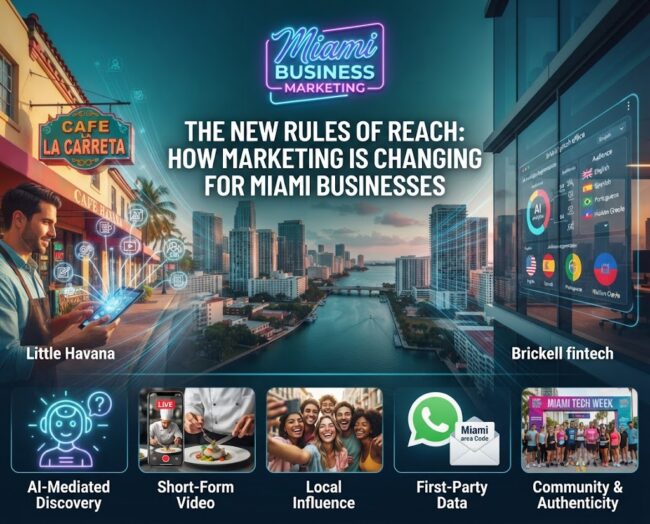
The Rise of AI-Mediated Discovery
There is a subtler shift underway that many business owners have not yet internalized: AI is changing not just how businesses market, but how customers find them in the first place.
For twenty years, digital marketing strategy revolved around the search engine results page. You optimized your website, bought your keywords, and fought for position. But a growing share of discovery now happens through AI assistants and AI-generated answers. When a visitor asks an AI assistant for the best Peruvian restaurant near Wynwood, or a new Brickell resident asks for a recommendation for a family dentist, there is no results page at all — there is an answer. Being that answer is the new version of ranking first.
This has given rise to what marketers are calling answer-engine or AI-search optimization: making sure a business’s information is accurate, consistent, and richly described everywhere AI systems learn from — business listings, review platforms, structured data on the company website, local press, and directories. The fundamentals overlap with traditional local SEO, but the emphasis shifts toward being genuinely well-documented and well-reviewed rather than gaming keywords. Reviews, in particular, carry more weight than ever, because AI systems lean heavily on them when characterizing a business. For a Miami restaurant or service business, a steady stream of detailed, recent, authentic reviews is now among the highest-return marketing assets it can build.
The implication is uncomfortable for businesses that coasted on thin websites and neglected listings: in an AI-mediated discovery landscape, an invisible or inconsistent digital footprint doesn’t just cost you ranking — it can mean you are simply never mentioned.
New Strategies for a New Attention Economy
Alongside the AI revolution, the strategic playbook itself has been rewritten. Several shifts stand out for Miami businesses in particular.
Short-form video became the default language of discovery. Platforms built on short vertical video are now, for younger consumers especially, the primary way to find restaurants, events, gyms, salons, and things to do. Miami is arguably the perfect city for this format — photogenic, event-dense, and full of personalities — and the local businesses winning attention are the ones treating video not as a polished ad product but as a steady stream of authentic glimpses: the chef plating a dish, the trainer mid-class, the before-and-after, the behind-the-scenes of an event build-out. Production value matters far less than frequency, personality, and the first two seconds.
The influencer economy went local and micro. The era of paying celebrities for reach has given way, especially for small and mid-sized businesses, to partnerships with micro- and nano-influencers — local creators with audiences in the thousands or low tens of thousands who have real credibility in a specific community. Miami’s creator scene is unusually deep, spanning food, fitness, nightlife, real estate, fashion, and Spanish- and Portuguese-language audiences that national campaigns routinely miss. A neighborhood restaurant collaborating with five trusted local food creators will typically outperform a single expensive placement, both in cost and in the quality of customers it brings through the door.
First-party data became the crown jewel. Privacy changes across the major platforms and the long erosion of third-party tracking forced marketers to stop renting audiences and start owning relationships. The practical result is a renaissance of channels that many had written off: email lists, SMS clubs, loyalty programs, and increasingly WhatsApp — which deserves special mention in Miami, where it is the dominant messaging platform for large parts of the Latin American diaspora and for international clientele. Businesses that build a direct line to their customers — a text club with real perks, a WhatsApp channel for VIP reservations, a loyalty program that actually rewards regulars — insulate themselves from algorithm changes and rising ad costs. AI amplifies this strategy by making it feasible to personalize those direct messages at scale, so the regular who always orders the same dish gets a different offer than the tourist who visited once.
Community and experience reclaimed center stage. Paradoxically, as marketing has become more digital and automated, the strategies generating the strongest loyalty are intensely physical: run clubs sponsored by local brands, chef collaborations and pop-ups, gallery nights, workshops, and neighborhood events. Miami’s calendar — Art Basel week, Miami Tech Week, food and wine festivals, boat shows, music festivals — offers small businesses constant opportunities to attach themselves to cultural moments. The modern twist is that these physical experiences are designed from the start to generate digital content: an event that produces a hundred attendee videos is simultaneously a community investment and a content engine.
Authenticity became a hard requirement, not a buzzword. As AI-generated content floods every channel, consumers have grown sharply better at detecting — and discounting — the generic. The winning response is not to avoid AI but to pair it with what AI cannot fake: a real owner on camera, real customers, real stories, a genuine point of view about the neighborhood and the city. In a market as culturally attuned as Miami, audiences reward businesses that demonstrate they actually understand the communities they serve, and they are quick to dismiss those that pantomime it.
What This Means in Practice
For a Miami business owner looking at all of this, the transformation can feel overwhelming, but the practical path forward is more straightforward than the landscape suggests.
The foundation is a clean, complete, consistent digital footprint: accurate listings, a website with clear structured information, and an active pipeline of authentic reviews. This single unglamorous investment now pays off across traditional search, maps, and AI-driven discovery simultaneously.
On top of that foundation, the highest-leverage move for most small businesses is adopting AI tools for the work that used to be bottlenecks — content drafting, translation and localization, ad optimization, customer messaging — while keeping a human hand firmly on voice and judgment. The goal is not automation for its own sake; it is redirecting the owner’s scarce time toward the things machines cannot do: relationships, hospitality, community presence, and taste.
Strategically, the throughline is ownership and locality. Own your customer relationships through direct channels rather than renting them from platforms. Root your marketing in the specific communities, languages, and neighborhoods you actually serve rather than broadcasting generically at “Miami.” Show up physically in the city’s cultural life, and let those moments feed your digital presence.
Looking Ahead
The pace of change is not slowing. AI agents that can plan, book, and purchase on a consumer’s behalf are beginning to emerge, which will raise new questions about how a business makes itself legible and attractive not just to human customers but to the software acting for them. Video will keep eating a larger share of attention. Personalization will keep getting more granular. And Miami will keep doing what it has always done — growing, churning, reinventing itself, and attracting the next wave of residents, visitors, and businesses.
What endures through all of it is a truth that predates every algorithm: businesses win by being genuinely known and genuinely trusted by the people around them. The tools for building that knowledge and trust have changed almost beyond recognition, and they will change again. But for Miami businesses willing to learn the new instruments, the song they are playing is the same one that has always worked in this city — be visible, be authentic, speak your customers’ language, and give people a reason to talk about you. Now the machines are listening, too.
About the Author