May 27, 2026
Miami has a reputation that scares a lot of parents away. The South Beach club scene, the late-night Brickell crowd, the occasional headline about a tourist running into trouble — it’s not the first city most middle-aged couples with young children picture for a family vacation. That’s a shame, because the Miami that actually works for families is one of the best long-weekend destinations in the country. You just have to know which Miami you’re booking.
This is a three-day plan for parents with two young kids (think roughly ages 3 to 10) who want a memorable trip, a manageable pace, and a high margin of safety. Every recommendation here leans toward family-tested venues, well-trafficked daytime areas, and neighborhoods where you don’t have to keep your guard up the entire time.
Where to Stay: Pick the Neighborhood, Not the Hotel
The single most important safety decision you’ll make is your zip code. Miami is a collection of very different neighborhoods, and where you sleep determines how the rest of the trip feels.
For families, three areas are tough to beat:
Key Biscayne. A barrier island connected to the mainland by a single causeway, Key Biscayne feels more like a small coastal town than part of Miami. It has calm beaches, two large state parks, almost no nightlife, and one of the lowest crime rates in Miami-Dade. The trade-off is distance — you’re a 15-to-25 minute drive from most attractions — but the trade is worth it for the nightly peace of mind.
Coconut Grove. Walkable, leafy, packed with cafés and small parks, and home to two excellent family restaurants. The Grove is one of Miami’s oldest neighborhoods and one of its most reliably pleasant. Strollers are everywhere. Crime is low. Restaurants close at reasonable hours.
Aventura / Sunny Isles (north). Quieter, more residential, and built around large family-oriented resorts. If you want a hotel pool and a water park within walking distance, this is the area. You’ll be a longer drive from downtown but closer to outlet shopping and the calmer northern beaches.
What to skip if you’re traveling with small children: South Beach south of 15th Street, Wynwood after dark, downtown Miami at night, and anywhere directly on Ocean Drive. None of these areas are dangerous in any general sense, but they’re loud, late, alcohol-soaked, and not built around the rhythm of a family with bedtimes.
Day One: Easing In With Science, Splash, and Sleep
Arrive late morning. Drop bags. Get the kids outside and moving — fighting jet lag or a long drive with screens is a losing battle.
Morning to early afternoon: Phillip & Patricia Frost Museum of Science. This is the strongest single attraction in Miami for kids in the 3-to-12 range. Three levels of aquarium exhibits, a planetarium, a deep-sea viewing lens that genuinely impresses adults, and enough hands-on interactivity to burn off two or three hours of energy. Parking is on-site in a clean garage at a flat rate, which is a small thing that matters a lot with kids in tow. Plan for three hours minimum.
Lunch: Fiore Caffe (downtown). A short drive from the museum, this is one of the highest-rated breakfast-and-lunch spots in Miami. The atmosphere is casual enough for kids, the food comes out fast, and the menu has enough variety that picky eaters won’t melt down. Get there before 1 PM to avoid a wait.
Afternoon: Hotel pool or quick rest. Don’t try to stack two big attractions in one day. Miami is hot, and a tired kid at 4 PM ruins a 7 PM dinner. Build in the break.
Dinner: Stay in your neighborhood. Wherever you’re based, eat within a five-minute drive. After a travel day, you want a short walk between car and bed.
Day Two: Beach Day Done Right
Miami beaches are the headline, but they’re not all created equal — especially for families with young children. The right beach is the difference between a perfect day and a stressful one.
Skip: Ocean Drive beaches in South Beach. They’re fine, but they’re crowded, the water can be choppy, parking is a nightmare, and the surrounding scene isn’t built for kids.
Go to one of these instead:
Crandon Park (Key Biscayne). Two miles of clean sand, calm shallow water protected by an offshore sandbar, plentiful parking at about $11 per car for the whole day, clean bathrooms, picnic areas, and cabana rentals. The water stays warm later into the season than open Atlantic beaches because of the protection. This is the most family-friendly beach in Miami-Dade, full stop.
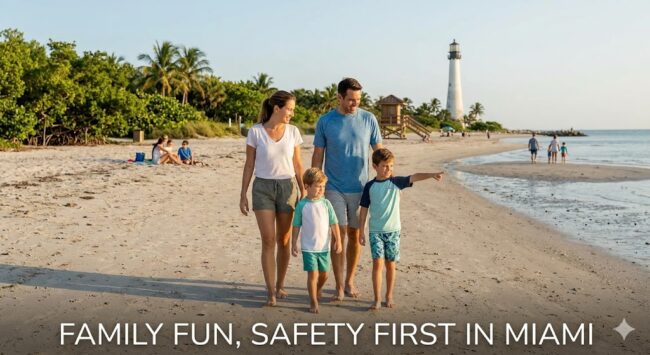
Bill Baggs Cape Florida State Park (Key Biscayne). A state park at the southern tip of the island with a historic lighthouse, a beach café, picnic shelters, and nature trails through coastal hammock. Slightly more rustic than Crandon, and the lighthouse climb (when open) is a memorable extra. Entry is a small state park fee per vehicle.
Key Biscayne Beach. Calm water, lighthouse views, no alcohol allowed — which keeps the crowd skewing toward families.
Practical safety basics that matter more in Florida than people realize: reef-safe sunscreen reapplied every 90 minutes, water shoes for the kids (Florida sand can hide shell fragments and the occasional jellyfish), a beach umbrella rather than just a hat (the UV index in Miami sits in the “extreme” range much of the year), and a designated meeting spot the moment you arrive in case a kid wanders. Lifeguards are present at Crandon and Bill Baggs during posted hours — verify before you let kids in the water.
Lunch at the beach. Pack it. The on-site cafés are fine but slow, and a sandy stroller plus a hungry four-year-old in a 25-minute line is exactly the situation to engineer around.
Late afternoon: Head back to your hotel. Most families with young kids will be cooked by 3 PM. Trying to push through to a 6 PM activity is when things fall apart.
Dinner: Glass & Vine (Coconut Grove). A casual outdoor restaurant in a leafy park setting, with a separate kids’ menu, plenty of space for restless little ones, and food that actually impresses adults. It’s a 15-to-20 minute drive from Key Biscayne and one of the most family-pleasant dinner spots in the city.
Day Three: A Slower, Stranger, More Memorable Day
The third day is the one most families overplan. The trick is to pick one signature experience and let the rest of the day unfold around it.
Morning option A: Miami Children’s Museum. For families with kids on the younger end (3 to 8), this is the strongest pick. Hands-on exhibits across multiple themes — a pretend grocery store, a music studio, an art room, a fitness area, a recreated ship — and a layout that lets kids dictate the pace. Plan for two to three hours. It’s across the causeway on Watson Island, right next to Jungle Island.
Morning option B: Jungle Island. For families with older kids (6 to 12) who prefer animals over interactive play. Capybaras, parrots, lemurs, and a treetop adventure course for the brave. It’s smaller than a major zoo, which is actually a plus with young kids — you can see it all without exhausting anyone.
Morning option C: Paradox Museum Miami (Wynwood, by day). Optical illusions, photo-friendly installations, mind-bending rooms. It’s small (about 90 minutes), highly rated, and a great rainy-day backup. Wynwood by daytime is safe and stroller-friendly; just don’t linger after dark.
Lunch: Wherever you are. If you’re at the Children’s Museum or Jungle Island, you’re on the causeway — a good option is to drive ten minutes to a casual Brickell or downtown spot for a quick bite. If you’re in Wynwood, you’ll find dozens of family-friendly cafés within walking distance.
Afternoon: Pool, easy walk, or a quick stop somewhere mellow. South Pointe Park at the southern tip of Miami Beach is a strong, often-overlooked pick — it has a playground, a water-play feature for hot days, paved paths for stroller pushing, and views of cruise ships entering and leaving the port. Flamingo Park in South Beach is another good playground option, slightly inland and safer-feeling than the Ocean Drive area.
Dinner: Early and casual. You’re flying out (or driving out) tomorrow. The right move is a 5:30 or 6 PM dinner near your hotel, the kids in bed by 8, and the parents getting actual sleep before travel.
Safety Rules That Apply Every Day
A few habits that turn an okay Miami trip into a low-stress one:
Drive, don’t walk, between neighborhoods. Miami is not a walking city outside of small pockets (Coconut Grove, parts of South Beach during the day, Key Biscayne). Distances are deceptive on a map, and crossing major roads with young kids is genuinely hazardous. Uber, Lyft, and rental cars are how locals move.
Stick to daytime in Wynwood, the Design District, and downtown. All three are excellent during business hours and meaningfully different after dark.
Use the hotel parking valet. It’s worth the $30 to not be hunting for street parking with two kids in the back seat after a long day.
Lock the car. Visibly empty. Car break-ins are the most common tourist crime in Miami. Leave nothing visible — not a beach bag, not a stroller, not a charging cable.
Sun and water are the actual risks, not crime. The statistical risks to kids on a Miami trip are sunburn, dehydration, riptides, and traffic — in that order. Plan around those four and you’ve covered 95% of what could go wrong.
Carry water everywhere. South Florida heat is deceptive. By the time a small kid says they’re thirsty, they’re already dehydrated. Every bag should have a bottle.
Have a “lost kid” plan before you need one. Before entering any crowded venue — beach, museum, park — agree on a meeting spot and make sure each child knows your phone number or has it written somewhere they can find. A photo of each kid in the outfit they’re wearing that day, taken on your phone that morning, is the simplest piece of advice that actually matters if something happens.
What This Trip Actually Costs
A weekend like this — three nights, mid-tier family hotel, rental car, attractions, meals — runs roughly $1,800 to $3,500 for a family of four depending on the season and how aggressively you book. Key Biscayne and Coconut Grove hotels are pricier than the Aventura area but save you driving time. Booking attractions in advance (especially Frost Science) is worth doing.
The Honest Bottom Line
Miami is not a difficult city for a family to enjoy. It’s a city where the difference between a great weekend and a stressful one is mostly geographic — which neighborhood you sleep in, which beach you pick, when you head home each day, and how willing you are to let the trip move at a kid’s pace rather than an Instagram pace.
Pick Key Biscayne or Coconut Grove. Build the trip around two big attractions and one great beach. Eat early. Drive between neighborhoods. Leave the late-night Miami to the people who came for it. Do that, and you’ll come home with a weekend’s worth of stories your kids will actually remember — and none of the ones you were worried about.
About the Author