How the 2026 World Cup Conquered South Florida — and How South Florida Conquered It Right Back
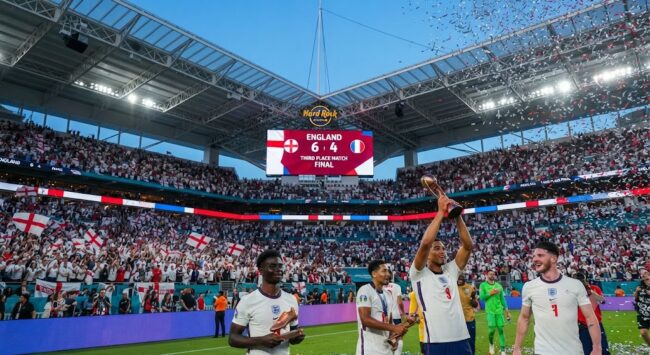
When the final whistle blew at Miami Stadium on the evening of July 18, 2026, it closed the highest-scoring third-place match in World Cup history — England 6, France 4 — and ended a thirty-four-day stretch in which Miami hosted seven matches of the biggest sporting event on earth. The scoreboard told one story. The concourses, the parking lots turned into flag-draped villages, the packed Brightline trains, and the 600,000 people who streamed through a transformed Bayfront Park told a bigger one: somewhere between a quiet Monday opener in June and a ten-goal thriller in July, international fans fell for Miami, and Miami — a city that has hosted eleven Super Bowls without ever quite belonging to any single sport — fell all the way for the World Cup.
This is the story of those seven matches, and of the city around them.
A Long Time Coming
The romance had history behind it. When the United States hosted the 1994 World Cup, Miami was passed over — a snub that stung for three decades in a metropolitan area whose population is stitched together from the world’s most football-mad nations. So when FIFA awarded Hard Rock Stadium (renamed the neutral “Miami Stadium” for the tournament, per FIFA’s sponsorship rules) a seven-match slate — four group games, a Round of 32 tie, a quarterfinal, and the bronze final — local organizers understood exactly what they’d been handed. Only the final cities of Dallas, Los Angeles, and New York/New Jersey carried more late-tournament weight. Miami Host Committee co-chair Rodney Barreto framed the assignment simply: this is what South Florida does best, and the region prepared for the equivalent of seven Super Bowls compressed into a single month.
The stadium itself, configured to roughly 64,000 seats for the tournament, had spent years auditioning — Copa América in 2024, eight Club World Cup matches in 2025 — so the venue was proven. The open question was the experience around it: could a car-bound, summer-scorched, thunderstorm-prone metropolis deliver a World Cup that felt like a festival rather than a logistics exercise? By July 18, the answer was in.
Match One — June 15: Saudi Arabia 1, Uruguay 1
Miami’s World Cup began not with fireworks but with a handshake — a 1-1 draw between Saudi Arabia and Uruguay in the Group H opener. As a match, it was cagey; as an occasion, it was a revelation. Uruguayan sky blue poured into Miami Gardens from every corner of a region that functions as a second capital for half of South America, while the traveling Saudi support brought drums, green, and genuine noise. First-time World Cup attendees discovered what veterans already knew: the event outside the stadium — the flags, the singing, the impromptu games of keep-up in the parking lots — is half the show. Miami had thirty-three days of it ahead.
Match Two — June 21: Uruguay 2, Cape Verde 2
Six days later came the match that gave Miami its adopted team. Cape Verde — an island nation of about half a million people, playing in its first World Cup — walked into Miami Stadium against two-time champions Uruguay and refused to be a footnote, battling to a 2-2 draw that sent shockwaves through Group H. The Cape Verdean diaspora, with deep roots in the eastern United States, turned their section into a carnival, and neutral Miami — a city that understands island pride in its bones — adopted the Blue Sharks on the spot. The point would prove decisive: Cape Verde advanced out of the group as runners-up, meaning the debutants’ fairy tale would return to Miami in the knockout rounds. The city already had a rooting interest.
Match Three — June 24: Brazil 3, Scotland 0
Then came the invasion nobody in South Florida will forget: the Tartan Army. Scotland had waited twenty-eight years to return to a World Cup, and its supporters treated the pilgrimage accordingly — thousands upon thousands of Scots in kilts, traffic cones worn as hats, bagpipes on Ocean Drive, choruses echoing through Fort Lauderdale bars for days before kickoff. Families described dragging their kids across the Atlantic for a once-in-a-lifetime chance to see their nation on this stage. Facing them: Brazil, five-time champions, effectively playing a home game in a city with one of America’s largest Brazilian communities.
The collision of yellow and tartan produced the group stage’s defining Miami spectacle. Downtown, the FIFA Fan Festival at Bayfront Park hit capacity and had to close its gates before 6 p.m. — police announced the shutdown on social media as thousands more massed outside. On the pitch, the football was one-sided: Brazil won 3-0 with the kind of controlled brilliance that ended Scottish hopes but not Scottish singing, which reportedly continued well into the South Beach night. Ask locals for their favorite memory of the group stage, and an enormous number will tell you about Scots — gracious in defeat, generous in the bars, and universally beloved by the city they briefly occupied.
Match Four — June 27: Portugal 0, Colombia 0
If Brazil-Scotland was Miami’s party, Portugal-Colombia was its family reunion. No fanbase in South Florida runs deeper than the Colombian community, and the Group K showdown against Cristiano Ronaldo’s Portugal was the tournament’s hottest local ticket from the moment the draw was made. The match itself finished 0-0 — a tense, tactical standoff between two sides unwilling to blink with the group lead at stake — but the atmosphere bore no resemblance to the scoreline. Yellow shirts owned the stadium, Portuguese red answered in waves, and the noise at every half-chance rattled around the canopy like a knockout tie. It was the night that settled a question visiting journalists had been asking all month: could American crowds generate genuine World Cup atmosphere? In Miami, the question was retired.
Match Five — July 3: Argentina 3, Cape Verde 2
The knockout rounds opened with the storybook nearly rewriting itself. The Round of 32 delivered Miami a gift: Argentina — the defending champions, with Lionel Messi playing his club football twenty miles away for Inter Miami — against Cape Verde, the city’s adopted underdogs, back in the building where their fairy tale began. What followed was the group-stage draw’s magic stretched to its absolute limit: the islanders traded blows with the world champions and fell 3-2 in a match that had a sold-out stadium — split between Argentina’s massive local support and everyone else on earth pulling for the debutants — on its feet for the final half hour. Argentina survived and marched on; they haven’t lost since, and play Spain in the final at MetLife Stadium the day after Miami’s tournament closed. Cape Verde went home having beaten expectations, charmed a continent, and given Miami two of its most emotional nights.
Match Six — July 11: England 2, Norway 1
By quarterfinal weekend, the tournament’s center of gravity had shifted to South Florida. Eight teams remained, and Miami drew England against Norway — the Three Lions against Erling Haaland’s golden generation, in the Norwegians’ first deep World Cup run in a generation. The stakes transformed the crowd: this was the tournament’s investment class, fans who had planned for months and crossed oceans for a single ninety minutes, layered over England’s enormous expat presence along the Florida coast. England ground out a 2-1 win — enough to send them to a semifinal against Argentina in Atlanta — while Norway’s supporters, red-shirted and gracious, joined the summer’s long list of fanbases who arrived as visitors and left as regulars at Bayfront Park. Nobody knew it yet, but Miami had not seen the last of England.
Match Seven — July 18: England 6, France 4 — History
England lost that semifinal to Argentina, France lost theirs to Spain, and so the bronze final on July 18 handed Miami a farewell fixture beyond any organizer’s dreams: England versus France, Bellingham and Saka versus Mbappé, in the last match either nation would play all summer.
Third-place matches are famously loose — played by teams with nothing left to protect — and this one detonated. Thomas Tuchel rotated his England side, resting captain Harry Kane and benching Jude Bellingham; Didier Deschamps, managing France for the final time after fourteen years in charge, refreshed his lineup around captain Kylian Mbappé. None of the caution mattered. Declan Rice thundered a shot in from the top of the box inside three minutes. Ezri Konsa headed in from a corner soon after. Bukayo Saka struck twice before the interval, and England walked into halftime 4-0 up in a match that appeared over.
Then France staged one of the great doomed comebacks in tournament history. Mbappé scored twice — his second, in the 66th minute, was the 22nd World Cup goal of his career, breaking the all-time record he had shared with Messi, and his 10th of the tournament, seizing command of the Golden Boot. Bradley Barcola pulled another back, and a stadium that thought it was watching a coronation was suddenly watching a cliffhanger. Saka completed his hat trick from the penalty spot in the 87th minute; Ousmane Dembélé answered in stoppage time; Bellingham, on as a substitute, applied the final flourish in the 97th. England 6, France 4 — ten goals, eclipsing the nine-goal record set by France and West Germany in 1958, and England’s first World Cup bronze ever after third-place defeats in 1990 and 2018.
Miami’s World Cup thus ended with a match that will be replayed for as long as the tournament exists. The city that waited three decades for a World Cup closed its account with a piece of the record book.
The Second Stadium: 600,000 at Bayfront Park
For every fan inside Miami Stadium, many more experienced the tournament downtown — and this is where the city’s World Cup truly lived. The official FIFA Fan Festival transformed more than 436,000 square feet of Bayfront Park into what organizers billed as a second stadium: giant LED screens carrying every match of the tournament, a 10,000-seat amphitheater staging concerts and cultural showcases, food stalls representing the cuisines of the competing nations, and turf laid across the park to simulate a pitch beneath the downtown skyline.
The numbers exceeded projections. More than 45,000 people came through on opening day alone — Pitbull, inevitably and perfectly, headlined the opening night — and by the time the festival closed after twenty-four days, extended an extra day by demand, attendance had surpassed 600,000, making it one of the largest sustained public gatherings in the city’s history. On Miami match days the park routinely swelled past 30,000; for Brazil-Scotland it reached capacity and closed. When the U.S. men’s team played across the country, Bayfront roared like a home end — through a red-flag weather delay against Bosnia, through line-dancing and own-goal pandemonium against Australia.
What visitors kept remarking on, though, wasn’t the scale — it was the mixture. A Haitian fan at a Brazil watch party captured the consensus: no ticket, no problem — the energy at the park rivaled the stadium, surrounded by fans of every nation at once. A Colombian supporter came to cheer Brazil and marvel at cone-hatted Scots. A Costa Rican attendee admitted he barely followed the sport and came for the humanity of it. In most host cities, the Fan Festival supplemented the World Cup. In Miami — where the crowd itself was Colombian, Venezuelan, Brazilian, Argentine, Haitian, Portuguese, Uruguayan, and fifty other things simultaneously — the festival was the World Cup, a month-long demonstration that this city doesn’t host international events so much as recognize itself in them.
Honesty requires the caveats: the summer was punishingly hot, and attendees questioned whether the park offered enough shade and cooling for the crush of bodies; afternoon thunderstorms forced at least one evacuation before crowds flooded back with the sun. South Florida’s climate negotiated with no one. The fans came anyway, in numbers that broke the projections.
The Brightline Experiment
Miami’s most-doubted variable heading into the tournament was the journey itself. Miami Stadium sits in Miami Gardens, fourteen-plus miles north of downtown, in a famously transit-thin corridor — and the pre-tournament guides were blunt about severe match-day traffic. The city’s answer became one of the tournament’s quiet logistical successes: the Brightline intercity rail, running from downtown Miami (and from Fort Lauderdale, Boca Raton, and West Palm Beach) to Aventura Station, connected to the stadium by free shuttles. From the heart of downtown, the combination delivered fans to the gates in roughly twenty-five air-conditioned minutes — a seamless routine that international visitors, accustomed to rail-served stadiums at home, adopted instantly and praised loudly. It did not solve every car-bound headache, and the parking lots still filled hours before kickoff, but it proved something with implications beyond soccer: South Florida can move a World Cup crowd without a highway meltdown, when the rails and the planning align.
The Ritual of a Miami Match Day
By the third fixture, a distinct Miami match-day liturgy had emerged, and visiting fans slid into it like regulars. It began downtown, hours before kickoff, at Bayfront and the surrounding blocks — jerseys of six nations at every café table, drummers laying down rhythms that changed nationality corner by corner. It moved north in waves: the Brightline platforms a sea of colors, the shuttle queues at Aventura turning into singalongs, the stadium’s vast parking acreage blooming into a tailgate unlike any the NFL ever staged there — less grill smoke, more flag capes; fewer cornhole boards, more improvised rondos played to phone-speaker cumbia.
The stadium’s signature canopy — engineered years earlier to shade South Florida crowds — earned its keep in June and July, and the tournament’s afternoon and evening kickoff slots spared fans the worst of the sun even as humidity remained the undefeated opponent. Veteran World Cup travelers, comparing notes across host cities, consistently ranked the Miami Gardens bowl among the loudest of the tournament for South American fixtures — an assessment locals who remembered Copa América nights found entirely unsurprising. And when the whistle blew, the liturgy ran in reverse: back down the rails, back to Bayfront, back to neighborhoods across three counties where the night’s result was re-litigated in Spanish, Portuguese, Creole, and broad Glaswegian until closing time.
The Ripple Across Three Counties
Though the matches belonged to Miami Gardens and the festival to downtown, the tournament’s footprint covered the whole of South Florida. Fort Lauderdale’s beach bars became unofficial Tartan Army headquarters. West Palm Beach and Boca Raton filled with traveling supporters who discovered that a Brightline ticket made the entire coast one extended host city. Hotels from the Keys to Palm Beach County reported the kind of summer occupancy the region usually only dreams of in low season; restaurants added match screenings the way they add happy hours; jersey and merchandise sellers, official and otherwise, did five weeks of business that retailers will be chasing again for years.
Harder to measure, and more valuable, was the audition the region passed in front of a global audience. For five weeks, international broadcasts framed South Florida not through hurricanes or headlines but through full stadiums, packed waterfront celebrations, and functioning logistics — a months-long advertisement, delivered match by match, to precisely the international travelers and event organizers the region courts. Eleven Super Bowls taught South Florida how to host America. The summer of 2026 was its proof of concept for hosting the world — and the bid portfolios for future finals, club tournaments, and international fixtures now carry seven matches of evidence.
Why They Fell in Love
Strip away the scorelines and a pattern runs through every visiting fanbase’s account of the month. The Scots found a city that partied with them harder than they partied. The Cape Verdeans found sixty thousand neutrals adopting their team. The Uruguayans, Colombians, Brazilians, and Argentines found something rarer: a World Cup abroad that felt like a World Cup at home, in a metropolis where their language, food, and flags aren’t tourist novelties but the fabric of the place. England’s supporters got two matches, a bronze medal, and a beach. And the football-curious locals — the ones who wandered into Bayfront Park with no allegiance — found what converts always find at a World Cup: that the sport is the pretext, and the gathering is the point.
Miami offered the amenities every guide promised — the beaches, the nightlife, the new FIFA museum at the Freedom Tower, the Bayside waterfront humming between matches. But amenities don’t explain a love affair. What explains it is fit. The World Cup is the planet’s festival of overlapping identities, and it landed in the American city most fluent in exactly that. International fans fell in love with Miami because Miami, uniquely among the sixteen host cities, didn’t have to perform internationalism for a month. It just had to be itself, with a tournament attached.
What Remains
The legacy questions will be answered over years — whether the transit lessons stick, whether the youth pipelines fed by a month of gospel-spreading produce players, whether the city leverages seven matches into the permanent big-event soccer status it has chased since 1994 passed it by. But some verdicts are already in. Miami staged a group-stage slate that produced the tournament’s best traveling-fan story, a knockout run that gave the champions-elect their fright and the debutants their legend, and a finale that rewrote a sixty-eight-year-old record. It moved more than half a million people through a downtown festival, absorbed the heat and the storms, and sent every fanbase home planning a return trip with no match attached.
Thirty-two years ago, the World Cup came to America and skipped Miami. In 2026 it came back, stayed five weeks, and left behind a city that no longer needs to argue it belongs on football’s map. The ten-goal roar that shook Miami Gardens on July 18 was the sound of the case closing.
About the Author