May 7, 2026
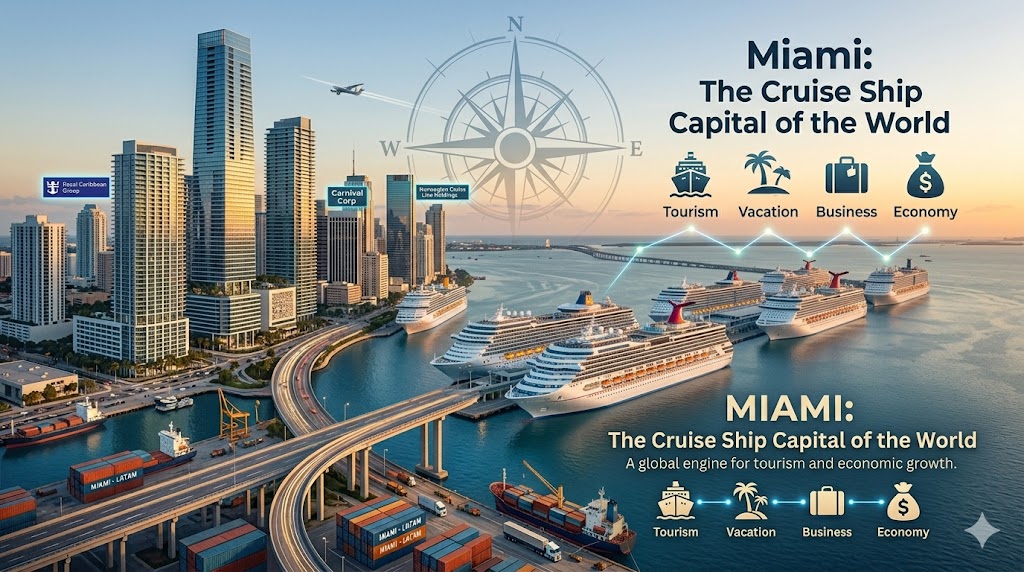
If you’ve ever stood on the MacArthur Causeway looking out toward Biscayne Bay on a Saturday morning, you’ve witnessed something genuinely remarkable.
Six. Seven. Sometimes eight massive cruise ships, each holding thousands of passengers, lined up along PortMiami’s docks like a fleet of floating cities. The combined passenger capacity of those vessels on a single morning can exceed 40,000 people — more than the population of many American small cities — preparing to embark on Caribbean voyages, transatlantic crossings, and increasingly creative itineraries that span virtually every region of the global ocean.
That scene plays out week after week, year after year, in Miami in a way that simply doesn’t happen anywhere else in the world.
Miami isn’t just a major American cruise port. Miami is the cruise capital of the United States, the cruise capital of the world, and one of the most consequential maritime tourism economies anywhere on Earth.
PortMiami — officially the Cruise Capital of the World — handles more cruise passengers than any port on the planet, serving as homeport to the largest cruise lines, the largest ships, and the most consequential cruise industry headquarters in existence. The economic impact of this industry on Miami, on Florida, on the Caribbean, and on the broader American tourism economy is enormous and growing.
How Miami Became the Cruise Capital of the World
Miami’s emergence as the world’s dominant cruise port wasn’t accidental. It resulted from a combination of geography, infrastructure, industry strategy, and decades of deliberate civic investment.
Geographic Position
Miami sits at the optimal geographic position for Caribbean cruising — close enough to major Caribbean destinations (the Bahamas, Cuba historically, Jamaica, the Cayman Islands, the eastern and western Caribbean) to enable 3-7 day round-trip itineraries, while remaining accessible to the enormous American population centers along the Eastern Seaboard, the Midwest, and beyond. The port can support both short Bahamas cruises and longer Caribbean expeditions without requiring extended ocean transit time.
Year-Round Operating Climate
Unlike northern ports that face winter weather constraints, Miami operates year-round with weather conditions appropriate to cruise tourism in essentially every season. The summer hurricane season requires careful operational planning, but even during peak hurricane months, Miami remains a viable cruise homeport.
Modern Port Infrastructure
PortMiami has been the beneficiary of decades of capital investment building world-class cruise terminal infrastructure. Multiple modern terminals capable of handling the largest cruise ships in the world, sophisticated passenger processing systems, integrated transportation connections, and the kind of operational scale that simply doesn’t exist at most other US ports.
Airport Connectivity
Miami International Airport — one of the busiest airports in the United States and one of the most internationally connected — provides cruise passengers from across the country and around the world with direct flight access to PortMiami. The combination of MIA and Fort Lauderdale-Hollywood International Airport gives the broader region exceptional aviation connectivity.
Industry Concentration
Miami became home to the major cruise line corporate headquarters — including Carnival Corporation, Royal Caribbean Group, and Norwegian Cruise Line Holdings — creating an industry concentration where decision-makers, executives, technical experts, vendors, and service providers all operate in close proximity. That concentration produces innovation, efficiency, and continued investment that reinforces Miami’s position.
Hospitality Infrastructure Around the Port
The hotel, restaurant, transportation, retail, and entertainment infrastructure across Miami Beach, Brickell, downtown, and the broader metro provides cruise passengers with extraordinary pre- and post-cruise options — extending the economic impact of cruise tourism well beyond the ship itself.
Caribbean Cultural Integration
As detailed in earlier articles, Miami’s deep cultural integration with the Caribbean and Latin American region — bilingual workforce, cultural fluency, family connections, and broader hemispheric integration — creates a natural alignment with cruise itineraries serving these regions.
Continuous Capital Investment
PortMiami has continued attracting major capital investment from cruise lines, the County, and private partners — building new terminals, expanding capacity, modernizing infrastructure, and ensuring the port remains capable of handling the largest and most sophisticated vessels the industry continues launching.
The result is one of the most operationally complete cruise ports anywhere in the world — and one whose competitive advantages keep compounding rather than eroding.
Brian’s Take: Miami’s Cruise Industry Is the Most Underappreciated Florida Tourism Story.
Most people think of Miami’s tourism economy in terms of beaches, hotels, restaurants, and nightlife — but the cruise industry quietly anchors a substantial portion of the city’s tourism activity, generates billions in annual economic impact, employs tens of thousands of people directly and indirectly, and projects Miami’s brand globally to tens of millions of cruise passengers every year. The fact that PortMiami is genuinely the cruise capital of the world, and that the major cruise lines are all headquartered in or near the city, gives Miami a structural tourism advantage that no other American city comes close to matching.
— Brian
PortMiami: The Cruise Capital of the World by the Numbers
Let’s look at what makes PortMiami so consequential:
Passenger Volume
PortMiami consistently handles more than 7 million cruise passengers annually, making it the busiest cruise port in the world for many consecutive years. Peak annual passenger volume has approached or exceeded 8 million passengers during recent strong years, with continued growth projected through 2030 and beyond.
Ship Calls and Capacity
The port handles thousands of cruise ship calls annually, with multiple major cruise lines operating year-round homeport operations. The port’s terminal infrastructure can simultaneously accommodate multiple Oasis-class and Icon-class megaships — the largest cruise ships ever built — alongside additional vessels of varying sizes.
Global Brand Position
PortMiami has been formally recognized as the “Cruise Capital of the World” for decades — a designation that reflects both passenger volume and the concentration of cruise industry corporate headquarters, vessel deployment, and industry leadership operating from the port.
Economic Impact
The cruise industry generates billions of dollars in annual economic impact for Miami-Dade County, supporting tens of thousands of jobs directly through the port and cruise lines, and many more thousands indirectly through hospitality, transportation, retail, and service industries supporting the cruise economy.
Workforce
PortMiami’s broader operations — including cruise, cargo, and supporting industries — anchor a workforce of more than 300,000 jobs across the regional economy when including direct, indirect, and induced employment. The cruise component specifically supports a substantial portion of this employment.
Capital Investment
Recent and ongoing capital investments at PortMiami include major terminal expansions and modernizations totaling hundreds of millions of dollars, ensuring the port can accommodate the next generation of even larger cruise vessels.
Carbon and Sustainability Investment
Major investment in shore power, alternative fuel infrastructure, and sustainability initiatives reflects the cruise industry’s increasing focus on environmental performance — and PortMiami’s role as a leader in implementing these capabilities.
The Major Cruise Lines Headquartered in or Operating from Miami
The cruise industry’s corporate concentration in Miami is one of the most distinctive features of the city’s economy. The world’s three largest publicly traded cruise companies are all headquartered in Miami or the immediate surrounding area:
Carnival Corporation & plc
Headquarters: Doral, Florida (immediately adjacent to Miami) Major Cruise Brands: Carnival Cruise Line, Princess Cruises, Holland America Line, Cunard Line, Costa Cruises, AIDA Cruises, P&O Cruises, P&O Cruises Australia, and Seabourn
Carnival Corporation is the largest cruise company in the world, operating one of the most extensive fleets in maritime history. Carnival Corporation’s brands collectively serve millions of passengers annually across virtually every major cruise market segment — from value-priced family cruising through Carnival Cruise Line to ultra-luxury experiences through Seabourn.
The corporation’s Doral headquarters anchors thousands of corporate jobs, and the substantial Carnival Cruise Line homeport operations at PortMiami make the company one of the port’s largest tenants.
Royal Caribbean Group
Headquarters: Miami, Florida (PortMiami area) Major Cruise Brands: Royal Caribbean International, Celebrity Cruises, and Silversea
Royal Caribbean Group is one of the most innovative cruise companies in the world, operating the largest cruise ships ever built including the Icon-class vessels that exceed 250,000 gross tons. The company’s flagship Miami headquarters anchors thousands of corporate jobs, and its substantial homeport operations at PortMiami include some of the largest cruise vessels currently operating anywhere on Earth.
Royal Caribbean’s continued investment in cutting-edge ship technology, sustainability, and passenger experience makes it one of the most consequential drivers of cruise industry innovation globally.
Norwegian Cruise Line Holdings
Headquarters: Miami, Florida Major Cruise Brands: Norwegian Cruise Line, Oceania Cruises, and Regent Seven Seas Cruises
Norwegian Cruise Line Holdings operates across multiple cruise market segments — from contemporary cruising through Norwegian Cruise Line to premium experiences through Oceania Cruises to ultra-luxury all-inclusive cruising through Regent Seven Seas Cruises. The company’s Miami headquarters anchors substantial corporate operations, and its PortMiami homeport operations are a major component of the port’s overall traffic.
MSC Cruises
Headquarters: Geneva, Switzerland (with major U.S. operations in Fort Lauderdale, Florida) Operating Brand: MSC Cruises
While MSC Cruises is headquartered internationally, the company’s U.S. operations are anchored in Fort Lauderdale immediately north of Miami, and its substantial PortMiami homeport operations make it a major presence at the port.
Virgin Voyages
Headquarters: Plantation, Florida (just north of Miami) Operating Brand: Virgin Voyages
Sir Richard Branson’s adult-only cruise line operates substantial homeport operations from PortMiami, with corporate operations anchored in the broader South Florida area.
Disney Cruise Line
Headquarters: Celebration, Florida (Central Florida) Operations: Disney operates substantial cruise operations from Port Canaveral primarily, but maintains relationships with the broader Florida cruise industry ecosystem.
The corporate concentration of these cruise lines in Greater Miami creates an industry cluster effect that reinforces the city’s position as the cruise capital — corporate executives, vendors, suppliers, technology partners, and the entire supporting ecosystem all operate in proximity.
Brian’s Take: The Cruise Industry’s Corporate Concentration in Miami Is One of the Most Strategically Valuable Industry Clusters in Florida.
When the world’s three largest publicly traded cruise companies are all headquartered in or immediately adjacent to Miami, the network effects, vendor ecosystems, talent pools, and continued reinvestment that flows from that concentration are extraordinary. Major industry clusters like this — Detroit for auto manufacturing in the 20th century, Houston for energy, Silicon Valley for tech — define their regions for generations, and Miami’s cruise industry cluster is producing exactly that kind of compounding regional advantage that will continue to strengthen the city’s economy for decades to come.
— Brian
The Massive Investment Reshaping PortMiami
PortMiami has been the beneficiary of major capital investment throughout the 2020s, and that investment continues into the late 2020s with multiple expansion projects at various stages.
Major Terminal Investments
Cruise lines and the County have invested heavily in modern cruise terminals capable of handling the largest vessels and the highest passenger volumes. Recent and ongoing major terminal projects include investments by Royal Caribbean, Carnival, Norwegian, Virgin Voyages, MSC, and others — collectively reshaping the port’s operational capacity.
Royal Caribbean’s Major Terminal Investments
Royal Caribbean Group has invested heavily in PortMiami terminal infrastructure, including major terminal facilities designed to accommodate the company’s largest ships and provide premium passenger experiences before and after cruises.
MSC Cruises Terminal Investment
MSC Cruises has made significant investments in PortMiami terminal infrastructure to support the company’s growing North American cruise market presence.
Norwegian’s Operational Expansions
Norwegian Cruise Line Holdings continues investing in operational infrastructure supporting its substantial PortMiami homeport activities.
Carnival’s Continued Investment
Carnival Corporation’s substantial PortMiami operations continue to receive ongoing capital investment supporting the company’s varied cruise brand operations.
Virgin Voyages Terminal
Virgin Voyages established sophisticated terminal infrastructure at PortMiami supporting the brand’s distinctive adult-only cruise experiences.
Sustainability and Shore Power
Major investments in shore power infrastructure allowing cruise ships to plug into electrical power while docked — reducing emissions during port stays — represent significant environmental investments. Combined with alternative fuel infrastructure investments supporting LNG-powered vessels and the eventual transition to even cleaner fuels, PortMiami is positioning itself as a leader in cruise industry sustainability.
Connectivity Improvements
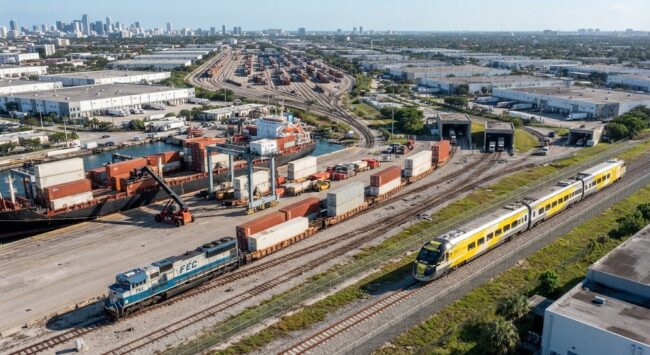
Continued investment in highway connections, the MacArthur Causeway, the PortMiami Tunnel (which separated cruise traffic from downtown Miami streets), and increasingly the Brightline rail expansion (creating direct rail connections between PortMiami area, Miami Beach, downtown, and points north) all enhance the operational efficiency of moving millions of passengers through the port annually.
Cargo and Multipurpose Capabilities
Beyond cruise, PortMiami remains a major cargo port serving Caribbean and South American trade. Continued investment in cargo capabilities supports the port’s full economic contribution to the regional economy.
The Economic Impact of Cruise on Miami and Florida
The cruise industry’s economic impact on Miami, Miami-Dade County, and the broader Florida economy is extraordinary across multiple dimensions:
Direct Employment
Tens of thousands of jobs directly support cruise operations — including port workers, terminal staff, security personnel, customs and immigration, ship’s crew based in Miami, corporate headquarters employees, and the immediate operational ecosystem.
Indirect Employment
Tens of thousands of additional jobs support the cruise industry indirectly — hospitality staff at Miami hotels accommodating pre- and post-cruise passengers, transportation workers (taxis, rideshare, transfers, charter buses), retail workers serving cruise passengers, restaurant staff, vendors supplying cruise operations, ship maintenance specialists, technology contractors, marketing agencies, legal services, banking services, and dozens of other categories.
Hotel Industry Support
Cruise passengers booking pre- or post-cruise hotel stays in Miami generate substantial hotel revenue. Even passengers flying in the day of departure typically generate hotel revenue, and the industry’s increasing emphasis on extended pre/post-cruise programming continues growing this segment.
Restaurant and Hospitality Spend
Cruise passengers, crew on shore leave, and the industry’s corporate workforce generate enormous restaurant, bar, and entertainment spending across Miami.
Retail Spending
Pre-cruise shopping for travel essentials, gifts, and luxury items, plus post-cruise shopping using accumulated cruise credit and celebrating the experience, generates significant retail revenue across Miami’s substantial shopping districts.
Transportation Spending
Airport-to-port transfers, taxi and rideshare activity, charter bus services, and rental cars all generate transportation revenue tied to cruise activity.
Tax Revenue
The cruise industry generates substantial tax revenue at the County, State, and federal levels — sales taxes, hotel occupancy taxes, port fees, payroll taxes, corporate taxes, and various other contributions.
Construction and Capital Investment
The major terminal expansions and infrastructure investments supporting the port generate substantial construction industry activity.
Vendor and Supplier Revenue
The cruise industry’s complex supply chain — provisions, technical equipment, fuel, technology, professional services, marketing, and dozens of other categories — generates substantial revenue across hundreds of Miami-area businesses serving cruise lines as vendors and suppliers.
Tourism Industry Catalyst
The cruise industry serves as a tourism catalyst, exposing tens of millions of cruise passengers to Miami over years and decades — many of whom return for non-cruise vacations, business trips, or eventually become Miami residents.
Brand and Marketing Value
Miami’s role as the Cruise Capital of the World contributes substantial brand value to the city’s broader tourism marketing — every cruise commercial featuring Miami, every news story about cruise industry developments, and every cruise passenger experience reinforces Miami’s global brand recognition.
Total Economic Impact
When all direct, indirect, and induced impacts are considered, the cruise industry’s total economic impact on Miami-Dade County alone is conservatively measured in the billions of dollars annually. The impact on the broader Florida and US economies is multiplicatively larger.
Brian’s Take: The Cruise Industry’s Economic Impact on Miami Is Both Massive and Highly Resilient.
Beyond the raw economic numbers, what makes the cruise industry so valuable to Miami is its resilience — even when other tourism segments soften, even when broader economic cycles fluctuate, even when geopolitical events disrupt international travel, the cruise industry has historically rebounded quickly because it offers vacation experiences that consumers continue prioritizing across economic cycles. That resilience makes Miami’s cruise industry concentration one of the most economically valuable industry clusters anywhere in the state, and the continued capital investment flowing into the port reflects industry confidence that this resilience will continue compounding for decades.
— Brian
What Cruise Passengers Should Know About Miami
For the millions of passengers cruising annually from PortMiami, several practical considerations apply:
Multiple Terminal Operations
PortMiami operates multiple cruise terminals, with different cruise lines typically operating from specific terminals. Always verify your specific terminal assignment in your cruise documentation and plan transportation accordingly.
Pre-Cruise Hotel Strategies
Many experienced cruisers arrive in Miami at least one day before departure to ensure flight delays don’t cause cruise misses. Miami offers thousands of hotel rooms across price points, with substantial inventory near the airport, downtown, Brickell, Miami Beach, and the Aventura/Sunny Isles area.
Airport-to-Port Transportation
Miami International Airport sits approximately 8 miles from PortMiami, with extensive transportation options including taxi, rideshare (Uber, Lyft), pre-arranged transfers, hotel shuttles, and rental cars. Plan for traffic during peak periods, particularly on cruise embarkation Saturdays.
Parking at PortMiami
PortMiami offers extensive cruise parking for passengers driving to the port, with multiple parking facilities and rate structures. Verify parking specifics through your cruise documentation.
Pre-Cruise Activities
Miami offers extraordinary pre-cruise activities — beaches (Miami Beach, Key Biscayne, South Beach, Sunny Isles), shopping (Aventura Mall, Bal Harbour Shops, Brickell City Centre, Miami Design District, Lincoln Road), dining (everything from celebrity chef destinations to authentic Cuban cafés), arts and culture (Pérez Art Museum Miami, Wynwood Walls, Vizcaya Museum & Gardens), and the broader urban experience that makes Miami one of the most distinctive American cities.
Post-Cruise Decompression
Many cruisers extend their trips by spending a day or more in Miami after disembarkation — letting cruise high spirits wind down gradually while exploring the city.
Caribbean and Bahamas Itineraries
PortMiami supports cruise itineraries reaching essentially every Caribbean destination — the Bahamas (Nassau, Freeport, private islands), the Cayman Islands (Grand Cayman), Jamaica (Falmouth, Ocho Rios, Montego Bay), the Dominican Republic, Puerto Rico, the U.S. Virgin Islands, the British Virgin Islands, the eastern Caribbean (Aruba, Curaçao, Bonaire, St. Maarten, St. Lucia, Barbados, Antigua, St. Kitts), and increasingly diverse destinations across the broader Caribbean and Atlantic.
Transatlantic and World Cruises
Beyond Caribbean cruising, PortMiami serves as a starting and ending point for transatlantic crossings, world cruises, repositioning cruises, and exotic itineraries reaching destinations across the globe.
Family-Friendly Through Adult-Only Options
PortMiami serves the full spectrum of cruise market segments — family-friendly mass-market cruises through Carnival, Royal Caribbean, and Norwegian; premium and luxury cruising through Celebrity, Princess, Holland America, Oceania, and Regent Seven Seas; ultra-luxury through Seabourn and Silversea; and adult-only through Virgin Voyages.
Accessibility Programming
The cruise industry has invested substantially in accessibility programming — accessible cabins, terminal accessibility, embarkation assistance, and shoreside accessibility options. Travelers with accessibility needs should coordinate with their cruise line to optimize their experience.
What’s Coming Next: The Future of Miami’s Cruise Industry
The cruise industry’s evolution continues, with several major trends shaping Miami’s role in the late 2020s and beyond:
Continued Ship Class Evolution
Cruise lines continue building larger, more sophisticated, more environmentally efficient vessels. The Royal Caribbean Icon-class ships represent the current frontier, but additional new ship classes are in development across multiple cruise lines.
Sustainability and Environmental Investment
Continued investment in shore power, alternative fuels (LNG, methanol, eventually hydrogen), waste management, water treatment, and overall environmental performance continues reshaping how cruise ships operate. Miami’s leadership in shore power infrastructure positions the port well for this transition.
Technology and Digital Experience
Cruise lines continue investing in mobile apps, digital boarding, contactless transactions, AI-driven personalization, and integrated entertainment technology. The passenger experience continues evolving substantially.
New Itinerary Development
Cruise lines continue developing new itineraries — including domestic options that don’t require foreign ports, expanded Caribbean private islands, longer expedition cruises, and creative routing that maximizes Miami’s central position.
Continued Capital Investment
Major capital investment in PortMiami terminal infrastructure, parking, transportation connections, and supporting infrastructure continues — ensuring the port can handle the next generation of even larger ships and continued passenger volume growth.
Brightline Rail Connection
The continued expansion of Brightline rail service connecting downtown Miami, the airport, the broader region, and eventually deeper Florida destinations creates new transportation options for cruise passengers and the broader regional tourism economy.
Industry Consolidation and Expansion
The cruise industry’s continued evolution may include further consolidation among brands, expansion into new market segments, and potentially new cruise companies entering the market — all of which Miami’s industry concentration positions the city to benefit from.
Growth in Repeat Cruise Customers
The industry continues benefiting from substantial repeat customer rates — passengers cruising multiple times per year, building cruise loyalty, and continuing to spend on cruise vacations across decades. Miami’s role as the cruise capital makes the city the central hub for this growing repeat customer market.
Geopolitical Considerations
Ongoing geopolitical considerations — Cuban relations evolution, broader Caribbean diplomatic dynamics, hurricane season impacts, fuel cost dynamics — all create both challenges and opportunities for cruise itinerary planning. Miami’s central position and operational sophistication position the port to navigate these dynamics effectively.
Brian’s Take: Miami’s Cruise Industry Will Continue Producing Massive Economic Impact for at Least the Next 50 Years.
The infrastructure, industry concentration, talent pools, capital investment, and operational sophistication that Miami has built around its cruise industry over the past 50 years aren’t going away — they’re compounding. The next 50 years of global cruise activity will continue flowing through Miami at rates that no other American or international port can match, and the economic impact on the city, on Florida, and on the broader American tourism economy will continue compounding for decades. For travelers considering cruise vacations and for businesses considering tourism industry investment, Miami remains the most strategically valuable cruise destination available anywhere in the world.
— Brian
The Bottom Line: A Cruise Capital That Has Earned Its Title
Miami’s emergence as the cruise capital of the United States and the world represents one of the most remarkable American tourism industry development stories of the past 50 years.
What began with relatively modest cruise operations in the 1970s and 1980s has grown into an industry concentration unmatched anywhere on Earth — anchored by world-leading port infrastructure at PortMiami, headquartered cruise companies including Carnival Corporation, Royal Caribbean Group, and Norwegian Cruise Line Holdings, the largest cruise ships ever built operating from the port year-round, more than 7 million annual cruise passengers, billions of dollars in annual economic impact, and tens of thousands of jobs across direct and indirect employment.
The industry’s continued capital investment in terminal infrastructure, sustainability capabilities, and operational sophistication ensures that Miami will remain the cruise capital for decades to come.
For Miami residents, civic leaders, and the broader Florida tourism economy, the cruise industry represents one of the most economically valuable and resilient industry clusters anywhere in the state — generating extraordinary economic impact while continuing to compound through reinvestment and innovation.
For travelers considering cruise vacations, Miami offers the most extensive cruise options available anywhere in the world — from short Bahamas getaways through luxury world cruises, from family-friendly mass-market experiences through ultra-luxury adult-only voyages, departing from one of the most operationally sophisticated cruise ports anywhere on Earth.
For the broader story of American tourism and hospitality, Miami’s cruise industry concentration stands as one of the most successful examples of industry clustering in modern American economic history — proving that when geography, infrastructure, talent, and capital combine across decades, the result can be a regional industry advantage that compounds into generational economic value.
The MacArthur Causeway view stays remarkable. The lines of cruise ships keep extending across PortMiami’s terminals. The corporate offices of the world’s largest cruise companies continue anchoring Miami’s business community. The 7+ million annual cruise passengers keep flowing through the port. The economic impact keeps compounding across the regional economy. The capital investment keeps flowing into terminal expansions and sustainability infrastructure. The industry keeps innovating and growing.
Miami earned its title as the cruise capital of the world. And every metric continues confirming that title for the foreseeable future.
For anyone who has cruised from Miami, the experience speaks for itself. For anyone who hasn’t, the city’s role as the cruise capital is one of the most distinctive and accessible American tourism experiences available — and one worth experiencing at least once.
That’s the Miami cruise story.
That’s a Florida tourism story worth knowing — and one that will continue producing extraordinary economic impact for the city and the broader region for decades to come.
Resources & Further Reading
- PortMiami Official Website — Miami-Dade County’s official port website with cruise terminal information, schedules, parking, and operational details for one of the busiest cruise ports in the world.
- Carnival Corporation & plc — Official corporate website for the world’s largest cruise company, headquartered in Doral, Florida, with brands including Carnival Cruise Line, Princess Cruises, Holland America Line, and others.
- Royal Caribbean Group — Official corporate website for the parent company of Royal Caribbean International, Celebrity Cruises, and Silversea, headquartered in Miami.
- Norwegian Cruise Line Holdings — Official corporate website for the parent company of Norwegian Cruise Line, Oceania Cruises, and Regent Seven Seas Cruises, headquartered in Miami.
- Greater Miami Convention & Visitors Bureau — Official destination marketing organization with extensive resources on Miami’s tourism and cruise industry.
- Cruise Lines International Association (CLIA) — The cruise industry’s primary trade organization with industry data, statistics, and consumer resources.
About the Author