For decades, Miami had a reputation that locals knew well but rarely talked about openly: a city where you could live in paradise, but you’d probably earn less doing it.
The classic Miami economic equation involved trading wage growth for lifestyle. Working in Miami meant accepting compensation below what comparable jobs paid in New York, San Francisco, Chicago, or Boston, while enjoying the year-round sunshine, the beaches, the international culture, the relatively lower (though never genuinely cheap) cost of housing, and the no-state-income-tax advantage that softened the blow.
That equation has fundamentally changed.
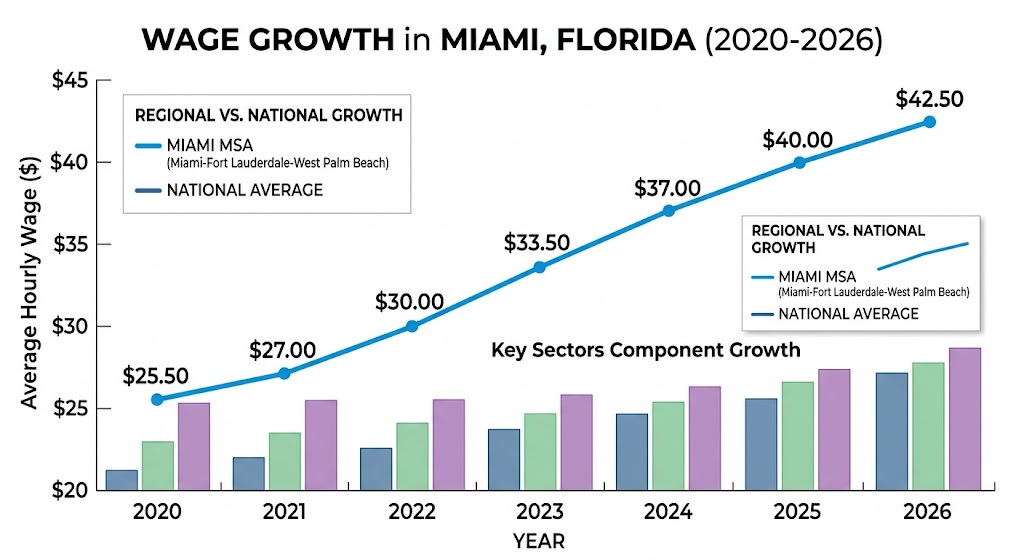
Over the past five years, Miami has experienced one of the most dramatic wage growth stories of any major American metropolitan area — driven by the migration of high-paying financial industry jobs, the explosion of fintech and technology employment, the maturation of professional services across multiple sectors, the continued growth of the healthcare industry, and the broader transformation of Miami from a tourism-and-real-estate economy into one of the most diversified urban economies in the southeastern United States.
The implications are profound. For workers and professionals, Miami increasingly offers wage opportunities competitive with traditional financial and technology centers. For employers, the wage growth creates both opportunities (attracting top talent to Florida) and challenges (managing rising compensation costs). For policymakers and civic leaders, the wage growth produces both prosperity and affordability pressures that will shape Miami’s future for decades. For the broader Florida economy, Miami’s wage transformation represents one of the most consequential developments shaping the state’s overall trajectory.
The Big Picture: How Miami Wages Have Actually Changed
Before getting into specific industries and dynamics, it helps to establish the broader picture of Miami wage growth over recent years.
The Pandemic-Era Surge
The 2020-2022 period produced extraordinary changes in Miami’s labor market. The pandemic-driven migration of high-earning professionals to Miami — combined with the broader Wall Street South migration of major financial firms, the explosion of remote work that allowed New York-paying employers to hire Miami-based workers, the booming Miami real estate market drawing professionals from across the country, and the broader influx of high-net-worth residents — produced a wage environment fundamentally different from anything Miami had previously experienced.
Average hourly earnings in the Miami-Fort Lauderdale-West Palm Beach metropolitan statistical area grew substantially during this period, with particularly dramatic gains in:
- Financial services as Wall Street South firms began paying New York-style compensation in Miami
- Professional services including legal, consulting, and accounting roles
- Technology as remote work allowed major tech employers to compensate Miami workers competitively
- Real estate and construction as the booming market drove wage premiums
- Healthcare as the broader sector competed for talent in a tight labor market
- Hospitality as labor shortages drove wage increases across previously low-wage categories
The Continued Growth Through 2023-2026
While the pandemic-era surge was extraordinary, the more important story is that Miami wage growth has continued at meaningful rates beyond the initial pandemic bump — establishing a sustained trajectory rather than a temporary spike.
The continued growth has been driven by:
- Continued financial industry migration with each new firm relocation establishing new compensation benchmarks
- Maturation of fintech and crypto industries generating substantial high-wage employment
- Continued international business growth particularly Latin American and global business activity
- Healthcare industry expansion with major systems competing aggressively for talent
- Real estate industry depth generating substantial professional service employment
- Hospitality industry sophistication with high-end hospitality establishing premium compensation tiers
- Continued population growth of high-earning professionals
The Comparison to National Averages
Miami’s wage growth has consistently exceeded national averages over the past five years across multiple measurement periods. While exact figures vary by source and time period, the pattern is unmistakable: Miami has experienced wage growth meaningfully above the broader American economy.
This represents a substantial reversal from Miami’s historical pattern of below-average wages relative to peer metropolitan areas, and reflects the broader transformation of the city’s economic base.
The Industry Variation
Wage growth has varied substantially across industries, with some sectors experiencing extraordinary increases while others have grown more modestly. The next sections walk through the most consequential industry-specific patterns.
Brian’s Take: Miami’s Wage Transformation Is One of the Most Consequential Florida Economic Stories of the Past Five Years.
The traditional Miami narrative of trading wages for lifestyle has been fundamentally rewritten over the past five years — and most observers, including many Miami residents, haven’t fully internalized just how much the city’s compensation landscape has changed. The combination of Wall Street South migration, fintech industry growth, professional services maturation, and the broader high-earning professional population transformation has produced wage opportunities in Miami that simply didn’t exist in the city’s previous economic era. Florida professionals considering Miami opportunities, employers managing compensation strategies, and civic leaders thinking about the city’s future all need to engage seriously with this wage transformation rather than relying on outdated assumptions about how Miami compensation actually works.
— Brian
Why Miami Wages Have Grown So Dramatically
Several major factors have combined to produce Miami’s wage growth story. Understanding these drivers is essential to understanding both the current environment and the likely trajectory ahead.
The Wall Street South Migration
The relocation of major financial firms — including Citadel to Miami, Elliott Investment Management to West Palm Beach, Point72 to Palm Beach Gardens, dozens of additional hedge funds and private equity firms across South Florida, and the broader migration of asset managers, family offices, and specialty financial firms — has imported New York-level compensation structures into the Miami market.
When a hedge fund relocates from New York to Miami, the senior portfolio managers earning multi-million-dollar packages don’t suddenly accept lower compensation just because they’ve moved. The compensation expectations move with the firms — and over time, those compensation structures cascade through the broader local financial industry as Miami-based firms have to compete for talent against the relocating firms.
The Fintech and Cryptocurrency Industry Concentration
Miami’s emergence as a major fintech and cryptocurrency hub has produced substantial high-wage employment across:
- Senior software engineers and product managers at major fintech and crypto firms
- Trading and quantitative roles at digital asset firms
- Compliance, legal, and regulatory specialists at fintech and crypto companies
- Business development and partnerships roles at firms serving Latin American and global markets
- Executive and leadership positions across the broader fintech ecosystem
These roles typically command substantial premium compensation versus comparable positions in non-tech industries.
Remote Work and Geographic Compensation
The pandemic normalized remote work in ways that fundamentally changed how compensation works for Miami-based professionals. Many high-earning roles can now be performed remotely from Miami while drawing compensation set by New York, San Francisco, Boston, or other premium labor markets.
This has produced a substantial population of Miami residents earning premium-market wages while living in Miami’s tax and lifestyle environment — fundamentally changing local compensation dynamics.
The Professional Services Expansion
The substantial expansion of legal, consulting, accounting, and other professional services serving Miami’s growing financial, technology, and corporate sectors has produced substantial high-wage employment. Major law firms, consulting firms, and accounting firms have all expanded Miami operations with compensation structures reflecting the demanding nature of the work and the competitive labor market.
The Healthcare Industry Growth
Florida’s enormous and growing healthcare industry — with major systems including Baptist Health South Florida, Jackson Health System, the University of Miami Health System, Memorial Healthcare System, Cleveland Clinic Florida, Nicklaus Children’s Hospital, and dozens of others — has produced substantial high-wage healthcare employment as systems compete for physician, advanced practice clinician, executive, and specialized professional talent.
The International Business Expansion
Miami’s role as a hemispheric business capital has produced substantial high-wage employment serving Latin American business, including:
- International banking and private wealth management roles serving high-net-worth Latin American clients
- Corporate executives managing Latin American operations from Miami
- Trade and logistics professionals supporting international commerce
- Legal and consulting specialists in international business
- Multinational corporation regional headquarters roles
The Real Estate Industry Depth
Miami’s enormous real estate industry — supporting the city’s substantial residential, commercial, hospitality, and industrial real estate markets — has produced substantial high-wage employment across brokerage, development, finance, legal, architecture, design, and broader supporting roles.
The Hospitality and Tourism Sophistication
Miami’s hospitality industry has matured substantially in recent years, with the explosion of luxury hotel development, fine dining establishment, and high-end hospitality services producing premium compensation tiers across executive, management, and specialized hospitality roles.
The Technology Sector Growth
Beyond fintech specifically, Miami’s broader technology sector — including software companies, e-commerce, digital media, and various other technology-driven businesses — has expanded substantially, producing substantial high-wage technology employment.
Population Growth of High-Earning Professionals
Beyond specific industries, the broader migration of high-earning professionals to Miami — bringing existing high-paying jobs with them, starting businesses that require substantial professional staffing, and generally elevating the local professional population — has continued reshaping the city’s labor market.
The Demographic Inflows
The substantial migration of professionals from New York, California, Illinois, Massachusetts, and other states to Miami has brought workforce talent capable of commanding premium compensation, supporting the broader high-wage industry development.
Brian’s Take: The Drivers of Miami Wage Growth Aren’t Slowing Down — They’re Compounding.
The structural factors driving Miami’s wage growth over the past five years — Wall Street South migration, fintech industry concentration, remote work flexibility, professional services expansion, international business connections, and broader high-earning professional population growth — aren’t temporary phenomena. They’re compounding. Each new financial firm relocation makes the next one easier. Each new fintech success story attracts additional industry investment. Each new high-earning resident strengthens the consumer base for premium services that themselves generate high-wage employment. Florida operators who understand these compounding dynamics are positioned to benefit from continued Miami wage growth across the next decade and beyond.
— Brian
Industry-Specific Wage Growth Patterns
Different Miami industries have experienced dramatically different wage growth patterns over recent years. Understanding these variations is essential for workers, employers, and policymakers making decisions about Miami labor market participation.
Financial Services
Financial services has experienced arguably the most dramatic wage growth in Miami over recent years. The combination of Wall Street South migration, the maturation of family office services, the expansion of investment banking and private wealth management, and the broader financial industry growth has produced compensation packages at the senior level that genuinely compete with New York and San Francisco.
Specific high-growth roles include:
- Hedge fund portfolio managers and analysts at relocated and locally established firms
- Private equity professionals at firms with substantial Miami operations
- Investment banking professionals at firms with growing Miami presence
- Private wealth management roles serving the city’s enormous high-net-worth resident base
- Family office professionals serving substantial single-family and multi-family office clients
- Capital markets and trading specialists at firms operating across asset classes
For senior roles in financial services, Miami compensation has substantially closed the gap with traditional financial centers — and in some cases, after-tax compensation now exceeds New York compensation due to Florida’s tax advantages.
Technology and Fintech
Technology compensation has grown substantially in Miami, particularly at the senior and specialized levels. Major contributors include:
- Senior software engineers at fintech, e-commerce, and digital media companies
- Product management roles at growing technology companies
- Data scientists and AI specialists across multiple industries
- Cybersecurity specialists addressing surging demand across financial services and broader industries
- Engineering leadership roles at companies expanding Miami operations
- Founder and executive compensation at growing technology companies
Healthcare
Healthcare wage growth has reflected broader national trends with additional Miami-specific dynamics:
- Physicians across specialties, with particular premiums for high-demand specialties
- Advanced practice clinicians including nurse practitioners and physician assistants
- Healthcare executives at major systems competing for top leadership
- Specialized clinical roles in cardiology, oncology, neurosurgery, and other premium specialties
- Healthcare technology and informatics specialists
- Travel and contract clinical roles that have commanded substantial premiums during persistent labor shortages
Legal Services
Major law firms with substantial Miami operations have continued increasing compensation packages reflecting both broader legal industry trends and Miami-specific market dynamics:
- Associate and senior associate attorneys at major firms
- Partner-level compensation at firms with growing Miami footprints
- Specialized practice areas including financial services, real estate, international, and corporate law
- In-house counsel at major Miami corporations
- Compliance and regulatory specialists across financial services and broader industries
Real Estate
Real estate professional compensation has grown substantially with Miami’s continued real estate market expansion:
- Senior commercial real estate brokers working on major transactions
- Luxury residential real estate specialists serving high-net-worth clients
- Real estate development professionals managing major projects
- Real estate finance specialists including capital markets and lending professionals
- Real estate executives at major firms
Construction and Trades
Construction-related wages have grown substantially with the building boom across Miami:
- Skilled trades including electrical, plumbing, HVAC, and specialty construction roles
- Project management roles at major construction projects
- Engineering and architecture professionals supporting major developments
- Construction executive roles at firms with substantial Miami operations
- Specialized construction trades related to luxury and high-rise construction
Hospitality
Hospitality wages have shown more complex patterns — with substantial increases in many roles driven by labor shortages, alongside continued challenges in others:
- Senior hospitality executives at luxury hotels and major restaurant operations
- Specialized culinary professionals including chefs at high-end establishments
- Sommelier and beverage specialists at premium restaurants
- Hospitality technology and operations specialists
- Front-of-house management at premium establishments
Professional Services
Beyond legal specifically, broader professional services have experienced substantial wage growth:
- Management consulting professionals at firms with Miami operations
- Senior accounting and tax professionals at major firms
- Wealth and financial advisory roles at major firms
- Specialized consulting across financial services, technology, and healthcare
- Executive search and recruiting specialists
Brian’s Take: The Miami Wage Growth Is Genuinely Concentrated in Specific Industries and Roles — Not Uniform Across the Economy.
One important caveat to the Miami wage growth story is that the increases have been substantially concentrated in specific industries and at specific levels — particularly in financial services, technology, healthcare, and senior professional roles — rather than uniformly distributed across the entire economy. Miami workers in retail, traditional services, and many lower-tier hospitality roles have experienced wage growth far below the headline industry numbers, even as costs of living have risen substantially. The Miami wage transformation has produced extraordinary opportunities for workers in high-growth sectors and roles, while creating substantial affordability pressures for workers in slower-growth categories. Engaging with this nuanced reality is essential to understanding the full Miami wage story.
— Brian
The Geographic Variation Within Miami
Wage growth has varied substantially across different parts of Greater Miami, with some areas experiencing dramatic increases while others have grown more modestly.
Brickell and Downtown Miami
Brickell — the heart of Miami’s financial district — has experienced perhaps the most dramatic wage growth in the city. The concentration of relocated financial firms, fintech companies, professional services firms, and corporate operations has produced extraordinary compensation packages across the workforce serving these industries.
Miami Beach
Miami Beach has experienced substantial wage growth in hospitality, real estate, and professional services serving the high-net-worth resident and visitor base. The luxury hospitality concentration has been particularly consequential.
Coral Gables
Coral Gables has experienced substantial professional services wage growth, anchored by the substantial concentration of major law firms, financial services firms, healthcare operations, and corporate headquarters in the area.
Coconut Grove and Wynwood
The growing technology and creative industry concentrations in Coconut Grove and Wynwood have produced substantial wage growth in those neighborhoods’ specific industry mixes.
Aventura and Sunny Isles Beach
These northern Miami-Dade markets have experienced substantial wage growth driven by the high-net-worth resident concentrations and the supporting service industries.
Doral
Doral’s substantial corporate concentration — including major operations of Carnival Corporation, Univision, and dozens of other companies — has produced substantial wage growth in supporting professional services.
Continued Variation Across the Metro
The broader Miami metropolitan area continues to show substantial geographic variation, with wage growth concentrated in areas hosting growing industries and slower in areas dependent on lower-wage sectors.
The Cost-of-Living Reality
Any honest discussion of Miami wage growth requires equally honest engagement with the cost-of-living reality that has accompanied the wage increases.
Housing Costs
Miami housing costs — both for purchase and rental — have grown substantially over the past five years. The combination of in-migration of high-earning professionals, the booming luxury real estate market, the broader population growth, and the limited housing supply expansion has produced housing cost increases that have substantially absorbed the wage growth for many Miami workers.
Insurance and Property Costs
Florida’s broader property insurance challenges have particularly affected Miami homeowners, with insurance costs rising dramatically in recent years for properties in coastal areas and condominiums.
Transportation Costs
Transportation costs — including auto-related expenses, parking, and broader transportation access — have grown with the broader cost environment.
Healthcare Costs
Despite Miami’s strong healthcare infrastructure, healthcare costs have grown across the broader American economy in ways that affect Miami workers regardless of local conditions.
Education and Childcare Costs
Education and childcare costs have grown substantially, particularly for families seeking private school education or quality childcare in competitive Miami neighborhoods.
Food and Service Costs
Restaurant prices, grocery costs, and broader service costs have grown substantially in Miami’s premium service environment.
The Net Effect
For many Miami workers — particularly those at lower wage levels or in slower-growth industries — the cost-of-living increases have substantially offset or exceeded wage growth, producing affordability pressures that affect daily life in significant ways.
For workers in the highest-growth industries and roles — particularly senior professionals in financial services, technology, healthcare, and other high-wage sectors — the wage growth has typically exceeded cost-of-living increases, producing genuine real wage improvements.
The variation across these populations creates one of the most consequential dynamics shaping Miami’s social and economic future.
Brian’s Take: Miami’s Wage Growth Story Cannot Be Honestly Discussed Without Engaging the Affordability Reality.
The headline Miami wage growth numbers are genuinely impressive, but Florida operators thinking honestly about the city need to engage with the affordability reality that has accompanied the wage increases. For workers in high-growth industries and senior roles, Miami increasingly offers genuinely compelling compensation. For workers in slower-growth sectors, the cost-of-living increases have substantially offset or exceeded the modest wage growth they’ve experienced. The Miami operators, employers, and policymakers thinking seriously about the city’s future need to engage with both sides of this equation — celebrating the genuine wage growth while addressing the affordability pressures that affect substantial portions of the workforce.
— Brian
What Miami Wage Growth Means for Different Stakeholders
The wage transformation affects different stakeholders in dramatically different ways.
For Workers in High-Growth Industries
Workers positioned in financial services, technology, healthcare, senior professional services, real estate, and other high-growth sectors have access to compensation opportunities in Miami that genuinely compete with traditional premium labor markets — particularly when factoring in Florida’s tax advantages.
For Workers in Lower-Growth Industries
Workers in traditional retail, services, hospitality (at lower levels), and other slower-growth sectors have experienced more modest wage growth that has often been offset by cost-of-living increases.
For Employers
Employers face increasingly competitive labor markets requiring substantially higher compensation to attract and retain talent across many roles. Companies that haven’t adjusted compensation strategies to reflect Miami’s new wage environment are losing talent to competitors that have.
For Relocating Professionals
Professionals considering Miami relocation can increasingly find compensation opportunities competitive with their current markets, particularly when factoring in tax advantages and broader cost-of-living considerations (for senior professionals).
For Policymakers
Local and state policymakers face complex challenges in supporting both continued economic growth and affordability for workers across the wage spectrum.
For Real Estate Developers and Operators
The wage growth supports continued demand for residential and commercial real estate, while the affordability pressures create complications for workforce housing development.
For Service Industries
Service businesses face both opportunities (serving higher-income consumer bases) and challenges (managing labor costs to support continued operations).
For Educational Institutions
Educational institutions producing the talent that supports Miami’s high-wage industries are increasingly important to continued growth, with implications for K-12, higher education, and workforce development programming.
For Civic and Cultural Institutions
The growing high-net-worth professional population supports continued investment in civic and cultural institutions, while the broader workforce diversity creates opportunities for inclusive cultural programming.
What Comes Next: The Future of Miami Wages
Several major trends will shape Miami’s wage trajectory across the next decade.
Continued Industry Migration
Continued relocation of major financial firms, technology companies, and professional services to Miami will continue to support high-wage employment growth.
Industry Maturation
Miami’s growing industries will continue maturing in ways that produce both continued wage growth (in high-growth roles) and broader workforce employment (in supporting roles across wage levels).
Talent Supply Dynamics
Continued migration of high-earning professionals will support continued wage growth, while developing local talent pipelines through educational institutions will affect how broadly the wage growth distributes.
Affordability Responses
Policy and market responses to affordability pressures — including workforce housing development, transportation investment, and broader cost-of-living mitigation — will shape how the wage growth ultimately affects different worker populations.
Technology Disruption
Continued technology integration across industries will create both new high-wage opportunities and pressures on existing roles, with implications across the wage spectrum.
Continued Economic Diversification
The continued diversification of Miami’s economic base beyond tourism, real estate, and traditional services will support continued wage growth across multiple industry categories.
Geographic Distribution Evolution
Continued evolution of which Miami neighborhoods host high-wage industries will affect geographic patterns of wage growth and broader development.
Demographic Patterns
Continued evolution of Miami’s demographic composition — including continued migration patterns and local population dynamics — will shape both labor supply and service demand affecting wage trajectories.
Federal and Macroeconomic Conditions
Federal Reserve policy, broader macroeconomic conditions, and federal regulatory environments will all affect Miami’s continued wage growth in ways that interact with local dynamics.
Climate and Insurance Considerations
Florida’s broader climate and insurance dynamics will continue affecting cost-of-living calculations that interact with wage growth.
Brian’s Take: Miami’s Wage Growth Story Will Continue to Define the City’s Economic Future Across the Next Decade.
The Miami wage transformation is one of the most consequential American economic stories of the past five years, and its continuation will shape the city’s future across the next decade in ways that affect virtually every aspect of Miami life — from housing affordability to educational programming to civic infrastructure to broader quality of life. Florida professionals, employers, and civic leaders engaging seriously with this wage growth story are positioning themselves to benefit from continued Miami transformation; those relying on outdated assumptions about Miami compensation are increasingly missing the actual reality of what the city has become and what it’s becoming.
— Brian
The Bottom Line: Miami Wages Have Genuinely Transformed
The growth of average wages in Miami over the past five years represents one of the most consequential American economic stories of the era — driven by the Wall Street South migration, the fintech and technology industry concentration, the professional services expansion, the healthcare industry growth, the international business connections, the real estate industry depth, the hospitality sophistication, and the broader population growth of high-earning professionals.
For workers positioned in high-growth Miami industries and senior roles, the wage opportunities now genuinely compete with traditional premium American labor markets — and after factoring in Florida’s tax advantages, often exceed comparable opportunities in New York, San Francisco, Boston, or Chicago.
For workers in slower-growth sectors, the wage transformation has been more modest, with cost-of-living increases often substantially offsetting the gains experienced in headline numbers.
For employers, the new Miami wage environment requires fundamentally different compensation strategies than the city’s previous labor market supported.
For relocating professionals, Miami increasingly offers genuine compensation opportunities alongside the lifestyle advantages that attracted previous generations of relocators.
For policymakers and civic leaders, the wage transformation creates both opportunities (continued economic growth, increased tax revenue, improved quality of life for many residents) and challenges (affordability pressures, workforce housing needs, broader economic inequality between high-growth and slower-growth sectors).
For the broader Florida economy, Miami’s wage transformation represents one of the most consequential developments shaping the state’s overall trajectory across the next decade and beyond.
The transformation continues. The capital keeps flowing. The firms keep relocating. The talent keeps arriving. The compensation keeps growing in high-growth sectors. The cost of living keeps rising. The opportunities keep expanding for workers positioned correctly. The challenges keep emerging for those caught in slower-growth segments.
That’s the Miami wage growth story.
That’s a Florida economic reality worth understanding seriously — and engaging with honestly across all its dimensions of opportunity and challenge — because the next decade of Miami’s economic trajectory depends substantially on how the city, its employers, its workers, its policymakers, and its broader civic community navigate the wage transformation that has fundamentally rewritten Miami’s economic story.
Resources & Further Reading
- Bureau of Labor Statistics: Miami-Fort Lauderdale-West Palm Beach Area Economic Summary — Federal source for current Miami metropolitan area employment, wage, and labor market data.
- Florida Department of Commerce / Department of Economic Opportunity — State agency providing Florida-specific labor market data, wage information, and economic analysis.
- Greater Miami Chamber of Commerce — Regional business advocacy organization providing economic data, industry analysis, and business community resources.
- Miami-Dade Beacon Council — Miami-Dade County’s official economic development organization with extensive resources on regional industry data and economic transformation.
- Federal Reserve Bank of Atlanta — Atlanta Fed serves the Sixth District including Florida, providing regional economic research relevant to Miami labor market dynamics.
About the Author