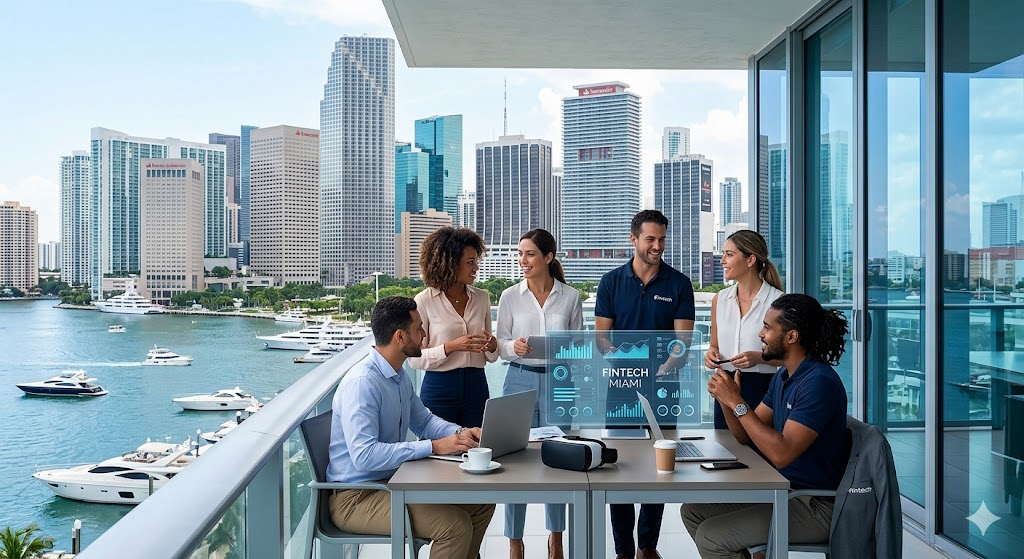
If you’ve spent any time in Miami’s Brickell or downtown business districts in 2026, you’ve noticed something that genuinely didn’t exist five years ago.
The conversations at lunch tables aren’t all about real estate, hedge funds, or international wealth management anymore. They’re about cross-border payments. Stablecoin infrastructure. Crypto custody. Latin American remittance technology. Embedded finance. Banking-as-a-service. Digital wallets. AI-driven trading. Decentralized finance. The dozens of specific subcategories that collectively define one of the most consequential industries to emerge in modern American finance: fintech.
Miami has spent the past five years aggressively positioning itself as one of the most consequential fintech hubs in the United States — and arguably in the world. The combination of Latin American business connections, the Wall Street South migration that brought major financial firms from Manhattan, the wealth concentration in the city, the growing technology sector, the regulatory environment that’s been welcoming to crypto and fintech innovation, and the sheer volume of capital flowing through the region has created a fintech ecosystem that competes with Silicon Valley, New York, and global financial capitals for talent, capital, and consequential companies.
This article is for informational and educational purposes only and is not financial, investment, or professional advice. Always consult qualified professionals for any financial, investment, or business decisions.
What Is Fintech, Exactly?
The term fintech — a contraction of “financial technology” — describes the broad category of companies, products, and services that apply technology to financial services. The category is enormous and constantly evolving, but at its core, fintech includes any business using technology to:
- Make financial services more accessible to consumers, businesses, or markets that traditional finance has underserved
- Make financial services more efficient by automating processes that historically required substantial human labor
- Make financial services cheaper by reducing the costs of intermediation, infrastructure, and operations
- Make financial services more sophisticated by applying AI, machine learning, blockchain, and other advanced technologies to financial problems
- Create entirely new financial services that weren’t possible before specific technology innovations emerged
The fintech category has expanded dramatically over the past 15 years. What started as primarily online banking and digital payments has now evolved into a vast ecosystem spanning:
Major Fintech Subcategories
Payments and Money Movement Companies enabling faster, cheaper, more accessible payment processing — including peer-to-peer payments, business-to-business payments, cross-border remittances, point-of-sale systems, and increasingly real-time payment infrastructure.
Lending and Credit Companies using technology to extend credit more efficiently, including alternative lenders, marketplace lending platforms, buy-now-pay-later services, business lending platforms, and underwriting innovation.
Banking and Neobanks Digital-first banking services, including challenger banks, banking-as-a-service infrastructure, account services for underbanked populations, and embedded banking products.
Investment and Wealth Management Robo-advisors, digital wealth management platforms, micro-investing apps, alternative investment platforms, retirement technology, and AI-driven portfolio management.
Cryptocurrency and Digital Assets Cryptocurrency exchanges, custody services, blockchain infrastructure, stablecoin issuers, decentralized finance (DeFi) platforms, and Web3 financial services.
Insurance Technology (Insurtech) Companies applying technology to insurance underwriting, claims processing, distribution, and product design — including digital insurance carriers, embedded insurance, and AI-driven risk assessment.
Capital Markets Technology Trading platforms, market infrastructure, alternative trading systems, AI-driven trading, and the broader technology serving institutional capital markets.
RegTech (Regulatory Technology) Companies helping financial institutions comply with regulations through technology — including KYC/AML automation, fraud detection, transaction monitoring, and regulatory reporting.
Personal Finance Management Apps and services helping consumers track spending, manage budgets, build savings, manage debt, and improve overall financial health.
Real Estate Fintech (PropTech with Financial Components) Mortgage technology, real estate transaction technology, fractional real estate investment, and financial infrastructure serving real estate markets.
SMB Fintech Companies serving small and medium-sized businesses with payments, banking, lending, accounting integration, and operational financial tools.
Embedded Finance Infrastructure allowing non-financial companies to embed financial services (banking, lending, payments, insurance) directly into their products.
The breadth of fintech reflects the reality that essentially every aspect of financial services is being reshaped by technology — and that the boundaries between traditional finance and fintech are increasingly blurred as established financial institutions adopt fintech approaches and fintech companies mature into substantial financial services providers.
Brian’s Take: Fintech Has Quietly Become One of the Most Consequential Industries Shaping the Modern American Economy.
Most people still think of fintech as relatively niche — apps you use to send money to friends or invest small amounts — but the reality is that fintech has become one of the most economically significant industry categories in the United States, generating hundreds of billions in market capitalization, employing hundreds of thousands of professionals, and reshaping virtually every aspect of how individuals and businesses interact with financial services. Miami’s emergence as one of the most important fintech hubs in the country reflects exactly how consequential this industry has become — and how strategically positioned Miami is to capture an outsized share of the continued growth.
— Brian
Why Miami Specifically Has Emerged as a Major Fintech Hub
Several factors have combined to make Miami one of the most consequential fintech hubs in the United States — and arguably the most strategically positioned American city for the next decade of fintech industry growth.
The Wall Street South Migration
The dramatic migration of major financial firms from New York to Miami — including hedge funds like Citadel, Elliott Management, Point72, family offices, private equity firms, asset managers, and broader financial industry talent — has produced a concentration of financial industry expertise, capital, and decision-making that supports fintech development across multiple categories.
Latin American Business Bridge
Miami’s role as the gateway between the United States and Latin America gives the city a structural advantage in fintech categories serving cross-border commerce, remittances, multilingual financial services, and Latin American consumer and business markets. Latin American fintech opportunities are substantial — and Miami is the natural American base for companies pursuing them.
Crypto and Digital Asset Concentration
Miami has aggressively positioned itself as a crypto-friendly city, hosting major crypto conferences, attracting crypto companies, and welcoming digital asset innovation. The combination of Mayor Francis Suarez’s high-profile crypto advocacy during 2021-2022, the city’s hosting of major Bitcoin Conference events, and the broader regulatory environment created a Miami crypto ecosystem that has continued maturing through industry cycles.
Regulatory Environment
Florida’s regulatory environment has generally been welcoming to fintech innovation, with state-level frameworks supporting payments, lending, money transmission, and crypto activities. The state’s broader business-friendly positioning extends naturally into fintech regulation.
Tax Environment
The absence of state income tax, combined with the broader cost-of-living advantages versus New York and California, has attracted both fintech founders and fintech employees who relocate to Miami for personal financial reasons that compound the broader business advantages.
Capital Concentration
The concentration of family offices, private wealth, venture capital, and traditional financial firms in Miami creates capital availability for fintech investment that’s increasingly competitive with the traditional fintech capital centers of New York and Silicon Valley.
Infrastructure and Talent
Miami’s growing technology infrastructure, expanding higher education connections (University of Miami, Florida International University, and others), and increasing talent migration from across the United States have built the operational foundation that supports fintech company development.
International Connectivity
Miami International Airport’s exceptional international connectivity, the city’s bilingual and multilingual population, and the general international orientation of Miami’s business community all support fintech companies serving global markets — particularly Latin American, Caribbean, and increasingly broader international markets.
Founder and Investor Migration
The high-profile relocations of major venture capital firms, fintech founders, and technology executives to Miami over the past five years have created a self-reinforcing concentration where each new arrival makes Miami more attractive to the next.
Continued Capital Investment
Both private and public investment in Miami’s fintech infrastructure — including events, accelerators, coworking spaces, educational programs, and broader ecosystem support — continues to compound the city’s fintech advantages.
Brian’s Take: Miami’s Fintech Position Will Strengthen Over the Next Decade Even If Specific Companies and Trends Cycle.
Crypto and fintech go through cycles — bull markets followed by bear markets, hype cycles followed by consolidation, specific companies rising and falling — but the structural advantages Miami has built for fintech will persist across those cycles. The Latin American bridge, the financial industry concentration, the regulatory environment, the tax advantages, the international connectivity, and the talent migration all compound regardless of which specific fintech subsectors are hot at any given moment. The Florida operators paying attention to Miami’s fintech ecosystem are positioned to benefit from a structural growth story that should continue across the next decade and beyond.
— Brian
The Top 3 Fintech Companies in Miami
While Miami’s fintech ecosystem includes hundreds of companies across virtually every fintech subcategory, three companies in particular illustrate the diversity, scale, and global ambition that characterizes Miami’s emergence as a major fintech hub. These three companies — Mastercard’s Miami operations, Citadel’s quantitative trading infrastructure, and the various crypto and digital asset companies anchored in Miami — represent different but equally important pieces of the broader fintech story.
For this article, we’ll focus on three specific notable fintech companies with substantial Miami presence that illustrate the broader ecosystem:
1. Pipe
Headquarters: Miami, Florida Category: Recurring revenue financing and capital markets technology Website: pipe.com
Pipe emerged as one of the most prominent fintech companies anchored in Miami during the 2020-2022 period and has continued evolving as a meaningful presence in the city’s fintech ecosystem. The company pioneered the concept of allowing businesses with recurring revenue (subscription companies, SaaS businesses, and similar) to trade their future revenue streams for upfront capital — essentially creating a marketplace for recurring revenue as a financial asset class.
What Pipe represents in Miami’s fintech ecosystem:
- Innovative capital markets approach to a problem (financing growth-stage subscription businesses) that traditional venture capital and lending didn’t solve elegantly
- Major Miami headquarters presence representing one of the most prominent fintech relocations to the city during the recent migration wave
- Substantial venture capital backing from major investors recognizing the company as a category-defining fintech business
- Continued evolution through industry cycles as the company adjusts its strategic positioning
- Symbol of Miami’s ability to attract category-defining fintech companies beyond just established firms relocating from elsewhere
While Pipe has navigated significant business evolution since its initial growth phase — as virtually all venture-backed fintech companies do across cycles — its Miami headquartering remains symbolically and operationally significant for the city’s fintech ecosystem.
2. Aspiration
Major Operations: Miami presence among multiple locations Category: Sustainable banking and consumer fintech Website: aspiration.com
Aspiration represents one of the more distinctive fintech models — a financial services company explicitly built around sustainability, environmental impact, and consumer financial values aligned with broader social goals. Aspiration provides spending and savings accounts, investment products, and other financial services with a sustainability orientation, positioning the company in the growing intersection of fintech and ESG (environmental, social, governance) considerations.
What Aspiration represents in Miami’s fintech ecosystem:
- Distinctive value proposition combining mainstream consumer fintech with sustainability orientation
- Significant Miami operations as part of the company’s broader presence
- Growth in a category (sustainable finance) that continues attracting both consumer and institutional interest
- Symbol of fintech diversity in Miami’s ecosystem extending beyond crypto and trading-focused companies
- Connection to broader trends in values-aligned investing and consumer finance
While the sustainable banking sector has navigated complex business cycles, Aspiration’s Miami presence reflects the broader diversity of fintech categories anchored in the city.
3. Major Crypto and Digital Asset Companies (FTX Legacy and Successor Ecosystem)
Multiple Companies, Various Categories Sector: Cryptocurrency, digital assets, blockchain infrastructure
Miami’s status as a major crypto hub developed substantially during 2021-2022, anchored by FTX’s substantial Miami presence (including the FTX Arena naming rights) before the company’s catastrophic collapse in late 2022. While FTX’s failure represented a major blow to the broader crypto industry and to Miami’s specific crypto positioning, the city’s fundamental advantages for crypto and digital asset companies have persisted, supporting continued ecosystem development.
The current Miami crypto and digital asset ecosystem includes:
- Cryptocurrency exchanges and trading firms with Miami operations
- Crypto custody and infrastructure companies serving institutional digital asset needs
- Blockchain infrastructure companies building foundational technology
- Web3 startups developing decentralized applications and protocols
- Venture capital firms focused on crypto and Web3 investment
- Educational and event infrastructure including major industry conferences
- Service providers including legal, accounting, and consulting firms specializing in crypto
What Miami’s crypto ecosystem represents in the broader fintech story:
- Continued positioning as one of the most crypto-friendly major American cities
- Industry resilience through the substantial industry challenges following the 2022 cycle
- Connection to broader fintech innovation as crypto and traditional fintech increasingly intersect through stablecoins, tokenized assets, and digital infrastructure
- Ongoing capital investment in crypto-related companies despite industry volatility
- Latin American crypto connections particularly relevant given high crypto adoption rates across Latin American economies
For Miami’s fintech story, the crypto sector represents both a source of substantial industry activity and an example of how rapidly individual company outcomes can shift even as broader ecosystem advantages persist.
Important Note on Specific Fintech Company Selection
The fintech industry evolves rapidly, with specific companies experiencing significant business transitions, mergers, acquisitions, expansions, and challenges across short timeframes. The three companies highlighted above represent illustrative examples of Miami’s fintech ecosystem at the time of writing, but the broader Miami fintech ecosystem includes hundreds of additional companies across:
- Major established fintech operations from companies like Mastercard, Visa, and others with substantial Miami offices
- Trading firms and quantitative finance operations from major migrants like Citadel, Elliott Management, Point72, and others
- Latin American-focused fintech companies serving cross-border commerce and consumer markets
- Banking and neobank operations with Miami presence
- Insurance technology companies active in the city
- Real estate fintech serving Miami’s enormous real estate ecosystem
- Embedded finance infrastructure companies
- Capital markets technology firms supporting the broader Wall Street South migration
- Smaller startups across virtually every fintech subcategory
For current information on any specific fintech company, including current operational status, leadership, and business focus, always consult primary sources including company websites, recent SEC filings (where applicable), and qualified industry research.
Brian’s Take: The Specific Top Companies Will Cycle, but Miami’s Fintech Ecosystem Position Will Compound.
Specific fintech companies will rise and fall through cycles — that’s inherent to the industry’s dynamic nature — but Miami’s structural position as a major fintech hub will continue strengthening regardless of which specific companies happen to be in the spotlight at any given moment. The smart way for Florida operators to think about Miami’s fintech ecosystem isn’t through the lens of any specific company but through the lens of the broader ecosystem advantages — Latin American connections, financial industry concentration, regulatory environment, tax advantages, international connectivity, and continued talent migration — that compound regardless of individual company outcomes.
— Brian
The Broader Miami Fintech Ecosystem
Beyond specific companies, Miami’s broader fintech ecosystem includes essential infrastructure that supports continued growth:
Major Fintech Events
Miami hosts some of the most consequential fintech industry events globally:
- eMerge Americas — One of the largest technology events in the southeastern United States with substantial fintech programming
- Bitcoin Conference — Major annual cryptocurrency industry event historically anchored in Miami
- Various fintech-specific conferences throughout the year
- Latin American fintech connection events leveraging Miami’s hemispheric positioning
- Industry meetups and networking events across multiple Miami neighborhoods
Educational and Research Infrastructure
- University of Miami Herbert Business School with growing fintech and digital finance programming
- Florida International University with substantial business technology programs
- Miami Dade College with workforce development supporting fintech industry needs
- Continuing education and bootcamp programs training fintech professionals
- Research centers focusing on financial technology innovation
Capital Infrastructure
- Major venture capital firms with Miami offices or substantial Miami investment activity
- Family offices increasingly investing in fintech opportunities
- Corporate venture capital from major financial institutions
- Angel investor networks active in Miami’s fintech ecosystem
- Banking partners supporting fintech company operations
Service Provider Infrastructure
- Legal firms specializing in fintech, payments, banking law, and crypto regulation
- Accounting firms with fintech industry expertise
- Consulting firms serving fintech companies
- Marketing and PR agencies with fintech industry focus
- Recruiting firms specializing in fintech talent
Coworking and Office Infrastructure
- WeWork, The LAB Miami, and various other coworking spaces supporting fintech startups
- Class A office availability in Brickell and downtown for growing fintech companies
- Mixed-use developments providing fintech-friendly work environments
- Meeting and event spaces supporting industry programming
Regulatory and Government Engagement
- Florida Office of Financial Regulation oversight of fintech activities
- City and county economic development organizations supporting fintech industry growth
- Federal regulatory engagement through Miami’s various federal offices
- Industry-government dialogue through various forums and organizations
How to Engage With Miami’s Fintech Ecosystem
For Florida professionals interested in engaging with Miami’s fintech ecosystem, several practical pathways exist:
As a Founder or Entrepreneur
- Connect with major fintech-focused venture capital firms active in Miami
- Attend major industry events including eMerge Americas and crypto-focused conferences
- Engage with University of Miami and FIU business and technology programs
- Network through industry meetups and coworking communities
- Consider Miami’s accelerator and incubator programs supporting fintech development
As an Investor
- Connect with established Miami venture capital firms active in fintech
- Build relationships with founder communities across multiple fintech categories
- Engage with industry events to build deal flow
- Consider angel investing in earlier-stage Miami fintech opportunities
- Build expertise in specific fintech subcategories that align with your investment thesis
As a Professional Services Provider
- Develop fintech industry expertise in your specific service area (legal, accounting, consulting, marketing)
- Build relationships across the Miami fintech ecosystem
- Engage through industry events and meetups
- Develop content and thought leadership specific to fintech industry needs
As a Talent Considering Fintech Careers
- Develop technical skills relevant to fintech roles (engineering, data science, AI, product management, compliance)
- Build financial industry knowledge that complements technical skills
- Engage with Miami’s fintech community through events and meetups
- Consider specific fintech subcategories that align with your interests and skills
- Build cross-cultural and multilingual capabilities that align with Miami’s distinctive positioning
As a Traditional Financial Services Professional
- Develop fintech literacy and understanding of how technology is reshaping financial services
- Build relationships with fintech companies that may complement or partner with traditional financial services
- Consider fintech opportunities that leverage your existing financial services expertise
- Engage with Miami’s broader financial services community as fintech and traditional finance increasingly converge
Brian’s Take: The Florida Professionals Building Fintech Industry Engagement Now Are Positioned for Outsized Opportunities Over the Next Decade.
Miami’s fintech ecosystem is in a phase of continued expansion that creates substantial opportunities for professionals who engage thoughtfully — founders building category-defining companies, investors deploying capital into emerging opportunities, professional service providers building fintech industry expertise, and traditional financial services professionals expanding their skills into fintech-adjacent areas. The Florida operators who develop genuine fintech industry engagement now are positioning themselves for professional opportunities and business outcomes that will compound across the next decade as Miami’s fintech position continues strengthening.
— Brian
What Comes Next: The Future of Miami Fintech
Several trends will shape Miami’s fintech ecosystem evolution over the next decade:
Continued Industry Maturation
The Miami fintech ecosystem is transitioning from its initial high-energy growth phase into a more mature state with established companies, repeated capital cycles, and the kind of institutional infrastructure that distinguishes leading fintech hubs.
Cross-Border and Latin American Focus
Miami’s continued advantage in Latin American business connections will increasingly translate into fintech companies specifically focused on cross-border commerce, multilingual financial services, and Latin American consumer and business markets.
Crypto and Digital Asset Evolution
The crypto industry will continue evolving through cycles, with Miami positioned to capture continued activity even as specific companies and trends shift.
AI Integration Across Fintech
Artificial intelligence integration into fintech will accelerate dramatically, with Miami companies increasingly building AI-augmented financial services across consumer, business, and institutional applications.
Embedded Finance Expansion
The embedded finance category — allowing non-financial companies to offer financial services — will continue expanding, with Miami companies serving as infrastructure for this trend.
Continued Venture Capital Investment
Capital flows into Miami fintech will continue as the ecosystem matures and demonstrates ability to produce successful outcomes for investors.
Talent Concentration
Miami’s continued talent migration will deepen the fintech ecosystem’s human capital base.
Regulatory Evolution
Fintech regulation will continue evolving at federal, state, and international levels, with implications for Miami companies operating across these regulatory environments.
Industry Consolidation
The natural consolidation that occurs in maturing industries will likely accelerate, with successful Miami fintech companies acquiring smaller competitors and strategic partners.
The Bottom Line: Miami’s Fintech Story Is Just Getting Started
Miami’s emergence as a major fintech hub represents one of the most consequential American business development stories of the past five years. The combination of Latin American business connections, the Wall Street South migration, the regulatory environment, the tax advantages, the talent migration, and the broader ecosystem development has produced a fintech industry concentration that genuinely competes with traditional fintech capitals.
For founders, investors, and professionals considering fintech industry engagement, Miami offers exactly the kind of dynamic ecosystem where significant opportunities emerge — even as specific companies and subsectors cycle through their natural business evolution.
For Florida business operators more broadly, Miami’s fintech ecosystem represents both an industry to watch and a source of innovation that will increasingly affect virtually every other Florida industry as fintech reshapes payments, banking, lending, investment, insurance, and broader financial services across the economy.
For visiting executives, recruits, investors, and partners considering Miami, the fintech ecosystem is part of the city’s broader business proposition — proof that the financial industry migration, the technology sector growth, and the broader Miami business renaissance are reflected in genuinely consequential industry development.
Miami’s fintech story isn’t about any single company. It’s about an ecosystem that has built structural advantages compounding across cycles. Specific companies will rise and fall. Specific subsectors will boom and consolidate. Specific cycles will run their course.
But Miami’s position as one of the most consequential American fintech hubs will continue strengthening — and the Florida operators who engage with this ecosystem thoughtfully are positioned to benefit from a multi-decade growth story that’s still in its early chapters.
The conferences continue. The capital keeps flowing. The companies keep launching. The talent keeps arriving. The infrastructure keeps maturing. The Latin American connections keep deepening. The cycles keep producing the next generation of category-defining companies.
That’s the Miami fintech story.
That’s a Florida business reality worth understanding — and one that will continue producing extraordinary opportunities for the operators paying attention across the next decade and beyond.
Resources & Further Reading
- eMerge Americas — One of the most consequential technology and fintech events in the southeastern United States, anchored in Miami with substantial fintech industry programming and networking.
- Miami-Dade Beacon Council — Miami-Dade County’s official economic development organization with extensive resources on the regional fintech ecosystem and broader technology industry development.
- Florida Office of Financial Regulation — State regulatory body overseeing financial services including substantial portions of the fintech industry operating in Florida.
- CB Insights Fintech Research — Industry-leading research and data resource providing comprehensive coverage of the fintech industry including company tracking, funding analysis, and market trend research.
- University of Miami Herbert Business School — Academic institution with growing fintech, financial technology, and digital finance programming connected to the broader Miami fintech ecosystem.
About the Author