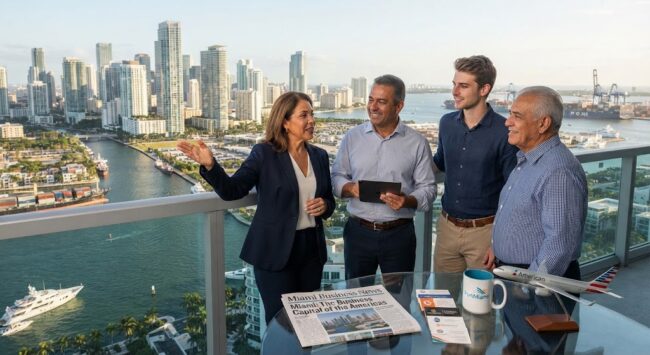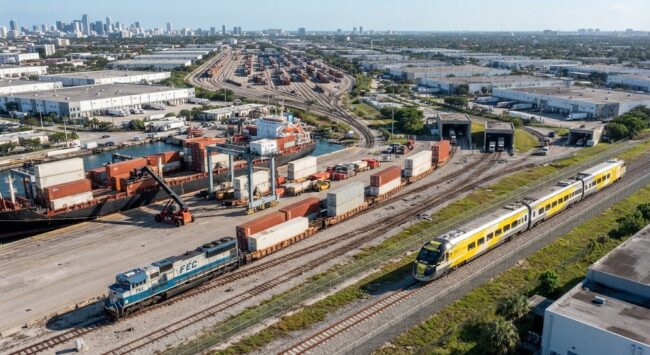
For most of the past half-century, South Florida operated under one of the most car-dependent business environments in the United States.
The region’s three major business markets — Miami-Dade, Broward, and Palm Beach counties — spread across roughly 100 miles of coastal development, anchored by Interstate 95’s six-lane corridor as the primary connection between the markets. Business travel between Brickell and Fort Lauderdale meant 45 minutes on a good day and two hours during the wrong rush hour. The trip from Miami to West Palm Beach for a morning meeting meant either a 4 a.m. departure to beat traffic or accepting that the day would be substantially consumed by transit. Business engagement between South Florida and Orlando meant booking flights, navigating Miami International or Fort Lauderdale-Hollywood airports, and accepting that what should have been a 200-mile trip actually consumed most of a workday.
The infrastructure consequences shaped business decisions in fundamental ways. Companies clustered talent recruitment to commute-feasible radius. Professional services practices anchored to single-county geography rather than serving the broader region. Client relationships across South Florida markets remained substantially harder to develop and maintain than the geographic distance suggested. Real estate decisions concentrated near highway interchanges rather than business activity centers. The region’s economic potential was substantially constrained by the practical reality that moving people between markets meant moving them through perpetually congested highway infrastructure.
That reality has changed substantially across the past several years.
Brightline opened intercity passenger rail service connecting Miami, Aventura, Fort Lauderdale, Boca Raton, and West Palm Beach — providing the first practical rail alternative to I-95 for South Florida cross-market travel. The Miami-to-West Palm Beach corridor that often consumed 2+ hours during peak traffic conditions now runs reliably in approximately 75 minutes via Brightline, with the productive working hours and predictable schedule that distinguishes rail from car travel.
Brightline extended service to Orlando International Airport — fundamentally transforming the practical South Florida-Orlando business relationship. The 235-mile journey that previously required either flights or 4-5 hours of driving now runs in approximately 3.5 hours via direct rail service, with the corresponding implications for business engagement, talent flow, tourism, and broader cross-market activity.
Miami-Dade Metrorail’s continued operation across approximately 25 miles of heavy rail infrastructure has continued supporting the substantial business density across downtown Miami, Brickell, Coral Gables, Coconut Grove, the Civic Center medical district, and Miami International Airport. The system’s integration with the free Metromover automated people mover system covering downtown Miami and Brickell creates “last mile” connectivity that makes rail genuinely practical for substantial portions of Miami business activity.
Tri-Rail’s commuter rail service along the western corridor continues providing additional commuter rail capacity supporting cross-county workforce mobility across Palm Beach, Broward, and Miami-Dade counties.
The combined effect across these systems has produced what amounts to a fundamental transformation in how South Florida business activity actually happens — with substantial implications for hiring, client engagement, market expansion, real estate decisions, and broader competitive dynamics that South Florida operators are still working through.
This article walks through the specific business benefits Miami Metrorail and Brightline provide, the strategic implications for South Florida businesses across multiple industries, the broader transformation rail infrastructure has produced in regional business activity, and what continued rail infrastructure development suggests for South Florida business positioning across the years ahead.
This article is for informational and educational purposes only and is not professional business, transportation, real estate, or planning advice. Specific business decisions involve considerations that vary substantially based on individual circumstances. Always consult qualified professionals for decisions affecting your business. Information about specific transit services, schedules, fares, and operational details reflects general public information at time of writing and may change; verify current information directly with transit operators.
The South Florida Rail Infrastructure Reality
Before discussing business benefits specifically, the actual rail infrastructure serving South Florida deserves clarification.
Miami-Dade Metrorail
Miami-Dade Transit operates Metrorail, the heavy rail rapid transit system serving Miami-Dade County. The system spans approximately 25 miles with 23 stations connecting major activity centers across the county.
Key Metrorail characteristics affecting business activity include:
Primary Corridor Coverage — The system’s two lines (the Green Line and Orange Line) provide service across major Miami-Dade activity centers including downtown Miami, Brickell, Coconut Grove, Coral Gables, the Civic Center medical district, the University of Miami area, Miami International Airport (via the Orange Line and the Miami Intermodal Center), and corridors extending north into northern Miami-Dade.
Frequency and Hours — Service operates with reasonably frequent intervals during peak business hours and extended operating hours covering business commute patterns and substantial discretionary travel times.
Integration With Other Transit — Metrorail connects with Miami-Dade’s Metromover (the downtown automated people mover system serving downtown Miami and Brickell), Metrobus service, Tri-Rail (the commuter rail service connecting West Palm Beach, Fort Lauderdale, and Miami), and Brightline at the MiamiCentral station.
Miami International Airport Connection — The Metrorail Orange Line connects to Miami International Airport via the Miami Intermodal Center, providing direct rail access between MIA and downtown Miami business districts.
MetroMover Integration — The free Metromover automated system extends Metrorail’s reach throughout downtown Miami and Brickell with frequent service throughout the central business district, providing the “last mile” connectivity that makes Metrorail genuinely practical for business activity.
Brightline Intercity Service
Brightline operates intercity passenger rail service connecting South Florida markets to each other and to Orlando. The service represents the first privately operated intercity passenger rail in the United States in decades and has fundamentally changed Florida intercity travel.
Key Brightline characteristics include:
Station Network — Brightline operates stations at MiamiCentral in downtown Miami, Aventura, Fort Lauderdale, Boca Raton, West Palm Beach, and Orlando International Airport. The station locations connect major South Florida business centers directly to each other and to Orlando.
Frequency and Schedule — Brightline operates multiple daily trains in each direction, with frequency and timing supporting both commuter use along the South Florida corridor and intercity business travel between South Florida and Orlando.
Travel Time Performance — Brightline travel times substantially undercut driving times during peak traffic conditions, with the Miami-to-West Palm Beach corridor typically running approximately 75 minutes versus often 2+ hours by car during peak traffic, and the Miami-to-Orlando route running approximately 3.5 hours versus 4+ hours by car.
Service Quality — Brightline service includes premium and standard service classes, reserved seating, food and beverage service, WiFi connectivity, and the broader service characteristics that distinguish intercity rail from commuter rail operations.
Business-Class Infrastructure — The Premium service tier includes business-appropriate accommodations supporting productive work during transit, business meetings between travel companions, and the broader business travel infrastructure that competes with short-haul flights.
MiamiCentral Integration — The downtown Miami MiamiCentral station integrates with Metrorail, Metromover, and broader downtown Miami connectivity, making Brightline genuinely accessible to downtown Miami business activity.
Tri-Rail Commuter Service
Beyond Metrorail and Brightline, the Tri-Rail commuter rail service operated by the South Florida Regional Transportation Authority provides additional commuter rail service connecting West Palm Beach, Fort Lauderdale, and Miami along the western corridor (different from Brightline’s eastern corridor). Tri-Rail serves substantial South Florida commuter activity and integrates with Metrorail at the Miami Intermodal Center.
Brian’s Take: South Florida’s Rail Infrastructure Has Fundamentally Transformed What’s Practically Possible for Regional Business Activity.
The rail infrastructure serving South Florida in 2026 represents a fundamentally different operational environment than existed before Brightline launched intercity service and before Metrorail’s network reached its current configuration. The transformation extends far beyond pure transportation convenience into substantial business strategy implications that South Florida operators are still working through. The businesses that have integrated rail into their operational strategies — for hiring, client engagement, market expansion, real estate decisions, and broader business dynamics — increasingly demonstrate competitive advantages over businesses still operating under the car-dependent assumptions that defined South Florida business activity in previous decades. Florida operators serious about long-term competitive positioning should pay substantial attention to how rail infrastructure affects their specific business situations.
— Brian
Business Benefit One: Substantially Expanded Talent Markets
One of the most consequential business benefits of South Florida rail service involves the substantial expansion of practical talent markets for South Florida businesses.
The Pre-Rail Talent Market Reality
Before substantial rail infrastructure connected South Florida markets, employer talent markets were constrained substantially by commute realities. A Brickell employer competing for talent essentially competed within the commute radius reasonable for car-dependent commuting — typically 30-45 minutes during peak traffic conditions. The practical talent market for most Brickell employers extended into adjacent Miami-Dade neighborhoods, parts of Broward County for employees willing to undertake substantial commutes, and limited additional reach.
Similarly constrained talent markets affected Fort Lauderdale employers, West Palm Beach employers, and businesses across South Florida. The car-dependent commute reality fundamentally limited which workers any given employer could practically access.
The Rail-Connected Talent Market Expansion
Rail service has substantially expanded practical talent markets across South Florida.
Brightline Corridor Effects — Brightline’s South Florida corridor service has connected the West Palm Beach, Fort Lauderdale, and Miami markets in ways that fundamentally expand talent accessibility. A Brickell employer can now practically access talent living in West Palm Beach who commute via Brightline. A West Palm Beach employer can practically access Miami-area talent. The previously separated talent markets have become substantially more interconnected.
Metrorail Corridor Effects — Metrorail service has expanded Miami-Dade talent accessibility for downtown Miami and Brickell employers, with workers across the broader Metrorail service area accessing downtown and Brickell employment without dependence on personal vehicles.
Tri-Rail Corridor Effects — Tri-Rail’s substantial commuter service supports additional cross-county talent accessibility along the western corridor.
Combined Network Effects — The integration of Brightline, Metrorail, Metromover, and Tri-Rail creates network effects beyond any individual system, with talent accessing employment across multiple connected markets through integrated transit infrastructure.
Specific Business Implications
The talent market expansion has specific implications for South Florida employers:
Larger Candidate Pools — Employers can access substantially larger candidate pools when rail-accessible workers are practically reachable, supporting both more sophisticated hiring and continued workforce expansion.
Reduced Compensation Pressure From Geographic Scarcity — When talent must commute by car within constrained radius, employers in talent-scarce locations face substantial compensation pressure. Rail-accessible talent expansion reduces this pressure by expanding effective labor supply.
Diversity Expansion — Larger geographic talent reach supports more diverse hiring across multiple dimensions including geographic origin, life experience, and broader characteristics.
Specialty Talent Access — Specialized roles requiring uncommon skills benefit substantially from expanded geographic reach, with rail-accessible candidates substantially expanding specialty talent availability.
Retention Through Commute Quality — Employees commuting by rail typically report substantially higher commute satisfaction than equivalent car commuters, supporting retention advantages for employers offering rail-accessible employment.
Industry-Specific Talent Implications
Different South Florida industries experience talent market expansion differently:
Financial Services — The substantial financial services migration anchored by Citadel’s Miami expansion, the continued private capital concentration in Palm Beach County, and broader Wall Street South activity benefits substantially from talent accessibility across the rail-connected corridor.
Professional Services — Legal, accounting, consulting, and related professional services benefit from substantially expanded talent markets supporting both senior professional recruitment and broader practice development.
Healthcare — Major healthcare systems including Baptist Health, Memorial Healthcare, Jackson Health, and others benefit from rail-accessible talent supporting their substantial workforce requirements.
Technology and Fintech — South Florida’s growing technology and fintech sector benefits from rail-accessible talent supporting continued sector growth.
Hospitality — The substantial hospitality industry concentration across South Florida benefits from rail-accessible workforce supporting continued industry activity.
Business Benefit Two: Expanded Practical Client and Customer Markets
Beyond talent markets, South Florida rail service has substantially expanded practical client and customer markets for South Florida businesses.
Cross-Market Client Engagement
Businesses serving clients across South Florida markets benefit substantially from rail accessibility:
Professional Services Cross-Market Practice — Attorneys, accountants, financial advisors, and consultants can practically engage clients across multiple South Florida markets through rail-supported travel that wasn’t practical when driving represented the only practical option during peak traffic conditions.
Sales and Business Development — Business development representatives can practically maintain accounts across multiple South Florida markets when rail supports efficient cross-market travel.
Service Delivery Across Markets — Businesses providing services requiring on-site presence — including consulting, specialty services, training, and others — benefit from rail-supported service delivery across multiple markets.
Customer Acquisition Expansion
Beyond pure service delivery, customer acquisition activities benefit:
Marketing Reach Expansion — Businesses targeting customers across multiple South Florida markets benefit from rail-supported customer engagement that wasn’t practical under pure car-dependent conditions.
Event Attendance — Business networking events, industry conferences, professional development activities, and broader business community engagement benefits substantially from rail accessibility supporting attendance across multiple South Florida markets.
Client Meeting Logistics — Client meetings requiring face-to-face engagement benefit substantially from rail-supported logistics that reduce the time and stress associated with cross-market travel.
Orlando Market Integration
Beyond South Florida corridor effects specifically, Brightline’s Orlando connection has fundamentally changed practical South Florida-Orlando business integration:
Direct Business Engagement — South Florida businesses can practically engage Orlando-area clients, partners, and opportunities through Brightline travel that substantially undercuts the time and frustration associated with flying or driving between markets.
Talent Market Bridge — The Orlando-South Florida talent market integration enabled by Brightline supports both businesses recruiting across markets and workers practically considering employment across the broader corridor.
Tourism and Hospitality Effects — South Florida’s substantial tourism and hospitality industry benefits from Orlando-area visitors traveling via Brightline, with substantial implications for hotel demand, restaurant activity, retail spending, and broader hospitality dynamics.
Convention and Event Effects — Conventions, conferences, and major events benefit from Brightline-supported attendance from both Orlando and South Florida origins.
Brian’s Take: The Orlando Connection Has Been More Consequential Than Most South Florida Operators Initially Recognized.
When Brightline launched the Orlando service, most South Florida operators viewed it primarily as tourism infrastructure supporting visitor flow between Orlando and South Florida destinations. The reality has been substantially more consequential for actual South Florida business activity. The integration of practical South Florida-Orlando business engagement supports substantially more sophisticated cross-market client relationships, talent recruitment, business development, and broader strategic opportunities than existed when flying or driving represented the only practical options. South Florida businesses serious about long-term opportunity development should pay substantial attention to how Brightline’s Orlando connection affects their specific competitive situations and growth opportunities.
— Brian
Business Benefit Three: Real Estate and Location Strategy Implications
South Florida rail infrastructure has substantial implications for business real estate decisions and broader location strategy.
Transit-Oriented Development Effects
Rail service has supported substantial transit-oriented development across South Florida, with implications for business real estate decisions:
Brickell and Downtown Miami — The substantial Brickell and downtown Miami office market continues benefiting from Metrorail and Metromover connectivity combined with Brightline access supporting business activity. The transit-oriented downtown Miami environment supports the major business district that anchors substantial South Florida professional activity.
Aventura Station Area — Brightline’s Aventura station has supported substantial Aventura-area real estate development including business activity benefiting from the rail connectivity.
Fort Lauderdale Brightline Station Area — Brightline’s Fort Lauderdale station has supported continued development in the surrounding area, with implications for businesses considering Fort Lauderdale location decisions.
West Palm Beach Brightline Station Area — The West Palm Beach Brightline station has supported substantial West Palm Beach business district development, complementing the broader Wall Street South migration that has reshaped Palm Beach County’s business profile.
Boca Raton Station Effects — Brightline’s Boca Raton station has supported continued Boca Raton business district activity benefiting from rail connectivity.
Office Real Estate Strategy
Rail accessibility increasingly factors into business office real estate decisions:
Rail-Proximate Office Premium — Office buildings near Brightline stations and Metrorail stations increasingly command premium positioning compared to less rail-accessible locations.
Employee Commute Considerations — Employers selecting office locations increasingly weight rail accessibility for workforce considerations, with implications for which locations support sophisticated talent recruitment.
Client Access Considerations — Office locations supporting easy client access via rail provide business development advantages compared to locations requiring car-dependent client visits.
Multi-Market Operations — Businesses operating across multiple South Florida markets can structure operations differently when rail connects offices, supporting more sophisticated multi-location strategies.
Specific Submarket Implications
Specific South Florida submarkets demonstrate rail effects substantially:
Brickell Continued Premium — Brickell’s continued office market premium reflects the combination of Metrorail, Metromover, and Brightline connectivity creating exceptional transit accessibility supporting the substantial business district.
Downtown West Palm Beach Development — The substantial West Palm Beach business district development benefits substantially from Brightline connectivity supporting the Wall Street South migration including major financial industry operations.
Fort Lauderdale Downtown Activity — Continued Fort Lauderdale downtown activity benefits from Brightline connectivity supporting the broader business district.
Aventura Mixed-Use Development — Aventura’s continued mixed-use development includes substantial rail-supported activity benefiting from Brightline connectivity.
Business Benefit Four: Productive Travel Time Conversion
Beyond pure transportation efficiency, rail travel converts otherwise unproductive travel time into productive work time in ways that substantially affect business operations.
The Working Travel Reality
Brightline service supports substantial productive work during transit:
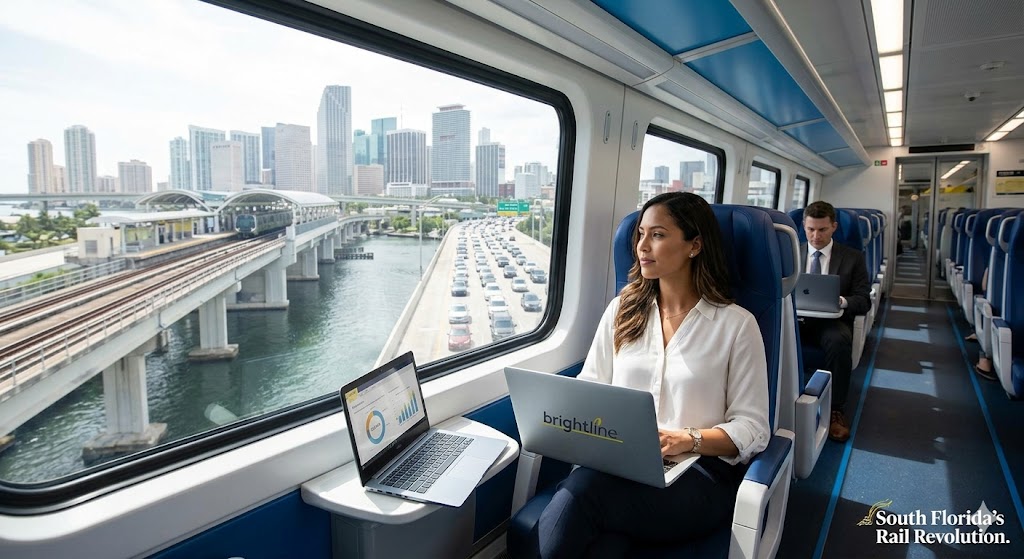
Reliable WiFi Connectivity — Onboard WiFi supports continued business communication, document review, and broader business activity during transit.
Reserved Seating Configuration — Seating configuration including table seating supports document review, laptop work, and meetings during transit.
Productive Multi-Hour Travel — The 3.5-hour Miami-Orlando journey supports substantial productive work compared to flying (which involves multiple unproductive transitions) or driving (which substantially limits work productivity for the driver).
Meeting Capability — Travel companions can conduct working meetings during Brightline transit, supporting business development, client engagement, and team coordination during travel.
Business Implications
Productive travel time conversion has specific business implications:
Effective Working Hours Expansion — Business professionals can substantially expand effective working hours by working during transit, supporting both productivity and work-life balance.
Reduced Total Travel Cost — When transit time is productive working time, the effective cost of travel decreases substantially compared to lost-productivity car or flight time.
Sophisticated Meeting Logistics — Multi-party meetings can incorporate transit-based working sessions, supporting more sophisticated meeting logistics than purely destination-based meetings.
Professional Service Delivery Efficiency — Professional service providers can use transit time for client work, deposition preparation, document review, and broader productive activity supporting client engagements.
Brian’s Take: The Productive Travel Conversion Has Subtler But Substantial Implications for Professional Service Economics.
Most discussions of rail benefits focus on direct transportation efficiency — faster travel, lower stress, predictable schedules. The productive travel time conversion produces less obvious but substantial implications for professional service economics specifically. When attorneys, consultants, financial advisors, and other professionals can productively work during transit between South Florida markets or between South Florida and Orlando, the effective cost of cross-market client engagement decreases substantially. This affects pricing, profitability, geographic practice scope, client relationship economics, and broader professional service business dynamics in ways that traditional cost-benefit analysis substantially underestimates. South Florida professional service providers serious about practice economics should pay specific attention to how productive travel time affects their service delivery economics.
— Brian
Business Benefit Five: Reduced Operational Disruption From Traffic Variability
South Florida’s substantial traffic variability has historically created substantial operational disruption for businesses dependent on cross-market activity. Rail service substantially reduces this operational disruption.
The Traffic Variability Problem
Pre-rail South Florida business operations faced substantial traffic-related disruption:
Highway Incident Disruption — I-95 incidents could turn 45-minute commutes into 3-hour ordeals with substantial unpredictability.
Weather-Related Disruption — South Florida weather including substantial rainfall, hurricane preparations, and other weather conditions created additional traffic disruption.
Construction Disruption — Continued highway construction across South Florida has created ongoing traffic disruption affecting business travel.
Seasonal Variability — South Florida’s seasonal traffic patterns including snowbird arrivals, tourism seasons, and event-driven traffic create additional variability.
The Rail Predictability Advantage
Rail service operates with substantially greater schedule predictability:
Schedule Reliability — Rail schedules operate with substantially better on-time performance than highway travel during peak conditions.
Weather Independence — Rail service operates substantially more reliably during weather conditions that disrupt highway travel.
Reduced Incident Impact — Rail service is substantially less affected by the incidents that create highway disruption.
Business Implications
Reduced operational disruption affects business activity substantially:
Reliable Meeting Scheduling — Businesses can schedule cross-market meetings with substantially greater confidence about arrival times.
Reduced Buffer Time — When schedules are reliable, businesses don’t need to build substantial buffer time into cross-market activity, supporting more efficient operations.
Client Relationship Reliability — When meetings happen on schedule, client relationships benefit from the professional reliability that rail-supported logistics provides.
Reduced Stress and Decision Quality — Reliable transit reduces the stress associated with uncertain travel, supporting better decision quality and broader professional performance.
Business Benefit Six: Specific Industry Transformation
Specific industries have experienced substantial transformation from South Florida rail service.
Financial Services Industry
The continued Wall Street South financial services migration has been substantially supported by rail infrastructure:
Cross-Market Practice Support — The Brightline corridor supports practical cross-market practice between Miami-Dade financial industry concentration and Palm Beach County’s substantial private capital activity.
Talent Recruitment Support — Rail-supported talent recruitment helps financial firms access talent across the broader South Florida corridor.
Client Engagement Support — Wealth management firms, family offices, and other financial services providers can practically serve clients across multiple South Florida markets.
Tourism and Hospitality Industry
The substantial tourism and hospitality industry benefits substantially from rail service:
Visitor Flow Support — Rail-supported visitor flow between Orlando-area attractions and South Florida destinations supports both markets.
Cross-Market Hotel Operations — Hospitality operations across multiple South Florida markets benefit from rail-supported operations.
Restaurant and Retail Activity — Rail-supported customer activity benefits restaurants, retail, and broader hospitality activity across station areas.
Convention and Event Industry — Conventions, conferences, and major events benefit substantially from rail-supported attendance.
Healthcare Industry
South Florida’s substantial healthcare industry benefits from rail accessibility:
Workforce Mobility — Rail-supported workforce mobility helps major healthcare systems access talent across the broader South Florida region.
Patient Access — Patients can access specialty healthcare across South Florida markets more practically when rail supports cross-market travel.
Medical District Connectivity — Miami’s Civic Center medical district benefits substantially from Metrorail connectivity supporting the substantial medical activity concentration.
Professional Services Industry
The substantial professional services industry across South Florida benefits across multiple dimensions:
Cross-Market Practice — Law firms, accounting firms, consulting firms, and other professional services can practically operate across multiple South Florida markets.
Talent Recruitment — Professional services firms can recruit talent across the broader South Florida corridor.
Client Relationship Development — Professional services firms can develop client relationships across the broader region more practically.
Real Estate Industry
The substantial South Florida real estate industry benefits substantially:
Cross-Market Brokerage — Real estate brokers can practically operate across multiple South Florida markets.
Client Service Support — Real estate clients benefit from broker accessibility across the broader region.
Investment Activity — Real estate investment activity benefits from improved cross-market accessibility supporting investment decisions across the broader region.
What South Florida Businesses Should Consider
For South Florida business owners considering how rail service affects their operations, several practical considerations apply.
Strategic Review
Periodically review whether current operations fully leverage rail infrastructure:
- Location decisions — Do current office locations appropriately leverage rail accessibility?
- Talent recruitment — Does talent recruitment activity reach the full rail-accessible candidate pool?
- Client engagement — Are cross-market client engagement opportunities fully developed?
- Operations integration — Do operational systems support rail-based business activity?
Employee Support
Consider how to support rail-using employees:
- Transit benefits — Pretax transit benefits and similar programs support employee rail use
- Schedule flexibility — Schedule flexibility supporting train schedules helps rail-commuting employees
- Workplace technology — Workplace technology supporting remote work during transit helps employee productivity
Client Service Optimization
Consider how to optimize client service for rail-supported logistics:
- Office accessibility — Office accessibility from rail stations affects client service experience
- Meeting scheduling — Meeting scheduling appropriate to rail schedules supports client engagement
- Multi-market service — Multi-market service capability benefits from rail-supported delivery
Real Estate Decisions
For real estate decisions, factor rail accessibility:
- New location selection — New location selection should consider rail accessibility
- Existing location evaluation — Existing location evaluation should consider whether rail accessibility matches business needs
- Expansion strategy — Expansion strategy should consider rail-connected market opportunities
Industry Network Engagement
Engage with industry networks across rail-connected markets:
- Cross-market professional networks — Cross-market professional networks supported by rail accessibility
- Industry events — Industry events across rail-connected markets
- Business community engagement — Business community engagement across the broader region
What Comes Next: Continued Rail Infrastructure Development
Several developments will continue shaping South Florida rail infrastructure across coming years.
Continued Brightline Service Development
Continued Brightline service development including potential frequency improvements, service quality enhancements, and broader operational evolution will continue affecting how the system supports business activity.
Continued Tampa Extension Consideration
Continued consideration of Brightline service extension to Tampa would further expand Florida intercity rail connectivity with substantial business implications for both South Florida and Tampa Bay markets.
Metrorail and Metromover Continued Development
Continued investment in Miami-Dade rail infrastructure including potential extensions, service improvements, and broader system development will continue shaping Miami-Dade business accessibility.
Tri-Rail Service Evolution
Continued Tri-Rail service evolution will continue affecting cross-county commuter rail capacity.
Transit-Oriented Development Continuation
Continued transit-oriented development across station areas will continue creating business opportunities and shaping real estate dynamics across rail-served communities.
Continued Technology Integration
Continued technology integration including improved scheduling systems, payment systems, and broader passenger experience technology will continue affecting business rail use.
Climate and Resilience Considerations
Continued climate and resilience considerations affecting Florida transportation infrastructure will continue shaping rail infrastructure development including climate adaptation, hurricane resilience, and broader environmental considerations.
The Bottom Line: Rail Has Fundamentally Transformed South Florida Business Possibilities
The combined effect of Miami-Dade Metrorail, Brightline intercity service, Tri-Rail commuter service, and Metromover downtown circulation has produced what amounts to a fundamental transformation in how South Florida business activity actually happens — with substantial implications for talent markets, client engagement, real estate decisions, operational efficiency, industry-specific dynamics, and broader business positioning that South Florida operators continue working through.
For South Florida business owners and operators, the practical reality includes several key implications:
Rail-connected business markets are substantially larger than pre-rail business markets, with corresponding implications for hiring, business development, client engagement, and strategic positioning.
Operational efficiency benefits compound across talent recruitment, client engagement, real estate decisions, professional service economics, and broader operational dynamics in ways that traditional cost-benefit analysis substantially underestimates.
Strategic positioning increasingly reflects rail accessibility with corresponding implications for businesses considering location decisions, expansion strategy, and broader competitive positioning.
Specific industries experience substantial transformation with financial services, professional services, healthcare, hospitality, real estate, and other industries demonstrating particular rail-driven dynamics.
Continued infrastructure development will continue shaping how rail supports business activity, with implications for businesses positioning themselves for continued rail-supported opportunities.
The trains continue running. The corridors continue connecting major business markets. The Orlando integration continues developing. The talent markets continue expanding. The professional services delivery economics continue evolving. The real estate dynamics continue reflecting transit accessibility. The transformation continues.
That’s the South Florida rail and business reality in 2026.
That’s a Florida economic and business strategy environment worth understanding seriously — and one that will continue producing substantial implications for South Florida business performance, market dynamics, and broader regional economic activity across the next decade and beyond.
For South Florida business operators serious about long-term competitive positioning, rail infrastructure represents one of the most consequential business strategy factors that the casual external observer of South Florida business activity might substantially underappreciate. The businesses that have integrated rail thoughtfully into their operational strategies continue establishing competitive positions that businesses still operating under car-dependent assumptions cannot easily match. The continued integration of rail into South Florida business strategy will continue shaping which businesses thrive across the years ahead.
Disclaimers and Methodology
Article Purpose and Methodology. This article provides general analysis of how rail infrastructure affects South Florida business activity based on publicly available information about Miami-Dade Metrorail, Brightline intercity service, Tri-Rail commuter service, and Metromover operations. The information reflects general business strategy considerations and is not comprehensive given substantial variation across specific business situations, industries, and operational contexts. Specific transit service details including schedules, fares, and operational characteristics reflect general public information and should be verified directly with transit operators for current accurate information.
Important Limitations. This article is not professional business strategy, transportation planning, real estate, financial, or legal advice and should not be relied upon for any specific business decision. Business strategy decisions involve complex considerations that vary substantially based on specific business circumstances, industry context, competitive dynamics, financial considerations, and dozens of other factors. Specific decisions affecting your business require qualified professionals with relevant experience including business strategy consultants, transportation planners, real estate professionals, and other qualified advisors. Information about specific transit services reflects publicly available sources at time of writing and may have changed; always verify current information directly with transit operators. The author and publisher disclaim any liability for outcomes resulting from the use, application, or interpretation of information in this article.
Resources & Further Reading
- Brightline — Official website for Brightline intercity passenger rail service connecting South Florida markets to each other and to Orlando, with information on schedules, stations, fares, and broader service details.
- Miami-Dade Transit Metrorail — Official Miami-Dade County website with information on Metrorail service, stations, schedules, and broader system details.
- Miami-Dade Metromover — Official Miami-Dade County website with information on the free Metromover automated people mover system serving downtown Miami and Brickell.
- Tri-Rail — Official website for Tri-Rail commuter rail service connecting Palm Beach, Broward, and Miami-Dade counties.
- South Florida Regional Transportation Authority — Regional transportation authority operating Tri-Rail with broader information on South Florida regional transit planning.
- Greater Miami Convention & Visitors Bureau — Regional tourism organization with information supporting visitor-related business activity affected by rail infrastructure.
- Greater Fort Lauderdale Convention & Visitors Bureau — Regional tourism organization with information supporting visitor-related business activity affected by rail infrastructure.
- Beacon Council — Miami-Dade County’s official economic development organization with resources on regional business development affected by transportation infrastructure.
About the Author