April 21, 2026
Pop quiz, hotshot. The S&P 500 closed up 0.4% today. Why?
Was it because:
- A) Inflation expectations cooled slightly
- B) Inflation expectations rose slightly
- C) Markets cheered better-than-expected jobs data
- D) Markets shrugged off worse-than-expected jobs data
- E) Investors rotated into tech
- F) Investors rotated out of tech
- G) The Federal Reserve hinted at something nobody actually said
- H) “Bargain hunters stepped in”
- I) “Profit-taking emerged”
- J) Mercury was in retrograde and one guy named Carl in Toledo finally got around to selling his Pfizer shares
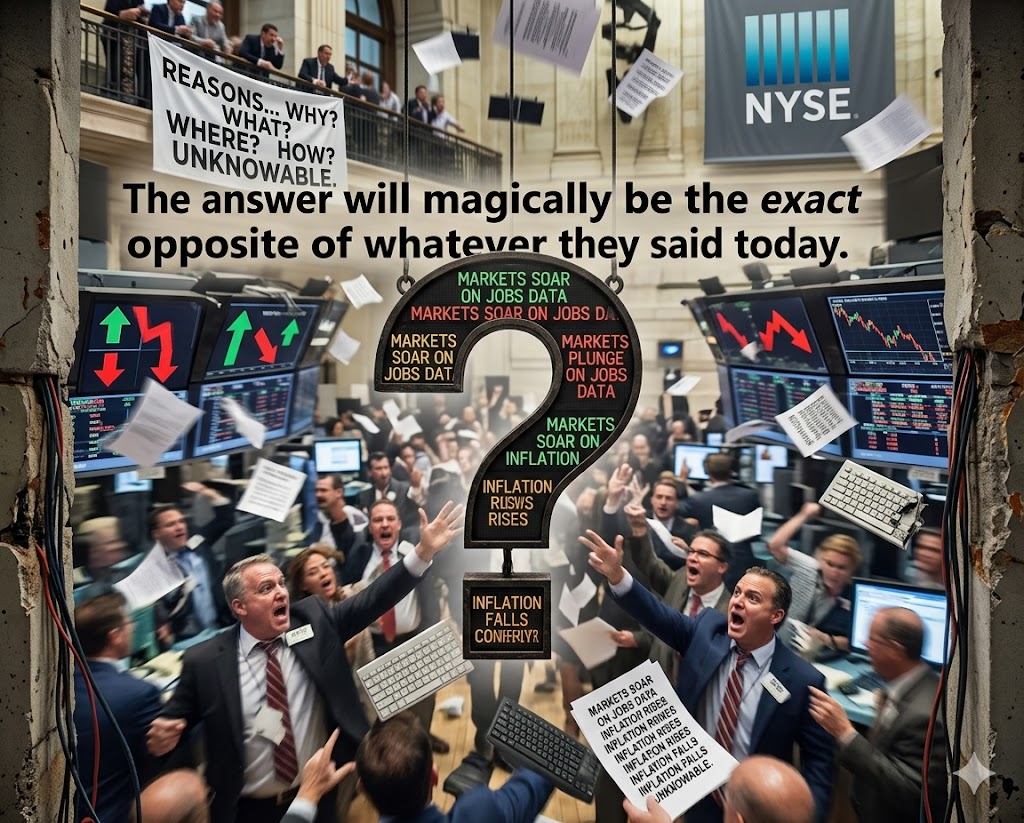
Trick question. The answer is whatever a financial reporter on a deadline decided to type at 4:02 PM EST. And tomorrow, when the same index closes down 0.4%, the answer will magically be the exact opposite of whatever they said today — and they’ll deliver it with the same straight face you used when you told your kid the tooth fairy is real.
Welcome to the wonderful, ridiculous, deeply unserious world of financial news narrative manufacturing. Pull up a chair. We’re going to have some fun with this.
The Rule Nobody Says Out Loud
Here is the dirty secret of financial journalism, the one nobody at CNBC will tattoo on their forehead even though they should:
The market moved. Then a reporter wrote the reason. Not the other way around.
Stocks don’t get up in the morning, decide “today I shall fall 1.2% because of mounting concerns over Treasury yields,” and then helpfully fax that explanation to Bloomberg. They just move. They move because trillions of dollars are sloshing around at any given moment, driven by automated algorithms, panicked retail traders, hedge funds rebalancing portfolios, sovereign wealth funds doing whatever sovereign wealth funds do, pension fund Larry hitting his quarterly target, options expiry mechanics nobody actually understands, and a teenager in Idaho who just learned what “puts” are.
Then, after all that chaos has shaken out and the closing bell rings, a financial reporter has approximately 90 seconds to file a story explaining what just happened. To 47 million readers. With confidence. Even though literally nobody knows.
The system has only one rule: the headline must contain a reason. “Stocks Closed Mixed Today For Reasons That Are Frankly Unknowable Even To The Most Sophisticated Quants In The World” is not a headline that gets clicks.
So the reporter looks at the day’s news, picks the shiniest available explanation, and slaps it on the chart. Voilà. Causation invented. Narrative complete. Everybody home by 5pm.
The Greatest Hits of Financial News BS
Once you start watching for it, you’ll see the pattern everywhere. Financial reporters draw from a finite set of pre-approved Reasons The Market Moved™. Allow me to introduce you to the canonical list:
The “Cheered” / “Shrugged Off” Combo
This is the heavyweight champion. Every market move can be assigned to either:
- Markets cheered [whatever good thing happened]
- Markets shrugged off [whatever bad thing happened]
The beautiful thing? The same news event can be cheered or shrugged off depending on which direction the market went. A jobs report comes in hot. Stocks go up? “Markets cheered the strong jobs data, signaling a resilient economy.” Stocks go down? “Markets shrugged off the strong jobs data on concerns it could delay Fed rate cuts.”
Same data. Opposite narrative. Both delivered with absolute confidence. Nobody ever calls them on it.
The Mystery of “Investors”
Financial news talks about “investors” the way old novels talk about “society.” It’s a vague, anthropomorphized blob that has feelings, makes decisions, and apparently has weekly meetings nobody invited you to.
- “Investors are concerned about valuation.”
- “Investors rotated into defensive sectors.”
- “Investors are awaiting Fed clarity.”
Who are these investors? Where do they live? Did they all get the same memo? Did they vote? Is Carl from Toledo invited to these meetings, or is he excluded for being too on-the-nose?
The truth: “investors” is a magic word that lets reporters attribute coordinated motivation to 75 million strangers who in reality have absolutely nothing in common except that they all happen to own some VOO.
The Beautifully Vague “Concerns”
Pay attention to this one because it’s everywhere. “Concerns over inflation.” “Concerns over the Fed.” “Concerns over geopolitical tensions.”
The word “concerns” is the financial reporter’s secret weapon. It can be applied to literally any topic at any moment without ever needing evidence. Are markets actually concerned? Is anyone polling them? Is there a Concerns Index? Of course not. But “concerns” sounds responsible, sober, and journalistic, so it gets deployed dozens of times a day.
You could write a financial news headline that says “Markets Drift Lower On Concerns About The Color Beige” and 60% of readers would nod and move on.
The Always-Available “Profit-Taking” and “Bargain Hunting”
These are the duct tape of financial journalism. When a reporter has absolutely no idea why something moved but has to file a story, they reach for one of these two:
- Stocks went down after going up? Profit-taking.
- Stocks went up after going down? Bargain hunting.
Both phrases are 100% non-falsifiable. Nobody ever announces “yes, that was me, taking profits.” Nobody ever calls in to say “I am a bargain hunter and that was indeed me.” The phrases exist purely to fill space in a sentence that needs a verb.
The Mystical “Technical Levels”
When all else fails, reporters can blame technical levels — invisible support and resistance lines on charts that supposedly have magical influence over market behavior.
- “The S&P 500 broke through key support at 5,800.”
- “Stocks bounced off resistance at the 50-day moving average.”
Are these levels real? Sort of, in the sense that some traders actually do watch them. Are they the actual cause of any meaningful market move? Almost never. But they sound technical, they sound expert, and most importantly, they sound like a reason. Which is the only thing required.
The Eternally Reliable “Fed Speak”
Every single business day, a Federal Reserve official is saying something somewhere. Maybe it’s a dinner speech in Cleveland. Maybe it’s a panel in Geneva. Maybe it’s an interview that lasts 14 minutes on Bloomberg radio.
Whatever they said, financial reporters can — and will — find the one sentence that “moved markets.” Did markets actually move because of that one sentence? Almost certainly not. Are 14,000 traders on Wall Street all listening to the Cleveland dinner speech in real time? Reader, they are watching March Madness brackets and arguing about lunch.
But “Fed Hawkish Comments Spook Markets” is a real, postable, clickable headline. So Fed-speak gets blamed. Daily.
Brian’s Take: Financial News Is Designed to Make You Trade. Successful Investing Is Designed to Make You Not Trade.
The fundamental conflict at the heart of financial media is that their entire business model depends on you feeling a sense of urgency that, statistically, is bad for your portfolio. Every breaking news alert, every “markets in turmoil” chyron, every red number flashing across the screen exists to convince you that right now is a critical moment requiring action — when in reality, the boring truth is that doing nothing has outperformed doing something for 95% of investors over 95% of years for the last 95 years.
— Brian
The Same Day, Two Networks, Two Realities
Want to test how absurd financial news narratives are? Here’s a fun experiment: on any given trading day, flip between CNBC and Bloomberg. Or read the Wall Street Journal and Reuters stories on the same market move.
You will frequently find:
- Network A: “Stocks Slid Today on Concerns Over Sticky Inflation”
- Network B: “Stocks Slid Today on Disappointing Earnings From Tech”
- Network C: “Stocks Slid Today as Investors Rotated Out of Risk Assets”
- Network D: “Stocks Slid Today After Hot CPI Data”
Different reasons. Same market. Same day. Each delivered with absolute conviction.
The kicker? Often none of them are actually correct. The market moved because a $40 billion sovereign wealth fund quietly rebalanced its portfolio overnight, or because a major options expiry created mechanical pressure, or because a Japanese carry trade unwound, or because the algorithms that now drive 70%+ of daily volume just did their algorithm thing. Boring, technical, structural reasons rarely make for compelling headlines.
So the headlines invent more compelling reasons. And we, the audience, dutifully internalize them and feel like we understand the market.
We don’t. Nobody does. That’s not a knock — it’s just the math of a system with millions of moving parts that can’t be reduced to a 12-word headline.
The Existential Crisis of “Markets Closed Mixed”
Sometimes — usually a few times a week — the market just sort of… muddles around. Some sectors up. Some sectors down. The S&P 500 finishes basically flat. Nothing happened. Everyone went home.
This is a financial reporter’s worst nightmare.
Because the rule of financial journalism is the headline must contain a reason, and “nothing meaningful happened today” doesn’t sell ad space, reporters resort to perhaps the funniest invention in the entire genre:
“Markets Closed Mixed.”
This phrase is doing extraordinary work. It implies analysis. It implies coverage. It implies a thoughtful summary of the day. What it actually means is “we have nothing to report and we’re hoping you don’t notice.”
Read on, and you’ll get an entire 600-word article explaining why mixed-ness happened, with quotes from analysts, references to forward earnings, and concerns about something or other. The whole article exists because finance can’t admit that some days are just boring and that’s actually fine.
Brian’s Take: The Best Investors I Know Read Less Financial News, Not More.
The pattern I’ve watched for two decades is that the people who consume the most financial news are the ones who underperform the most, while the people who basically ignore it and stick to a long-term plan tend to look like geniuses ten years later. There’s a real sense in which the financial news industry’s job is to convert your patience into anxiety, and your anxiety into trading activity, and your trading activity into someone else’s profits — and the only way to win that game is to refuse to play it.
— Brian
The CNBC Chyron Experience: A Tour
If you’ve ever sat in a hotel gym in the morning and accidentally watched CNBC for 45 minutes, you’ve seen the chyron experience. Let’s annotate a typical hour:
- 8:14 AM: “Markets Set To Open Higher On Optimism”
- 8:47 AM: “Markets Set To Open Higher On Cautious Optimism”
- 9:31 AM: “Stocks Open Mixed As Investors Weigh Conflicting Signals”
- 10:02 AM: “Stocks Slide As Yields Rise”
- 10:48 AM: “Stocks Recover As Bargain Hunters Step In”
- 11:21 AM: “Stocks Slip Again On Renewed Concerns”
- 11:55 AM: “Stocks Drift Sideways Ahead Of Fed Speaker”
- 12:32 PM: “Stocks Pop On Fed Speaker Comments”
- 1:06 PM: “Stocks Give Up Gains On Profit Taking”
- 1:54 PM: “Stocks Mixed As Market Awaits Clarity”
- 2:27 PM: “Stocks Stage Late-Day Rally”
- 3:11 PM: “Stocks Pare Gains In Final Hour”
- 3:58 PM: “Stocks Close Modestly Higher On Cautious Optimism”
Each chyron is treated as urgent breaking news. Each one is delivered by an anchor with a serious face. Each one represents a 0.1-0.3% move that will be entirely forgotten by the time you brush your teeth tomorrow.
If you watched only that one hour, you’d believe you’d witnessed a roller coaster of historic proportions. In reality, the market did roughly nothing. But the drama machine ran the entire time, because the drama machine has to.
How to Actually Read Financial News (Without Losing Your Mind)
Look, financial news isn’t going away. It serves a purpose — markets matter, public companies need scrutiny, business journalism is a legitimate profession with serious practitioners. The problem isn’t the existence of financial news. The problem is how it’s consumed.
Here’s a sane reader’s framework:
- Mute the daily noise. Daily and intraday market commentary is, with rare exceptions, ear candy. Don’t make portfolio decisions based on it. Ever.
- Trust trends, not days. A single day’s move is meaningless. A six-month trend is worth thinking about. A multi-year structural shift is worth acting on.
- Watch what reporters cite, not what they assert. Long-form business journalism that cites real data, real filings, real interviews, and real numbers is genuinely useful. The breathless 200-word “stocks fell on concerns about” articles are not.
- Distrust certainty. Any reporter or analyst who claims to know exactly why the market did anything on any given day is either lying, confused, or selling something. Healthy financial commentary embraces uncertainty.
- Recognize the incentive structure. Financial news outlets need clicks. Clicks come from emotion. Emotion comes from urgency. Urgency comes from “BREAKING” and “PLUNGE” and “SOAR” and “CONCERNS.” If the headline is screaming, that’s a tell.
- Read the Wall Street Journal, the Financial Times, Bloomberg’s long-form features, and Barron’s quarterly summaries. Skip the 30-second hot takes. Quality journalism still exists in finance — it just doesn’t dominate the chyrons.
- Build a rule: no portfolio decisions during news cycles. If you’re tempted to trade because of something you just read or watched, that’s almost always exactly the wrong moment to act.
Brian’s Take: The Dumbest Money in the Market Is Usually the Most Confident About What’s Happening Today.
Every time I see a retail investor explaining with absolute certainty why the market just moved, I know I’m watching someone who’s about to learn an expensive lesson — because real conviction in markets comes from understanding how little you actually know about any given day’s noise. The investors who built generational wealth got there by being humble about the short term and patient about the long term, which is exactly the opposite of what financial news is constantly trying to make you feel.
— Brian
A Tribute to “Sources”
Financial news has a final magical ingredient that deserves its own appreciation: sources.
Read enough Bloomberg or Reuters and you’ll notice the elegant architecture:
- “according to people familiar with the matter”
- “sources who spoke on condition of anonymity”
- “a person with knowledge of the discussions”
- “two officials briefed on the situation”
Who are these people? Are they real? Are they the same person? Is “person familiar with the matter” maybe just the reporter’s roommate? We will never know. The Vatican has more transparency than financial news sourcing.
Sometimes the article is built on three layers of these unnamed people stacked like a journalistic taco. “According to a source familiar with discussions among people briefed on conversations with officials with knowledge of the matter…” Translation: someone heard a thing from someone who heard another thing, and now it’s the lead headline.
Treat every sourced financial news scoop with the same skepticism you’d apply to gossip at a high school cafeteria. Sometimes it’s right. Often it’s wrong. Always it’s incomplete.
The Punchline
Here’s the cosmic joke of financial news: the very thing that makes it most addictive — the constant, dramatic, narrative-rich coverage of every twitch in the market — is also the thing that makes it most useless for actually building wealth.
Real investing is boring. It involves picking a sensible asset allocation, contributing regularly, ignoring noise, and waiting two or three decades. There is approximately zero drama in the actions that produce financial security.
But you can’t sell ads against zero drama. You can’t fill 24 hours of cable programming with “remember to keep dollar-cost-averaging into your index funds and check back in 25 years.” You can’t get someone to subscribe to a newsletter promising “we will tell you basically nothing today because basically nothing happened.”
So financial news manufactures drama. Every. Single. Day.
The market moved 0.3%? BREAKING NEWS.
A Fed governor said something mildly hawkish at lunch? MARKETS REACT.
Inflation came in 0.1% above expectations? STOCKS PLUNGE ON FEARS OF STICKY INFLATION.
It’s a beautifully orchestrated dance of urgency designed to keep you watching, reading, clicking, and most dangerously, trading. Because every time you trade based on financial news drama, somebody else — usually a hedge fund algorithm with a much better understanding of the actual structural dynamics — is delighted to take the other side.
What to Do With All This
Here’s the punchline you’ve been waiting for: the appropriate response to financial news is mostly to laugh at it and ignore it. Not in a smug, dismissive way — financial markets matter, and serious business journalism deserves serious engagement. But in the way you’d treat a particularly dramatic friend who insists every minor inconvenience is a five-alarm fire.
Acknowledge the entertainment value. Enjoy the spectacle. Marvel at the creativity of the same reporter writing “stocks rose on optimism” on Tuesday and “stocks fell on optimism fatigue” on Wednesday.
But don’t make portfolio decisions based on it.
Don’t let it spike your blood pressure.
Don’t refresh the apps fifteen times a day.
Don’t fire off a panicked text to your financial advisor every time CNBC types “PLUNGE” in red letters at the bottom of the screen.
Because here’s the thing — and this is the most important sentence in this entire article — the market will continue to do what it’s done for 100+ years: rise over the long term, in unpredictable bursts, with daily moves that no human can reliably explain, while financial news anchors continue to explain them anyway with the absolute confidence of someone reading horoscopes on the radio.
Your job, as a sane investor, isn’t to figure out why the market moved today. Your job is to not care.
Have a portfolio. Contribute consistently. Ignore the noise. Let the chyrons scream. Let the analysts pontificate. Let the headlines invent reasons.
Tomorrow, when the market does something different, the headlines will invent the opposite reasons. And the day after that, they’ll invent more reasons. And the day after that. Forever. Until the heat death of the universe or until cable news finally goes off the air, whichever comes first.
You, meanwhile, will be over here building wealth quietly. With a smile. And maybe, on really dramatic news days, a little popcorn.
A Final Sample Headline Generator
To send you off, here’s a randomly generated financial news headline you can use any day of the week:
“[Stocks/Bonds/Treasuries] [Slide/Climb/Drift] As [Investors/Traders/Markets] [Cheer/Shrug Off/Weigh] [Fed/Inflation/Earnings/Tariff] [Concerns/Optimism/Uncertainty].”
Mix and match those brackets. You will produce a headline that is functionally indistinguishable from the actual headlines published by every major financial news outlet today.
You’re welcome.
Now go close the app. The market is going to do whatever it’s going to do, with or without your permission.
The best investors aren’t the ones who watch the most. They’re the ones who learn to look away.
Cue the closing chyron: “Stocks Closed Higher On Cautious Optimism After Mixed Day Of Trading.”
Of course they did.
About the Author