April 28, 2026
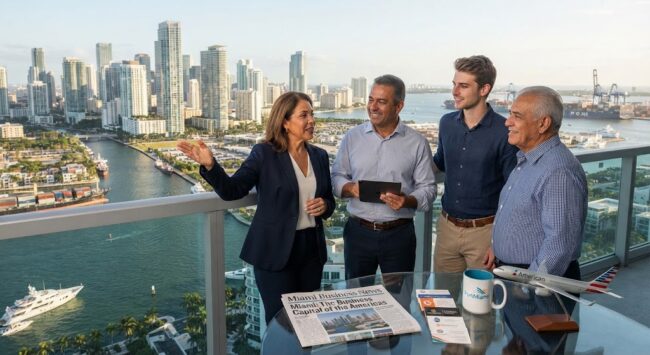
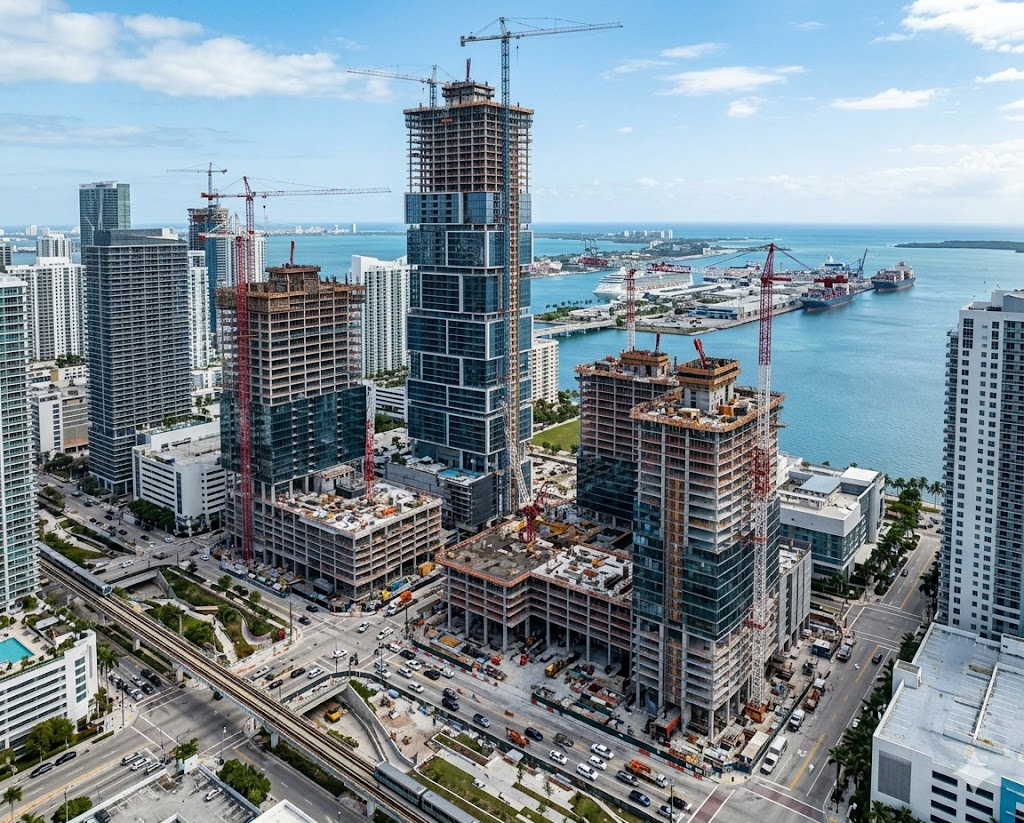
The Miami skyline isn’t just changing. It’s being rewritten — block by block, tower by tower, district by district — at a velocity that even longtime Miamians find disorienting.
The Waldorf Astoria Residences rising 1,049 feet in the heart of downtown, soon to be the tallest building south of New York City. Cipriani Residences Miami in Brickell already standing at 872 feet and climbing toward 950. The Residences at Mandarin Oriental Miami, an 850-foot South Tower joining forces with Harrods Interior Design. Miami Worldcenter, the 27-acre downtown district that just opened as one of the largest urban developments in America. The Underline, a 10-mile, 120-acre linear park stretching beneath the Metrorail. Miami International Airport’s $600.6 million Concourse K expansion. One Brickell Riverfront towers topping off. The Perigon Miami Beach. The Well Coconut Grove. 501 First welcoming residents. Pagani Residences. Frida Kahlo Residences. NoMad Residences Wynwood. The William in North Beach. Miami Freedom Park stadium opening this year as David Beckham’s Inter Miami CF gets a permanent home.
And we haven’t even mentioned the City of Miami’s Capital Improvements pipeline funding fire stations, police facilities, the Pedestrian Baywalk under the I-395 bridge, the Marine Stadium Basin Trail, or the dozens of municipal projects keeping the public infrastructure of Miami-Dade County functional and growing.
It is, by any measure, one of the most aggressive sustained construction booms any American city has ever experienced. And yet, behind every crane, every tower, every public infrastructure dollar — quietly, invisibly, relentlessly — sits a financial instrument the average Miamian has probably never thought about:
The construction bond.
If you live, work, invest, develop, contract, supply, or pay taxes in Miami-Dade County, construction bonds are the silent guarantor of nearly everything being built around you. Without them, this skyline doesn’t exist. With them, Miami has the financial confidence to keep redefining the future of urban America.
Let’s pull back the curtain on how it all actually works.
What Is a Construction Bond? A Plain-English Breakdown
A construction bond — also referred to as a surety bond or contract bond — is a legally binding three-party agreement that financially guarantees a construction project will be completed according to its contract terms. The three parties involved are:
- The Principal — the contractor performing the work.
- The Obligee — the project owner who requires the bond (this could be the City of Miami, Miami-Dade County, the State of Florida, the federal government, a private developer, or a construction lender).
- The Surety — the bonding company that financially backs the contractor’s promise to perform.
Here’s the simple value proposition: if the contractor defaults — by walking off the job, going bankrupt, doing defective work, failing to pay subcontractors, or otherwise blowing it — the surety steps in. The surety either pays damages to the project owner, hires a replacement contractor, finances completion of the work, or some combination of all three. The maximum exposure is capped at the bond amount, which on Florida public projects is typically 100% of the contract price.
For everyone touching a Miami construction project — owner, lender, subcontractor, supplier, taxpayer — the bond is the safety net that makes the whole high-stakes operation viable.
The Four Construction Bonds Every Miami Player Should Know
Whether you’re a Brickell developer signing a $400 million construction loan, a contractor bidding on a Miami-Dade County library renovation, or a subcontractor pouring concrete on a Wynwood mixed-use building, these are the bonds you’ll encounter:
- Bid Bonds. Submitted with a contractor’s bid. Guarantees that if the contractor wins the project, they’ll actually sign the contract on the bid terms and provide the required performance and payment bonds. Without bid bonds, contractors could submit lowball bids, win projects, then disappear when reality hits — a chaos Florida law refuses to allow on public works.
- Performance Bonds. Guarantee that the contractor will complete the project according to specs, on time, and to required quality standards. If they fail to perform, the surety either finishes the work or compensates the owner for completion costs.
- Payment Bonds. Guarantee that subcontractors, laborers, and material suppliers will get paid even if the prime contractor fails them. This is the bond that protects the small Miami businesses doing the actual labor and providing the actual materials.
- Maintenance (or Warranty) Bonds. Cover defects and warranty obligations after the project is complete, typically for one to two years post-completion. Maintenance bonds matter most on infrastructure projects and large public works where defects sometimes emerge only after months of use.
In Miami, where projects routinely exceed nine and ten figures and where one stalled tower can cascade into millions in losses for everyone connected to it, all four bond types are everyday tools of the trade.
Brian’s Take: Construction Bonds Are the Reason Miami’s Skyline Doesn’t Look Like a Graveyard.
Every glittering Brickell tower, every Wynwood condo, every Miami-Dade school and fire station exists because somewhere in the background a surety company evaluated the contractor and said, “Yes, we’ll back this.” Without that single act of underwriting confidence, half the projects you drive past every day would have stalled mid-construction and never recovered.
— Brian
The Florida Legal Framework: Why Bonds Are Mandatory on Miami’s Big Projects
Miami’s construction boom doesn’t happen on the honor system. It happens because Florida law explicitly requires surety bonds on virtually every meaningful public project — and because private lenders and developers in Miami’s competitive marketplace effectively require them on private projects too.
Florida’s Little Miller Act (Section 255.05)
The cornerstone of Florida public works bonding is Section 255.05 of the Florida Statutes, commonly known as Florida’s Little Miller Act. It functions as the state-level mirror of the Federal Miller Act (40 U.S.C. § 3131), which imposes bonding obligations on federal contracts above $100,000.
Here’s what Section 255.05 requires for state and local public projects in Miami:
- Public contracts of $100,000 or less may be exempt from bonding.
- Contracts between $100,000 and $200,000 — the local government may, at its discretion, exempt the contractor from bonding obligations.
- Contracts of $200,000 or more — payment and performance bonds are required, generally in an amount equal to 100% of the contract price.
- Counties and municipalities may waive bonding requirements on contracts of $200,000 or less, but most major Miami-Dade jurisdictions require bonding regardless as a matter of standing policy.
When you stack that against the reality that the City of Miami’s Office of Capital Improvements runs hundreds of millions of dollars in active public projects at any given moment — and Miami-Dade County’s combined municipal, school district, and special-district construction spending pushes well into the billions annually — it becomes obvious: virtually every meaningful public construction project in Miami-Dade County is bonded.
FDOT and Major Transportation Projects: A Distinct Framework
Florida’s transportation construction operates under its own bonding regime via Section 337.18 of the Florida Statutes, which governs Florida Department of Transportation contracts. Under FDOT rules:
- A surety bond is required of the successful bidder in an amount equal to the awarded contract price.
- FDOT may waive bonding for non-critical contracts of $250,000 or less.
- For mega-projects of $250 million or more, FDOT can use a hybrid approach — partial surety bond plus alternative security mechanisms like letters of credit, U.S. bonds and notes, parent company guarantees, or cash collateral.
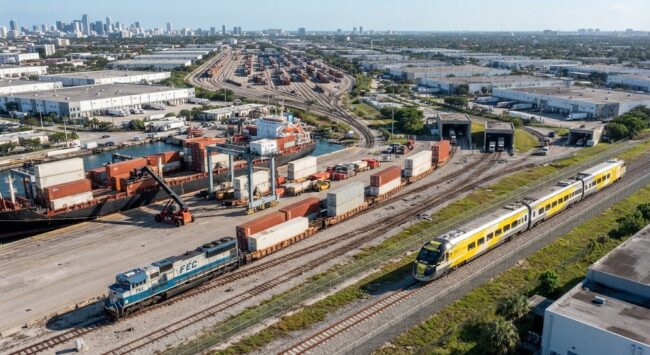
This matters intensely in Miami. Major projects like the I-395 Signature Bridge replacement, the ongoing Brightline rail expansion (which has dramatically driven up surrounding property values, with research from the City of Boca Raton indicating 83% gains near transit hubs), the Dolphin Expressway and Palmetto Expressway modernizations, and the PortMiami infrastructure investments are all bonded under Section 337.18. Every one of them required contractors to walk into a surety underwriter’s office, present financial statements, and prove they could be trusted with the public’s transportation dollars.
Florida’s Construction Lien Law for Private Miami Projects
Public sector projects aren’t the only bonded work in Miami. Florida’s Construction Lien Law (Chapter 713 of the Florida Statutes) also creates bonding tools and protections for private projects:
- Section 713.23 allows private developers to use a payment bond as an alternative to facing potential lien claims from subcontractors and suppliers. For luxury condo developers who can’t afford liens clouding their titles or scaring away pre-construction buyers, payment bonds are essential.
- Section 713.245 authorizes “Conditional Payment Bonds” with specific protections.
For Miami’s private mega-developments — Cipriani Residences, the Waldorf Astoria, the Mandarin Oriental Residences, Miami Worldcenter, NoMad Wynwood, The Perigon Miami Beach, every Brickell luxury tower, every Sunny Isles oceanfront condominium — payment bonds are a foundational part of how developers keep liens off their property and keep their construction lenders comfortable.
How Construction Bonds Actually Power Miami’s Skyline
Now let’s connect the legal framework to what’s literally happening on Miami streets right now.
Bonds Pre-Qualify Every Major Contractor in Miami
Before a surety company will issue a bond on a Miami project, they conduct rigorous underwriting. They review the contractor’s CPA-prepared financial statements, work-in-progress reports, project history, ownership structure, bank references, subcontractor relationships, and personal indemnity from the principals. Effectively, the surety functions as a financial gatekeeper, screening out contractors who don’t have the experience or balance sheet to deliver.
This is enormous for Miami. With billions of dollars of active development across the metro at any moment, the city simply cannot absorb a wave of contractor failures. The surety underwriting process quietly filters out marginal players before they ever swing a hammer on a major Miami project, which means the ecosystem stays remarkably stable even at this scale.
Bonds Protect Public Funds in Miami-Dade
When the City of Miami, Miami-Dade County, the Miami-Dade County Public Schools, the Greater Miami Expressway Agency, Miami International Airport, PortMiami, or any other governmental entity invests taxpayer money, construction bonds are how those tax dollars don’t get vaporized. If the contractor fails, the surety pays — not the taxpayer.
Across the United States, surety companies have collectively paid billions of dollars over the years on bonded projects where contractors failed. Without bonding, every one of those losses would have hit owners — and ultimately taxpayers — directly. In a high-volume building region like Miami-Dade, the insurance value of bonding is genuinely staggering.
Bonds Protect the Subcontractors Who Build the City
Walk onto any Miami construction site and you’ll see the truth of how this city is built: framers, electricians, plumbers, drywall crews, concrete pumpers, glaziers, HVAC installers, equipment rental companies, and material suppliers. Most of them are small Miami-Dade businesses, often family-owned, with thin margins and limited cash reserves.
Without payment bonds, when a prime contractor goes belly-up or simply refuses to pay, those subcontractors and suppliers can lose tens of thousands or hundreds of thousands of dollars overnight — often enough to put them out of business. Payment bonds change that math entirely. A subcontractor on a bonded Miami project knows they have a legal recourse against the bond if the prime contractor fails to pay, with the right notices filed under Florida Statute 255.05’s strict timelines.
Bonds Make Miami’s Construction Lending Possible
This is the part most people miss when they admire a new Brickell tower. The Cipriani Residences didn’t get built with a developer’s checkbook — it got built with massive construction loans from international banks, life insurance companies, and capital partners. Construction lenders financing nine- and ten-figure Miami projects do not fund unbonded work on the high end of the market.
A lender financing a 1,049-foot Waldorf Astoria tower needs to know the contractor cannot vanish mid-build leaving the project a half-finished mess and the loan upside-down. The bond is part of what makes the loan possible. No bond, no loan. No loan, no project. No project, no skyline.
That’s the cascade Miamians should understand: the bond makes the loan, the loan makes the project, the project makes the skyline.
Brian’s Take: Miami’s Smartest Developers Treat the Surety Underwriter as a Second Lender.
Every major Miami developer learns quickly that the surety underwriter functions as a second financial gatekeeper alongside the construction lender, evaluating not just whether the contractor can finish but whether they can finish on time and within tolerance. The reason Miami’s mega-projects keep delivering at world-class quality is that the bonding industry has quietly raised the bar for who’s allowed to build them in the first place.
— Brian
Real Miami Projects That Couldn’t Exist Without Construction Bonds
Let’s get specific about the headline developments reshaping Miami right now and the bonding implications behind each:
- Waldorf Astoria Residences Miami. A roughly 1,049-foot supertall tower that will be the tallest residential building south of New York City when completed. The bonding burden on a project of this scale ranks among the largest in Miami history.
- Cipriani Residences Miami. Mast Capital’s 872-foot Brickell luxury tower with nearly 400 residences, a 37th-floor speakeasy, and 50,000 square feet of amenities. Targeting completion in 2027.
- The Residences at Mandarin Oriental Miami. Swire Properties’ joint development with Harrods Interior Design and KPF architects, anchored by an 850-foot South Tower with 228 units. Penthouses listing for $50 million. Groundbreaking in early 2026, completion targeted for 2030.
- Miami Worldcenter. The 27-acre, 16-tower mixed-use district that officially opened as a downtown neighborhood in 2025. The 32-story 600 Miami Worldcenter condominium tower, now sold out, is targeting completion later in 2026.
- NoMad Residences Wynwood. Related Group, Tricap, and Lndmrk Development’s 9-story, 329-unit Arquitectonica-designed Wynwood building. Topping off in October 2024, with closings beginning Q1 2026.
- 501 First (Miami Worldcenter). Recently opened with a Temporary Certificate of Occupancy in December and now welcoming residents.
- The Well Coconut Grove. Terra Group and AB Asset Management’s wellness-focused 8-story, 194-residence project. Broke ground January 2026 after securing a $410 million construction loan.
- The Perigon Miami Beach. Mid-Beach low-density ultra-luxury beachfront tower with elevated residences, sculpted volumes, and bespoke interiors.
- Rivage Bal Harbour. A design-forward, low-density alternative to the Bal Harbour luxury stock with deep terraces and limited inventory.
- One Brickell Riverfront. Both towers topped off, with ongoing construction on amenities and the riverfront public space infrastructure.
- Pagani Residences. A first-of-its-kind partnership with the exotic car dealer Prestige Imports, raising the bar on lifestyle amenity programming.
- Miami International Airport Concourse K. Miami-Dade County approved a $600.6 million budget for six new gates, ground support facilities, baggage systems, and airfield infrastructure. Broke ground June 2025; completion targeted spring 2029.
- MIA Concourse F improvements. Targeting completion in 2026.
- The Underline. A 10-mile, 120-acre linear park, with the second 2.14-mile phase through Coconut Grove and south of Brickell already opened in 2024 and the southern segment through Coral Gables and South Miami targeted for 2026 delivery.
- Miami Freedom Park stadium. Inter Miami CF’s permanent home, opening in 2026 and serving as a catalyst for surrounding property values.
- 1 Southside Park. JDS Development Group’s revised 64-story mixed-use tower in Brickell, anchoring the financial district that’s drawing tenants like Microsoft.
- Frida Kahlo Residences, Kempinski Residences, Chipperfield, Shelton, La Baia South. A new wave of branded ultra-luxury residential debuts across Miami’s submarkets.
- City of Miami Capital Improvement Projects. Fire Station 10 reconstruction, Miami Police Department South Station restroom renovations, Pedestrian Baywalk and Bikeway under the I-395 bridge, Marine Stadium Basin Trail, and the broader Parks Master Plan.
Now multiply each of those projects by the dozens of other multi-million-dollar developments scattered across Brickell, Downtown, Edgewater, Wynwood, Design District, Coconut Grove, Coral Gables, Miami Beach, Bal Harbour, Sunny Isles, Aventura, Doral, North Beach, and Coral Gables. The collective bonded construction capacity required to power all of it simultaneously is unprecedented.
The Cost of Construction Bonds in Miami
For contractors trying to enter or expand in the Miami market, here’s the practical math:
- Bond premiums typically run 1% to 3% of the bond amount for contractors with strong financials, solid credit, and meaningful project history.
- Higher-risk situations can run 3% to 15% — for newer contractors, weaker balance sheets, lower credit scores, or specialty/high-risk project types.
- On very large projects (think hundreds of millions of dollars), premiums can drop below 1% as economies of scale and creditworthy underwriting kick in.
For a contractor bidding on a $10 million bonded Miami public project, the bond premium might run anywhere from $100,000 to $300,000 — a real cost, but one baked into the bid that ultimately enables the contractor to compete for projects that would be inaccessible without bonding.
What Miami-Focused Sureties Want to See
If you’re a contractor wanting to expand your bonded capacity to chase the Miami boom, sureties typically want:
- Audited or CPA-reviewed financial statements for the most recent 2-3 fiscal years.
- Work-in-progress reports showing current project commitments and capacity utilization.
- Bank reference letters demonstrating credit relationships and lines of credit.
- Personal financial statements from owners (almost always required for personal indemnity).
- Resume of completed projects demonstrating experience at the size and complexity of your target work.
- Organizational documents including operating agreements, articles of incorporation, and key personnel bios.
- References from past project owners and other sureties.
The stronger your financial picture and project history, the higher your aggregate bonding capacity — and the bigger the Miami projects you can chase. In a market where individual projects regularly exceed $100 million, your bonding capacity directly determines your competitive ceiling.
Brian’s Take: In Miami, Your Bonding Capacity Is Your Growth Ceiling.
The contractors quietly winning the biggest Miami towers spend as much time managing their relationship with the bonding company as they do with their actual customers, because every dollar of additional bonding capacity unlocks another dollar of project pursuit. If you’re a Miami GC operating without a long-term surety relationship at a top-rated carrier, you’re effectively capping your business growth at a level your better-bonded competitors will surpass while you watch.
— Brian
When a Bond Claim Happens: How the Process Plays Out in Miami
Construction bonds aren’t theoretical. They get used. Here’s how a typical bond claim unfolds on a Miami project:
- A default occurs. The contractor walks off the job, files bankruptcy, fails to pay subs, or delivers defective work the owner formally rejects.
- The owner declares default with proper notice to both contractor and surety, and terminates the contractor’s right to complete the work.
- The surety investigates the claim — verifying the default’s legitimacy, weighing the contractor’s defenses, calculating real cost-of-completion, and assessing total exposure.
- The surety chooses a remedy. Options typically include: financing the original contractor to finish, hiring a replacement contractor and paying the cost difference, negotiating a buy-out with the project owner, or paying damages up to the bond limit.
- The surety pursues the principal under the indemnity agreement, because almost every contractor has signed personal and corporate indemnity meaning they’re ultimately on the hook for surety losses.
Strict notice requirements under Florida Statute 255.05 govern subcontractor and supplier claims on payment bonds for public projects. Subcontractors without a direct contract with the prime contractor must serve a Notice to Contractor within 45 days of starting work, and a Notice of Nonpayment must typically be served within 90 days after the last furnishing of labor or materials. Missing these deadlines can invalidate an otherwise legitimate claim. Every smart Miami subcontractor has a Florida construction attorney on speed dial precisely because of these unforgiving timelines.
What Every Miami Stakeholder Needs to Take Away
Construction bonds aren’t a peripheral detail of Miami’s building boom. They are the financial scaffolding holding it all up. Every developer, contractor, subcontractor, supplier, investor, lender, and taxpayer in Miami-Dade has a stake in understanding them.
For developers: bonding lets you finance, build, and protect your investment.
For contractors: bonding capacity directly determines how large your projects — and your business — can grow.
For subcontractors and suppliers: payment bonds are your insurance policy when the prime contractor fails.
For lenders and capital partners: bonded projects are dramatically safer bets than unbonded ones.
For taxpayers: every public dollar invested in Miami infrastructure is protected by a surety guarantee.
The supertall towers rising over Brickell, the redevelopment of downtown Miami into a world-class urban district, the airport expansions handling tens of millions of passengers, the I-395 Signature Bridge connecting communities, the Underline turning ten miles of urban corridor into linear park, the schools educating Miami-Dade’s children — every one of them is supported by an unseen network of bonding companies, surety underwriters, and construction-finance professionals who never get the credit but always carry the risk.
The next time you drive over the MacArthur Causeway and watch the Miami skyline glittering in the distance, take a second to think about the financial infrastructure quietly supporting it all. Without construction bonds, the towers don’t stand. The streets don’t get paved. The schools don’t get built. The airport doesn’t expand.
With them, Miami keeps doing what it does better than any city in America right now: building the future, vertical foot by vertical foot, one bonded project at a time.
That’s the unglamorous, undersung reality of how a global city actually rises.
Resources & Further Reading
- Florida Surety Association: 10 Things About Surety Bonds — Authoritative state-level overview of how surety bonds work in Florida construction.
- Florida Statute 255.05 (Florida’s Little Miller Act) — The full text of Florida’s primary public works bonding statute, mandatory reading for anyone working on bonded Miami projects.
- Florida Statute 337.18 (FDOT Bond Requirements) — Governs surety bonds on Florida transportation projects, including major Miami infrastructure work.
- City of Miami Office of Capital Improvements — Active list of Miami’s bonded public construction projects across every district.
- Miami-Dade County Internal Services Department — Central resource for county-level procurement, contract administration, and bonding requirements on Miami-Dade public works.
About the Author