How Miami Ranks in U.S. Business & Commerce: A 2026 Comparison Against the Major American Cities
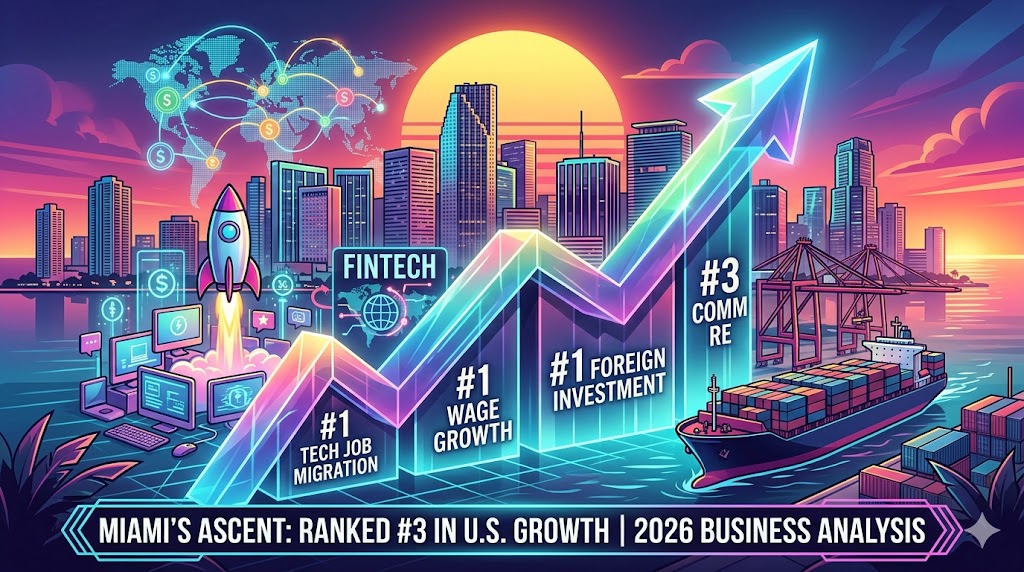
Five years ago, almost no serious financial executive would have ranked Miami above a dozen other American cities for business gravity. Today, that conversation looks dramatically different. With Miami-Dade County posting a $219 billion gross domestic product, the Miami metropolitan area generating more than $400 billion in annual GDP, and the city now ranked the #3 commercial real estate market in the United States for 2026 by the PwC and Urban Land Institute Emerging Trends in Real Estate report, Miami has rewritten its place in the American business hierarchy in less than a generation. The city now ranks #1 in the nation for tech job migration, #1 for wage growth, #1 for direct foreign investment, #1 in diversity, and #1 for Gen X, and serves as the home base for more than 500 fintech companies, 2,500 startups, and a startup ecosystem valued at $95 billion. This is the story of where Miami actually ranks today against the major American business cities — New York, Los Angeles, Chicago, Dallas, San Francisco, Boston, and the rest — and what is driving the city’s continued rise.
Miami’s Economic Scale: How the Numbers Stack Up
To understand Miami’s place in the U.S. business hierarchy, it helps to start with the headline numbers. Miami operates as both an individual city and as the anchor of a much larger metropolitan area that includes Miami-Dade, Broward, and Palm Beach counties — together generating one of the largest regional economies in the country.
Miami-Dade County
- GDP: $219 billion — Miami-Dade is the 14th-largest county economy in the United States by GDP, with an economy roughly the size of Greece [1]
- #1 GDP county in Florida, accounting for 14% of the state’s total GDP [1]
- Population: 2.7 million — The most populous county in Florida and the 7th most populous nationally [1]
- Labor force participation: 63.8% (1.4 million people) — Above national (62.7%) and state (58.8%) averages [1]
- Job growth: 6.7% from 2018–2023 — Outpacing national job growth by 3.1 percentage points [1]
Miami Metropolitan Area (Miami-Fort Lauderdale-West Palm Beach)
- GDP: $400+ billion — Florida’s largest metro area economy, more than twice the size of the Tampa Bay metro [2]
- Population: 6.1+ million — One of the 10 largest metropolitan areas in the United States
- 500,000+ new residents arrived between 2014 and 2024 [3]
State-Level Context
- Florida GDP: $1.726 trillion as of 2024 — The 4th-largest state economy in the United States [2]
- If Florida were a sovereign nation in 2024, it would rank as the world’s 15th-largest economy by nominal GDP, ahead of Spain and behind South Korea [2]
- Florida is responsible for 5.82% of the United States’ approximately $28 trillion GDP [2]
“Brian’s Take #1”
“What people miss when they look at Miami’s rise is that it’s not happening in isolation — it’s happening as part of a Florida economic engine that has quietly become the fourth-largest state economy in the country and would rank ahead of Spain if you treated it as a sovereign nation. Miami isn’t a city competing with Manhattan in a vacuum. Miami is the southern anchor of an entire state that has restructured the U.S. economic map over the last decade. When you have a $219 billion county economy plugged into a $1.7 trillion state economy plugged into the world’s seventh-most important financial hub plugged into the largest U.S. trade gateway to Latin America, you no longer compete on city-against-city terms. You compete on region-against-region terms — and on those terms, Miami is in a different conversation than it was even five years ago.”
Miami’s Place in the U.S. Financial Hierarchy
For decades, the U.S. financial services hierarchy was simple: New York at the top, with Boston, Chicago, San Francisco, and Charlotte filling out the upper tier. Miami was, charitably, a regional player. That has changed dramatically.
Current Financial Hub Rankings
- #7 most important financial hub in the United States [1]
- #24 in the world in the Z/Yen Global Financial Centers Index (September 2023) [4]
- #2 in the United States for international banking presence — South of New York, no other U.S. city has as many international banks as Miami [1]
- 500+ fintech companies currently located in the Miami area [1]
- 6th-best U.S. city for foreign business [1]
How Miami Compares to Top U.S. Financial Hubs (Z/Yen Global Financial Centers Index)
The Z/Yen Global Financial Centers Index ranks the world’s premier financial hubs. The U.S. cities ranked ahead of Miami in the September 2023 index include:
- New York — #1 globally
- San Francisco
- Los Angeles
- Chicago
- Boston — #17 globally
- Washington, D.C.
Miami sits at #24 globally — trailing six U.S. cities, but ahead of multiple international financial hubs and gaining ground in every subsequent annual update [4].
The Brickell “Wall Street of the South” Effect
The center of gravity for Miami’s financial transformation is Brickell — the downtown financial district that has been nicknamed “Wall Street of the South.” Among the major financial firms now headquartered or with significant Brickell operations:
- Citadel — Founder Ken Griffin relocated headquarters from Chicago to Miami
- Point72 Asset Management — Steve Cohen’s hedge fund
- Blackstone — Major Miami office expansion
- Goldman Sachs — Significantly expanded Miami presence
- Microsoft — Major office presence
- Numerous Am Law 100 firms — Driving prime office rents to $73.28 per square foot [5]
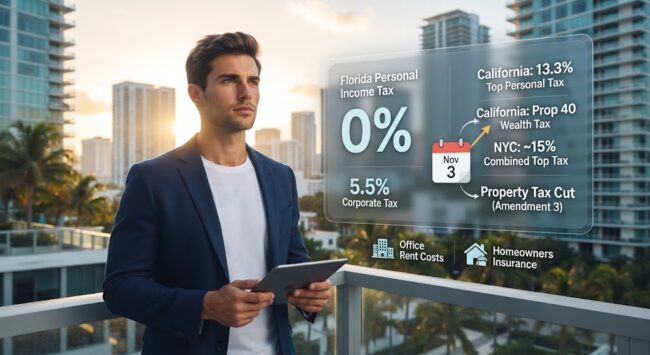
The relocation wave has been driven by a combination of factors: Florida’s zero state income tax, proximity to Latin America, post-pandemic operational flexibility, and the cumulative effect of major firms moving as soon as a few key competitors made the jump.
Miami in U.S. Commercial Real Estate Rankings
The most authoritative annual ranking of U.S. commercial real estate markets is the PwC and Urban Land Institute Emerging Trends in Real Estate report. The 47th annual edition, covering 2026 projections, ranks Miami among the top tier of U.S. markets.
Top 10 U.S. Markets to Watch (Emerging Trends in Real Estate 2026)
- #1: Dallas-Fort Worth
- #2: Jersey City
- #3: Miami
- #4: Brooklyn
- #5: Houston
- Plus Charlotte, Nashville, Tampa, Phoenix, Raleigh-Durham [5]
What’s Driving Miami’s #3 Ranking
According to the report, Miami’s position is propelled by:
- Physical and financial gateway operations serving trade with the Caribbean and Latin America [5]
- Surge of corporate relocations from Northeast markets [5]
- Office rents at $73.28 per square foot for prime space, with waterfront and Brickell submarkets commanding premium pricing [5]
- Asking office rents have doubled over five years in top-tier buildings due to demand from Am Law 100 firms and financial operators [5]
A separate Land App ranking placed Miami at #2 nationally for commercial real estate investment in 2026, behind only Dallas — with Houston, Nashville, and Jersey City rounding out the top 5 [6].
How Miami Compares on Office Rent Pricing
- Miami prime office space: $73.28/sq ft (Brickell and waterfront)
- Manhattan prime: $90+/sq ft in trophy assets
- San Francisco prime: $80+/sq ft
- Los Angeles prime: $70+/sq ft
- Chicago prime: $50–$60/sq ft
- Dallas prime: $50–$55/sq ft
Miami has gone from a discount market to commanding rents that are competitive with Los Angeles and substantially higher than Chicago and Dallas — a reset that has happened almost entirely in the last five years.
Miami’s Tech and Startup Rankings
Miami’s transformation into a meaningful technology hub is the most recent and most contested chapter of the city’s economic rise. The numbers — particularly around startup ecosystem value, venture capital deployment, and tech job migration — are now meaningful enough to warrant comparison with second-tier tech metros.
Current Tech and Startup Rankings
- #1 in the nation for tech job migration [7]
- #1 in the nation for wage growth [7]
- #1 in the nation for direct foreign investment [7]
- #1 in the nation for diversity [7]
- Top 10 destination for venture capital investment in startups [7]
- 2,500 startups in the Miami ecosystem [1]
- 90,000 startup-related jobs [1]
- 6+ unicorns (companies valued at $1 billion or more) [1]
- $95 billion total Miami startup ecosystem valuation [1]
How Miami Stacks Up vs. Major U.S. Tech Markets
The traditional U.S. tech hierarchy — San Francisco Bay Area, New York, Seattle, Boston, Austin, Los Angeles — still occupies the top positions in absolute startup count and total venture capital deployed. Miami has not displaced these markets. But Miami has emerged as the most consequential second-tier tech market in the country, alongside Austin and Denver, and is the fastest-growing tech-job destination by migration rate [7].
eMerge Americas: The Anchor Tech Conference
Miami’s tech conference scene is anchored by eMerge Americas, founded by Manny Medina, which has grown into one of the largest tech conferences in the southeastern U.S. and has attracted speakers including former Google CEO Eric Schmidt and Tom Brady. Schmidt, who now resides in Miami, has called eMerge “the most fun tech conference I’ve ever been to” [7].
Miami as the Trade Gateway
If there is one category where Miami’s ranking is genuinely unrivaled, it is U.S. trade with Latin America and the Caribbean.
Trade Gateway Rankings
- #1 U.S. trading partner with Latin America and the Caribbean — One-third of all U.S. exports to Latin America originate from Miami [1]
- Miami International Airport handles 85% of all U.S. air imports from Latin America [8]
- MIA serves more flights to Latin America than any other U.S. airport [1]
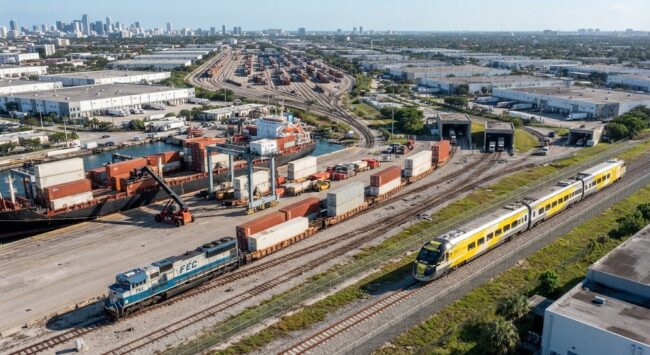
- PortMiami: “Cruise Capital of the World” — Also processes 390,000+ TEUs of imports annually, ranking among the 15 most active container ports in the United States [8]
- 30,000 direct local jobs in trade and logistics
- 340,000 jobs supported by the larger trade and logistics ecosystem in Miami-Dade County [1]
- 88,500 jobs in the aviation industry alone [1]
The Strategic Position
Miami’s geographic position makes it irreplaceable for North-South trade. Bogotá, Caracas, Lima, Santiago, and São Paulo are all closer to Miami than to most major U.S. business cities. The 58.3% foreign-born population — the highest of any major U.S. metro area — and the bilingual labor force amplify that geographic advantage in ways that no Northeast or West Coast competitor can match [1].
Fortune 500 and Corporate Headquarters Comparison
This is the category where Miami still trails the established U.S. business cities meaningfully. The Miami metropolitan area has approximately 6 Fortune 500 companies headquartered locally [9]:
- Lennar (Miami) — #126, $34.2 billion revenue
- NextEra Energy (Juno Beach) — #64, $26.2 billion
- Office Depot (Boca Raton) — #192, $12.1 billion
- World Kinect Corporation (Miami) — #205, $11.3 billion
- AutoNation (Fort Lauderdale) — #212, $11 billion
- Ryder System (Miami) — #426, $5 billion
How Miami Compares to Major U.S. Cities for Fortune 500 HQs
- New York metro: 60+ Fortune 500 headquarters
- Chicago metro: 30+ Fortune 500 headquarters
- Houston metro: 25+ Fortune 500 headquarters
- Dallas-Fort Worth metro: 25+ Fortune 500 headquarters
- San Francisco Bay Area: 25+ Fortune 500 headquarters
- Atlanta metro: 17+ Fortune 500 headquarters
- Boston metro: 13+ Fortune 500 headquarters
- Los Angeles metro: 13+ Fortune 500 headquarters
- Miami metro: ~6 Fortune 500 headquarters
This is a meaningful gap, and it’s the category where Miami most clearly trails the legacy U.S. business cities. However, Miami has a much larger footprint of:
- U.S./Americas regional headquarters — Including Microsoft, Disney, AIG, ExxonMobil, Cisco, Visa, Walmart, Sony, Oracle, SBC Communications, American Airlines, and Kraft Foods [9]
- Latin American regional headquarters — More than 1,400 multinational corporations operate Latin American regional headquarters from Miami
- Family offices — More than 100 family offices have relocated to Miami over the last five years
The headline Fortune 500 number understates Miami’s actual corporate gravity — particularly when international and regional HQ operations are factored in.
“Brian’s Take #2”
“The Fortune 500 number is the one place where Miami’s critics still have a real argument — six headquartered Fortune 500 companies is genuinely fewer than New York, Chicago, Dallas, Houston, or even Atlanta. But that single number obscures something more important: Miami has become the U.S./Americas regional headquarters city for hundreds of multinational firms whose actual Fortune 500 entry is somewhere else. When you look at where global capital is being deployed into the Americas — where the family offices, the hedge funds, the private equity dry powder, and the Latin American regional HQs are based — Miami is no longer in second-tier territory. It’s competing directly with the legacy capitals. The Fortune 500 number will eventually catch up. The other indicators already have.”
How Miami Ranks on Specific Business Indicators
Beyond top-line GDP, financial hub, and Fortune 500 metrics, here is how Miami currently ranks on more specific business indicators:
Population and Growth
- #7 most populous county in the U.S. (Miami-Dade) [1]
- 500,000+ new residents added between 2014–2024 [3]
- #1 in the nation for direct foreign investment [7]
Labor Market
- Above national and state averages for labor force participation (63.8% vs. 62.7% national) [1]
- Job growth: 6.7% from 2018–2023 — Outpacing the national rate [1]
- #1 in the nation for tech job migration [7]
- #1 in the nation for wage growth [7]
Industry Concentration
- #1 in the U.S. for trade with Latin America and the Caribbean [1]
- #1 in the U.S. for cruise port traffic (PortMiami) [8]
- #7 most important financial hub in the U.S. [1]
- #2 in the U.S. for international banking presence [1]
Quality and Diversity Indicators
- #1 in the nation for diversity [7]
- #1 in the nation for Gen X [7]
- 58.3% foreign-born population — highest among major U.S. metros [1]
- 6th-best U.S. city for foreign business [1]
Real Estate and Infrastructure
- #3 commercial real estate market in the U.S. (PwC/ULI 2026) [5]
- #2 commercial real estate market in the U.S. (Land App 2026) [6]
- Office rents doubled over five years in top-tier buildings [5]
Forward-Looking Economic Forecasts
Looking forward, Miami’s projected GDP growth ranks among the most aggressive of any U.S. metropolitan area. The Oxford Economics forecast for the 2024–2028 period identifies Miami and Seattle as the two metros outside the current top 10 that are most likely to outpace national average GDP growth [10].
Projected Top 10 GDP Growth (2024–2028, Oxford Economics)
The leaders for U.S. metro GDP growth over 2024–2028 are projected to be:
- San Francisco
- Dallas
- Boston
- Atlanta
- Most of the East Coast metros and Chicago trailing behind
Notable Outside-Top-10 Performers
- Seattle — Forecast to surpass Atlanta and Philadelphia in total GDP and rival Boston
- Miami — Both metros are projected to outpace national and 10-metros average growth, driven by rapidly expanding tech sectors [10]
What Drives Miami’s Rise
The tailwinds behind Miami’s economic rise are remarkably diverse and reinforce each other in ways most U.S. cities cannot match:
1. Tax Policy
Florida has no state income tax, no personal income tax on wages, and a relatively favorable corporate tax structure. This single policy has driven a massive wave of corporate and individual relocations from California, New York, Connecticut, and New Jersey.
2. Geographic Position
Miami is the natural U.S. gateway to Latin America — the closest major U.S. business city to Bogotá, Caracas, Lima, Santiago, São Paulo, Buenos Aires, and Mexico City. This is a structural advantage no domestic competitor can replicate.
3. International Connectivity
Miami International Airport’s Latin American flight network is the deepest in the U.S., supporting both passenger travel and air cargo at a scale that anchors the entire trade economy.
4. Population Migration
Net positive migration from the Northeast, California, and Latin America has added more than 500,000 new residents between 2014 and 2024 — driving demand for housing, retail, professional services, and consumer goods [3].
5. Lifestyle and Quality of Life
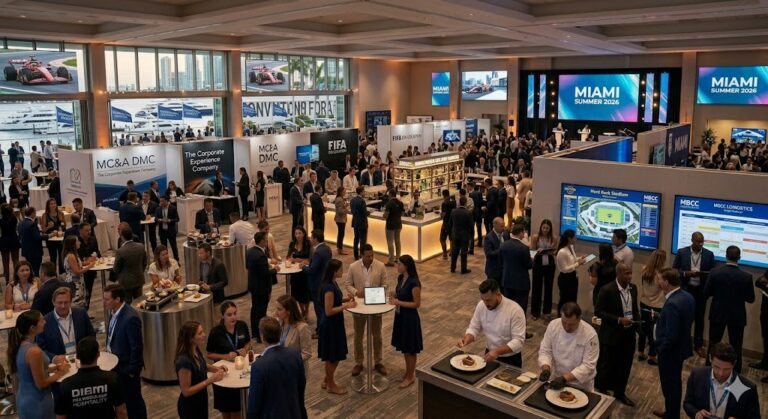
Year-round warm weather, beachfront access, world-class dining, sports, music, and cultural infrastructure (Art Basel, F1 Miami Grand Prix, FIFA World Cup 2026, two Stanley Cup-winning markets in Florida) make the city genuinely attractive to senior executives, entrepreneurs, and investors.
6. Diversity and Bilingual Workforce
The 58.3% foreign-born population creates one of the most natively bilingual professional workforces in the United States — a competitive advantage for any company doing business in Latin America, Europe, or the Caribbean [1].
7. Real Estate and Infrastructure Investment
Massive private capital deployment — including Stephen Ross’s $10 billion Related Ross West Palm Beach vision, Jeff Vinik’s Tampa redevelopment, the new Grand Hyatt Miami Beach Convention Center Hotel, and the ongoing Worldcenter, Brickell, and Wynwood developments — is reshaping the physical infrastructure of business in South Florida.
“Brian’s Take #3”
“The thing most observers get wrong about Miami’s rise is that they treat it as a single phenomenon — ‘finance moved to Miami’ or ‘tech is moving to Miami’ or ‘Latin American business is consolidating in Miami.’ It’s actually all three happening simultaneously, plus a population migration, plus a real estate boom, plus a tax-policy advantage, plus a lifestyle pull, plus a Spanish-bilingual workforce advantage that no other U.S. city has at this scale. When you have seven independent tailwinds reinforcing each other, the result isn’t linear growth — it’s compound growth. Miami’s 14th-largest county economy in the U.S. today will almost certainly be a top-10 county economy within a decade. And the cities that don’t take that seriously will spend the next ten years explaining why their tax base, executive talent, and capital deployment kept moving south.”
Final Rankings Summary: Miami in the U.S. Business Hierarchy
Putting it all together, here is where Miami currently stands across the major U.S. business and commerce indicators:
| Metric | Miami’s Ranking | Notes |
|---|---|---|
| County GDP | #14 in the U.S. | Miami-Dade ($219B) |
| Florida GDP rank | #1 county in Florida | 14% of state GDP |
| Financial Hub Rank (U.S.) | #7 | Per Beacon Council |
| Financial Hub Rank (Global, Z/Yen) | #24 | Behind 6 U.S. cities |
| International Banks (U.S.) | #2 | Behind only New York |
| Commercial RE Market (PwC/ULI 2026) | #3 | Behind Dallas, Jersey City |
| Commercial RE Market (Land App 2026) | #2 | Behind Dallas |
| U.S. Trade w/ Latin America | #1 | One-third of all U.S. exports |
| U.S. Air Imports from Latin America | 85% via MIA | #1 |
| Container Port (U.S.) | Top 15 | PortMiami |
| Tech Job Migration (U.S.) | #1 | |
| Wage Growth (U.S.) | #1 | |
| Direct Foreign Investment (U.S.) | #1 | |
| Diversity (U.S.) | #1 | |
| Foreign Business (U.S.) | #6 | |
| Population (county) | #7 | Miami-Dade |
| Foreign-Born % (U.S. metros) | #1 | 58.3% |
| Fortune 500 HQs (metro) | ~6 | Trails NY, Chicago, Dallas, etc. |
| Startup Ecosystem Value | $95B | 2,500 startups, 6+ unicorns |
| 2024–2028 GDP Growth Forecast | Outpaces top-10 average | Per Oxford Economics |
Conclusion
Miami no longer competes against Tampa, Orlando, and Jacksonville for Florida-based business gravity. It competes against New York, Chicago, Dallas, Houston, Los Angeles, San Francisco, Boston, and Atlanta for U.S.-wide business gravity — and on a meaningful subset of indicators, it is now winning. #3 commercial real estate market in the U.S. for 2026. #7 most important financial hub. #1 trading partner with Latin America. #1 in tech job migration, wage growth, direct foreign investment, and diversity. 14th-largest county economy. 6+ unicorns and 2,500 startups in a $95 billion ecosystem. Miami still trails the legacy capitals on Fortune 500 headquarters, total venture capital deployed, and absolute tech job count — but on every forward-looking growth indicator, Miami is moving in the right direction faster than nearly any other major U.S. business market. The cities that compete with Miami for the next decade of corporate relocations, family office migration, and Latin American business gravity will need to do something Miami’s competitors haven’t yet figured out how to do: replicate the combination of zero state income tax, hemispheric geographic position, bilingual workforce, year-round lifestyle pull, and the cumulative effect of every other major firm having already moved. That formula — five years into its current acceleration — is what has reset Miami’s place in the U.S. business hierarchy from regional player to top-tier capital.
Complete Resources
Economic Development Authorities
- Miami-Dade Beacon Council — beaconcouncil.com (Official county economic development organization)
- Miami-Dade County Office of Innovation & Economic Development — miamidade.gov/global/economy
- Greater Miami Convention & Visitors Bureau — miamiandbeaches.com
- Florida Department of Economic Opportunity — floridajobs.org
Major Reports and Rankings Cited
- PwC and Urban Land Institute — Emerging Trends in Real Estate® 2026 — Annual U.S. commercial real estate ranking.
https://www.pwc.com/us/en/industries/financial-services/asset-wealth-management/real-estate/emerging-trends-in-real-estate-pwc-uli/markets-to-watch/miami.html - Z/Yen Global Financial Centers Index — Global financial hub ranking
- Land App — Top Cities for Commercial Real Estate Investing in 2026 —
https://www.landapp.com/post/top-cities-for-commercial-real-estate-investing-in-2026 - Oxford Economics — Top 10 U.S. Metro GDP Growth Forecasts —
https://www.oxfordeconomics.com/resource/dallas-and-san-francisco-lead-top-10-us-metro-gdp-growth/ - Fortune 500 Annual Rankings — fortune.com/fortune500
- U.S. Bureau of Economic Analysis — bea.gov
Major Miami Business Districts
- Brickell — Financial district, “Wall Street of the South”
- Downtown Miami — Corporate, Worldcenter, government
- Wynwood — Tech, creative, brand activation
- Design District — Luxury retail, design, art
- Aventura — Retail, Latin American HQ
- Doral — Healthcare, regional HQ, golf and convention
- Coral Gables — International banking, luxury retail
- Miami Beach — Hospitality, convention, finance overflow
- West Palm Beach — Emerging financial hub via Related Ross development
Major Anchor Companies and Recent Relocations
- Citadel — Hedge fund (Ken Griffin) relocated HQ from Chicago to Miami
- Point72 Asset Management — Steve Cohen
- Blackstone — Major Miami office expansion
- Goldman Sachs — Significantly expanded Miami presence
- Microsoft — Major office presence (Fort Lauderdale)
- Lennar (Miami HQ)
- NextEra Energy (Juno Beach HQ)
- World Kinect Corporation (Miami HQ)
- Ryder System (Miami HQ)
- AutoNation (Fort Lauderdale HQ)
Major Sectors Anchoring the Miami Economy
- International Trade and Logistics — PortMiami, Miami International Airport
- Financial Services and International Banking — Brickell, fintech
- Real Estate Development — Related, Related Ross, Worldcenter
- Tourism and Hospitality — Beaches, conventions, cruise
- Technology and Startups — eMerge Americas, Embarc Collective
- Healthcare and Life Sciences — Biotech, pharma, medical devices
- Aviation — 88,500 county jobs
- Latin American Regional HQs — 1,400+ multinational firms
Key Infrastructure Assets
- Miami International Airport (MIA) — #1 U.S. airport for Latin American flights and air cargo
- PortMiami — Top 15 U.S. container port; “Cruise Capital of the World”
- Brightline rail service — Connecting Miami, Fort Lauderdale, West Palm Beach, and Orlando
- Miami Beach Convention Center — 500,000 sq ft post-renovation, with new 800-room Grand Hyatt under construction
Major Sources Cited in This Analysis
- Miami-Dade Beacon Council — “Robust Economy” — Official Miami-Dade economic data and rankings.
https://www.beaconcouncil.com/robust-economy/ - Wikipedia — Economy of Florida — State GDP and ranking data.
https://en.wikipedia.org/wiki/Economy_of_Florida - Miami Weekly — “Miami’s Economic Triumph: Experts Hail Robust Performance and Trending Sectors” — Coverage of Miami’s economic performance and migration trends.
https://miami-weekly.com/miami-economy - Euromoney — “Miami’s rise from financial backwater to wealth powerhouse” — Z/Yen Global Financial Centers Index analysis.
https://www.euromoney.com/article/2dqy8qiwsvplwm68c696o/wealth/miamis-rise-from-financial-backwater-to-wealth-powerhouse/ - Primior Group — “Top 10 U.S. Cities For Commercial Real Estate Investment In 2026” — PwC/ULI report analysis.
https://primior.com/top-10-u-s-cities-for-commercial-real-estate-investment-in-2026-ranked-by-roi-and-growth/ - Land App — “Top Cities for Commercial Real Estate Investing in 2026” —
https://www.landapp.com/post/top-cities-for-commercial-real-estate-investing-in-2026 - Babson Entrepreneurship — “Why Miami Is Emerging as a Top 5 Entrepreneurial City” — Coverage of Miami tech rankings, eMerge Americas, and startup ecosystem.
https://entrepreneurship.babson.edu/miami-top-5-entrepreneurial-city/ - PwC — “Emerging Trends in Real Estate Markets to Watch: Miami” — Trade and logistics infrastructure data.
https://www.pwc.com/us/en/industries/financial-services/asset-wealth-management/real-estate/emerging-trends-in-real-estate-pwc-uli/markets-to-watch/miami.html - Wikipedia — List of Companies Based in Miami — Fortune 500 and major company headquarters in the Miami metro area.
https://en.wikipedia.org/wiki/List_of_companies_based_in_Miami - Oxford Economics — “Dallas and San Francisco lead top 10 US metro GDP growth” — 2024–2028 GDP growth forecast.
https://www.oxfordeconomics.com/resource/dallas-and-san-francisco-lead-top-10-us-metro-gdp-growth/ - Wikipedia — List of United States Metropolitan Areas by GDP — Metro area GDP rankings.
https://en.wikipedia.org/wiki/List_of_United_States_metropolitan_areas_by_GDP - St. Louis Federal Reserve — Total Gross Domestic Product for Miami-Fort Lauderdale-West Palm Beach — Historical metro GDP data.
https://fred.stlouisfed.org/series/NGMP33100 - Sparkly Maid Miami — “Is Miami A Financial Hub?” — Coverage of the Brickell financial district transformation.
https://www.sparklymaidmiami.com/blog/is-miami-a-financial-hub
This analysis was compiled using publicly available reporting, government economic data, official economic development authority publications, and major industry rankings as of April 2026. All financial figures cited are subject to ongoing market change. GDP, ranking, and sector data reflect the most recently published authoritative sources at the time of writing. Where multiple sources reported slightly different rankings or figures (which is common across economic indicators), the analysis cites the most recent and most authoritative source.
About the Author