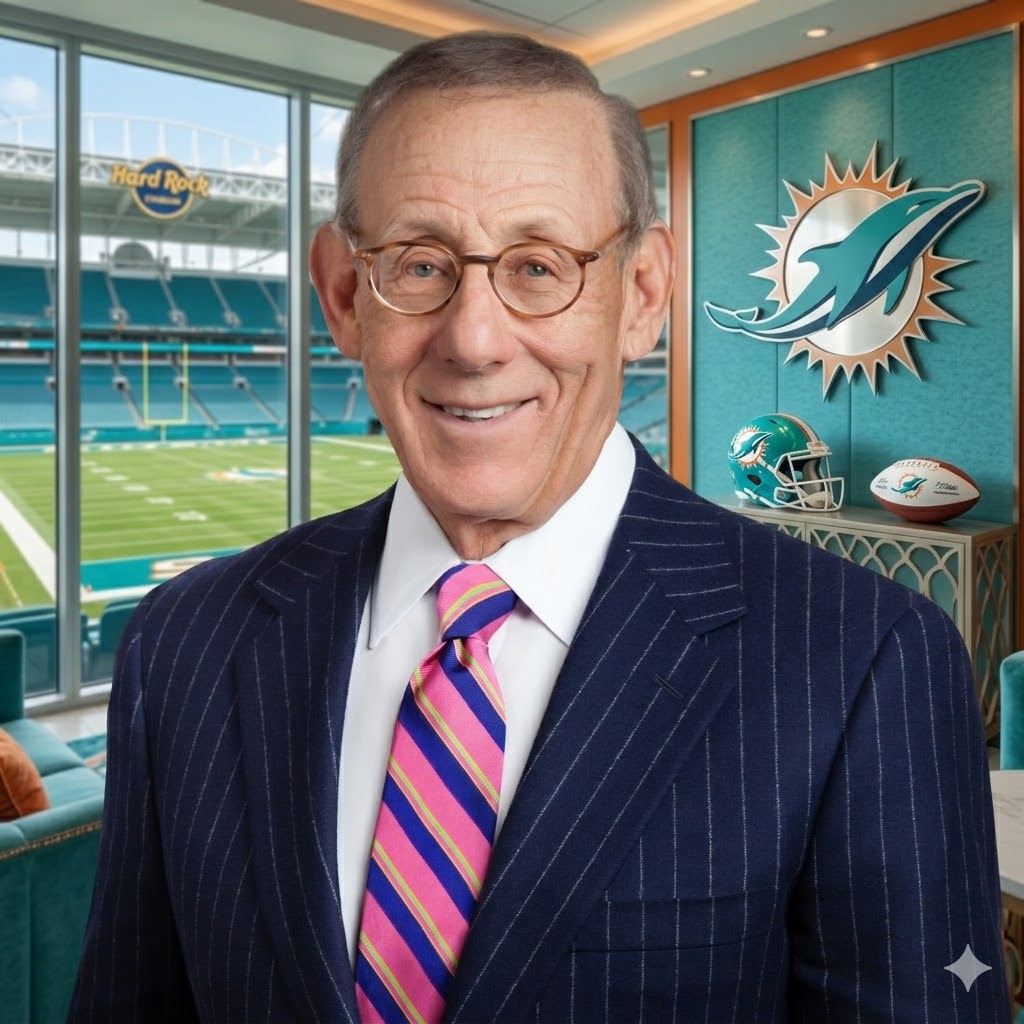
Stephen Ross: The Detroit-Born Tax Attorney Who Built Hudson Yards, Bought the Miami Dolphins, and Reshaped South Florida
April 26, 2026
When Stephen Ross borrowed $10,000 from his mother in 1972 to quit his job as a tax attorney and start a real estate advisory business, almost nothing about that moment would have predicted what came next. Fifty-plus years later, Ross sits at the helm of a privately held real estate empire valued at more than $60 billion in assets owned or under development, owns the Miami Dolphins at a record $12.5 billion valuation, controls Hard Rock Stadium and the Miami International Autodrome, holds the contract to host the Formula 1 Crypto.com Miami Grand Prix through 2041, brought the Miami Open tennis tournament to South Florida, and is in the process of investing $10 billion to transform downtown West Palm Beach into a global financial hub. He built the largest and most expensive real estate project in U.S. history at Hudson Yards in Manhattan, and he is the largest single donor in the history of the University of Michigan with $478 million in lifetime contributions. This is the story of how Stephen Ross — Detroit-born, three-degree academic, real estate visionary, and one of the most consequential sports owners of his generation — built a multi-decade empire that has fundamentally reshaped two American cities.
Early Life and Education
Stephen Michael Ross was born on May 10, 1940, in Detroit, Michigan [1]. He was raised in a Jewish family with deep midwestern roots, and the values of that upbringing — work ethic, education, and disciplined ambition — would define every chapter of his career.
Ross holds three degrees, an academic credential stack that reflects the unusually technical foundation he brought to real estate. He earned his Bachelor of Business Administration from the University of Michigan, where he would later become the largest donor in the school’s history. He earned his Juris Doctor from Wayne State University Law School, and he earned a Master of Laws in Taxation from New York University School of Law [2, 3].
He began his professional career as a tax attorney at Coopers & Lybrand in Detroit, before moving to New York City and joining Laird Inc. and Bear Stearns in finance and corporate roles [4]. Those early jobs gave him a deep working knowledge of capital structure, federal tax incentives, and real estate financing — knowledge he would weaponize when he eventually founded his own firm.
“Brian’s Take “
“What separates Stephen Ross from almost every other real estate developer of his generation is that he didn’t start as a builder — he started as a tax attorney. That’s an enormous advantage. Most developers learn the financing side after they’ve already built a few projects; Ross built every project from day one with a sophisticated understanding of capital structure, tax incentives, and federal subsidy economics that took his competitors years to develop. The result is a 50-year track record where almost every major project he has touched — from federally subsidized housing in the ’70s to Hudson Yards in the 2010s — has been financed in ways most developers never even consider. The empire wasn’t built on luck. It was built on a tax code most people don’t bother to read.”
Founding Related Companies
In 1972, at age 32, Ross borrowed $10,000 from his mother to leave a salaried job and start a real estate advisory business [5]. That same year, he founded The Related Companies to invest his own capital into real estate alongside the firm’s clients [5].
The early business model was distinctive. Ross specialized in helping wealthy investors shelter income by developing federally subsidized affordable housing — a strategy that combined social impact with sophisticated tax planning. By the 1980s, Related had built thousands of subsidized low- and moderate-income apartments across the United States, establishing what is now one of the largest portfolios of affordable housing in the nation [5].
Through the 1990s and 2000s, Ross expanded Related’s scope dramatically — moving into luxury residential, office, retail, and mixed-use projects. He hired architect Robert A. M. Stern to design The Chatham on the corner of 65th Street and Third Avenue in New York [5]. The firm developed projects at Willets Point near Citi Field in Queens and reimagined the New York Coliseum site in Manhattan, which became the Deutsche Bank Center (originally the Time Warner Center) at Columbus Circle when it opened in 2004 [5].
Today, Related Companies has more than 3,000 professionals on staff and over $60 billion in assets owned or under development, including:
- Deutsche Bank Center (formerly Time Warner Center) — Mixed-use Columbus Circle development
- Hudson Yards — 28-acre Manhattan west side megadevelopment
- CityPlace — West Palm Beach mixed-use district
- The Grand in Los Angeles — Designed by Frank Gehry
- 40,000+ luxury residential rental units — The largest such portfolio in the United States [1, 2]
Related is also a major investor in Equinox Fitness Clubs, Equinox Hotels, and SoulCycle, reflecting Ross’s long-standing commitment to wellness and lifestyle businesses [3].
Hudson Yards: The Largest Real Estate Project in American History
If a single project defines Ross’s career as a developer, it is Hudson Yards — the 28-acre Manhattan west side redevelopment that began construction in 2012 and stands as the largest and most expensive real estate project in U.S. history at almost a billion dollars an acre [1].
The project transformed an industrial rail yard above Penn Station’s storage tracks into a fully realized neighborhood with office towers, luxury residential buildings, retail, public space, and the controversial Vessel art installation. Ross’s tenant strategy at Hudson Yards has become legendary in real estate circles — he constructed an entire atrium inside Hudson Yards specifically to entice Coach (Tapestry) into signing as an anchor tenant [1].
Hudson Yards’ impact on Manhattan is generational. The development pulled Midtown West’s center of gravity dramatically west, attracted companies including BlackRock, KKR, Wells Fargo, and Time Warner/WarnerMedia as anchor tenants, and effectively created an entirely new neighborhood from a former rail yard.
“Brian’s Take “
“Hudson Yards is the kind of project most developers spend a lifetime dreaming about and never build. Stephen Ross actually built it — and he built it during and after the 2008 financial crisis, when most of the real estate industry was sitting on its hands trying to survive. The audacity of breaking ground on a $25+ billion mixed-use project on a deck above active rail tracks, in a market where almost nobody else would bet that big, is what separates Ross from everyone else in his industry. Then he convinced Coach to anchor the development by literally building an atrium for them. That’s not real estate development. That’s empire-building.”
Acquiring the Miami Dolphins
In February 2008, Ross made his entry into NFL ownership. He bought 50% of the Miami Dolphins franchise, Dolphin Stadium (now known as Hard Rock Stadium), and surrounding land from Wayne Huizenga for $550 million, with an agreement to later become the team’s managing general partner [1].
On January 20, 2009, Ross closed on the purchase of an additional 45% of the team from Huizenga. The total value of the deal was $1.1 billion, making Ross the owner of 95% of both the franchise and the stadium [1].
Since then, Ross has aggressively diversified the Dolphins’ minority ownership group, bringing in cultural and athletic powerhouses including Gloria Estefan, Marc Anthony, Venus Williams, and Serena Williams as minority owners [1]. The strategy was deliberate: layer Miami cultural icons into the cap table to anchor the franchise’s identity in the local community.
In March 2026, Ross sold 1% of his stake in the holding company behind the Dolphins for $125 million — implying a $12.5 billion valuation, a record valuation for a minority transaction in sports. Ross sold the 1% stake to Lin Bin, the co-founder of Xiaomi [1].
Earlier, in December 2024, Ross had facilitated the sale of a 13% stake in the Dolphins, Hard Rock Stadium, and the Formula 1 Crypto.com Miami Grand Prix to Ares Management funds and Brooklyn Nets owners Joe Tsai and Oliver Weisberg, with the raise intended to fuel continued investment into his diverse South Florida-based sports and entertainment portfolio [2].
The math on Ross’s NFL investment is remarkable: a 2008–09 acquisition at $1.1 billion grew to a $12.5 billion valuation by 2026, representing approximately an 11x increase over roughly 17 years.
Hard Rock Stadium: A Billion-Dollar Transformation
Ross’s most significant operational transformation has been at Hard Rock Stadium, where he has invested more than $1 billion of private capital to modernize and expand the venue and its surrounding properties — most notably during the 2015–17 renovation that added a stadium-spanning canopy, club spaces, and modernized fan facilities [2].
The investment turned Hard Rock Stadium into one of the most coveted event venues in North American sports. Major events secured at Hard Rock under Ross’s ownership and investment include:
- Super Bowl LIV (February 2020) — Coinciding with the 100th season of the NFL
- 2021 College Football Playoff National Championship
- 2026 College Football Playoff National Championship
- Formula 1 Crypto.com Miami Grand Prix (annual since 2022)
- 2026 FIFA World Cup — Seven matches at Hard Rock Stadium, including the Bronze Final
- Miami Open Tennis Tournament (annual since 2019)
- Major global concert tours and international soccer matches [2]
In 2017, when Miami Open organizers began exploring leaving the tournament’s longtime home in Key Biscayne, Ross stepped in to propose hosting the tournament at Hard Rock Stadium. Two years later, the Miami Open debuted in its new home in Miami Gardens, where Ross had spearheaded and funded construction of a custom tennis complex now considered one of the best in professional tennis for guest experience and player amenities [2].
The Formula 1 Miami Grand Prix
Ross’s most audacious sports business achievement may be the Formula 1 Crypto.com Miami Grand Prix. He owns the Miami International Autodrome, a purpose-built temporary circuit around Hard Rock Stadium. The Autodrome holds exclusive rights to host the Miami Grand Prix through the 2041 season, with the Formula One Grand Prix held for the first time during the 2022 season [1].
Working with CEO Tom Garfinkel and specialist designers, Ross built an FIA Grade One track around Hard Rock Stadium — possible only because of his sole ownership of the venue and surrounding property and his willingness to put private capital into the build [2]. The circuit layout was specifically designed so that local residents would not be disrupted by the races [1].
The results have validated the investment dramatically:
- Best New Event of 2022 — Sports Business Journal [2]
- Promoter of the Year — Formula 1 awarded the organization this title after just the third edition of the event [2]
- Estimated economic impact: more than $1 billion to the local area [2]
- Cemented as America’s premier Formula 1 race [2]
- Extended contract through 2041, securing two decades of additional Grand Prix events [1]
Ross had been trying to bring a Formula 1 race to Miami for several years before finally succeeding [1]. The combination of stadium ownership, surrounding land control, private capital, and political navigation required to land an F1 race is precisely the kind of multi-domain execution his five-decade career has been built around.
Related Ross and the West Palm Beach Vision
In 2024, Ross announced he would step down as chairman of Related Companies — continuing as non-executive chairman — to focus on his business ventures via Related Ross, the Miami Dolphins, and Formula 1 [1].
Related Ross has already become the largest commercial-property owner in downtown West Palm Beach [3]. The vision is staggering in scope: Ross plans to invest $10 billion to turn West Palm Beach into a financial hub, with plans for 6 million square feet of office space, 1.4 million square feet of condos, and nearly 900 hotel rooms across the 70 acres of land he has amassed over the last two decades [1].
Recent milestones reflect the pace of execution:
- December 2025: Related Ross received a $772 million construction loan, one of the largest in Florida history, for two office towers in West Palm Beach [1]
- April 2, 2026: Related Ross broke ground on a 28-story condominium along the water in West Palm Beach [1]
The strategy is to attract a new generation of leaders across finance and technology to “The Gold Coast,” replicating in West Palm Beach what Ross accomplished at Hudson Yards in Manhattan — but on terms specifically engineered for the post-pandemic migration of capital to South Florida [2].
Philanthropy: The University of Michigan and Beyond
Stephen Ross is, by total dollar contribution, the largest donor in the history of the University of Michigan with $478 million in lifetime contributions [1]. According to the Chronicle of Philanthropy, his higher education gifts rank behind only those of fellow American billionaire and former New York City Mayor Michael Bloomberg [1].
Major Ross gifts to Michigan include:
- 2004: $100 million donation that led to the renaming of the business school as the Stephen M. Ross School of Business at the University of Michigan [4]
- 2011: University of Michigan awarded Ross an honorary degree, Doctor of Laws [3]
- 2013: Additional $200 million gift distributed equally between the business school and athletic department [4]
- Establishment of the Detroit Center for Innovation [3]
- Funding for critical athletic facilities, scholarships, career development programs, and faculty recruitment [3]
In 2013, Ross took the Giving Pledge — the long-term global initiative created by Warren Buffett and Bill and Melinda Gates — pledging to give more than half of his estate to philanthropic causes and charitable organizations [3, 6].
Beyond Michigan, Ross’s philanthropy spans education, the arts, racial equality, healthcare, and sustainable cities. He serves on the Executive Committee as a trustee of Lincoln Center, as a trustee of New York-Presbyterian Hospital, on the board of the Jackie Robinson Foundation, the New York Stem Cell Foundation, The Shed, and the Guggenheim Foundation. He is chairperson emeritus of the Real Estate Board of New York (REBNY) [3, 6].
He established the WRI Ross Center for Sustainable Cities at the World Resources Institute, an initiative that integrates urban planning, sustainable transport, energy and climate change, water resources, and governance [3].
In 2015, Ross founded the Ross Initiative in Sports for Equality (RISE) — a nonprofit using the unifying power of sport to advance race relations across the country. RISE was recognized in 2017 by ESPN’s Humanitarian Awards with the Stuart Scott ENSPIRE Award [3].
In 2019, Ross was inducted into the National Football Foundation Leadership Hall of Fame, becoming the 12th inductee. NFF Chairman Archie Manning said at the time that Ross “has built a reputation as one of the top business leaders in our country today” [7].
The Brian Flores Lawsuit and NFL Sanctions
No honest profile of Stephen Ross can omit the most significant controversy of his ownership tenure. On February 1, 2022, Ross and the Dolphins, among other teams, were cited in a federal class-action lawsuit brought forth by his former head coach Brian Flores. Flores alleged that Ross offered him a $100,000 bonus for every game he lost in the Dolphins’ 2019 campaign in order to improve the team’s draft position [1].
Following a six-month independent investigation, the NFL did not substantiate the tanking allegations directly but uncovered a different offense: the Dolphins had violated the league’s anti-tampering policy on three past occasions by having forbidden conversations with quarterback Tom Brady and New Orleans Saints coach Sean Payton [8].
The NFL’s sanctions were significant:
- Stripped the Dolphins of their 2023 first-round draft pick and a 2024 third-round draft pick
- Fined Ross $1.5 million
- Suspended Ross through October 2022
- Removed Ross from all league committees indefinitely [8]
The lawsuit and NFL sanctions remain part of the public record of Ross’s tenure as an NFL owner and are referenced in essentially every comprehensive profile of his career.
“Brian’s Take”
“There’s no way to write honestly about Stephen Ross without addressing the Flores lawsuit and the NFL sanctions — but it’s also impossible to write honestly about Ross without recognizing that very few NFL owners in modern history have invested $1 billion of personal capital into a stadium, secured Super Bowl LIV, anchored Formula 1 in the U.S. through 2041, brought a Grand Slam tennis tournament to their stadium, and elevated their team’s valuation by 11x. The full picture is more complicated than either Ross’s critics or admirers prefer to acknowledge. He is, simultaneously, one of the most operationally successful sports owners of his generation and a figure who has been formally sanctioned by his own league. Both things are true, and a serious profile has to hold both.”
Other Business Interests
Ross’s portfolio extends well beyond Related Companies and the Dolphins:
- RSE Ventures — Co-founded with Matt Higgins in 2012; private investment firm focused on sports and entertainment, media and marketing, food and lifestyle, and technology. Investments include the Drone Racing League, Thuzio, VaynerMedia, and Relevent Sports (which created the International Champions Cup global preseason soccer tournament) [1, 5]
- Equinox Holdings, Inc. — Chairman of the Board of Directors [3]
- Miami Open Tennis Tournament — Hosted at Hard Rock Stadium since 2019 [2]
- Miami International Autodrome — Home of the Formula 1 Crypto.com Miami Grand Prix through 2041 [1]
Ross’s net worth has fluctuated with markets but stands at approximately $15 billion according to Celebrity Net Worth (2026), with other sources citing figures up to $16.98 billion ranking him #166 globally and #63 in the United States [5, 9].
Recognition and Honors
Over the years, Ross has accumulated honors that span business, civic, real estate, and philanthropic categories:
- National Building Museum Honor Award [3]
- National Housing Conference’s Housing Person of the Year [3]
- REBNY’s Harry B. Helmsley Distinguished New Yorker Award [3]
- Multi-Family Property Executive of the Year — Commercial Property News [4]
- Jack D. Weiler Award from UJA [4]
- New York Power Player — The New York Times [4]
- Most Powerful Person in New York Real Estate — The New York Observer [4]
- One of the 100 Most Influential Leaders in Business — Crain’s New York [4]
- Leadership in Tourism Award — NYC & Company [4]
- National Football Foundation Leadership Hall of Fame (2019) [7]
- University of Michigan Doctor of Laws honorary degree (2011) [3]
Legacy
Stephen Ross will turn 86 in May 2026. He sits at an unusual moment in his career — having handed the chairman role at Related Companies to a successor while still serving as non-executive chairman, having sold a 13% stake in his sports holdings to fuel continued investment, while simultaneously launching Related Ross’s $10 billion West Palm Beach vision and overseeing his Dolphins through the most consequential summer in their stadium’s history with the 2026 FIFA World Cup arriving at Hard Rock Stadium.
His legacy across two cities is genuinely difficult to overstate:
- In New York: Hudson Yards — the largest and most expensive real estate project in U.S. history — and the Deutsche Bank Center, both reshaping Manhattan’s geography [1]
- In Miami Gardens: A modernized Hard Rock Stadium that has hosted Super Bowl LIV, two College Football Playoff National Championships, the Formula 1 Miami Grand Prix, and seven matches of the 2026 FIFA World Cup, all while elevating the Dolphins’ valuation to a record $12.5 billion [1, 2]
- In West Palm Beach: A $10 billion private investment program engineered to turn the city into a financial hub, supported by the largest commercial property portfolio in downtown [1]
- At the University of Michigan: $478 million in lifetime contributions, the largest in school history, and a business school that bears his name [1]
- Through the Giving Pledge: A commitment to give away more than half of his estate to philanthropic causes [3, 6]
Ross built it the way only a tax attorney from Detroit could have — by understanding the financing, the tax code, and the political mechanics of every project before he ever broke ground on the building. The Dolphins will keep playing at the stadium he built. The Formula 1 race will keep running on the track he funded. Hudson Yards will keep dominating Manhattan’s west side. And every business student walking past the Stephen M. Ross School of Business sign at the University of Michigan will see his name for as long as the school stands.
That’s not a real estate career. That’s an American empire.
Sources
- Wikipedia — Stephen M. Ross — Comprehensive biographical reference covering Ross’s life, career, sports ownership, real estate developments, and recent transactions including the March 2026 Lin Bin / Xiaomi deal at $12.5 billion valuation.
https://en.wikipedia.org/wiki/Stephen_M._Ross - Miami Dolphins Official Website / NFL.com — Front Office: Stephen M. Ross — Official organizational biography covering his Dolphins ownership, Hard Rock Stadium investment, F1 Miami Grand Prix, Miami Open, and South Florida sports portfolio.
https://www.miamidolphins.com/team/front-office-roster/stephen-m-ross - Related Ross — Leadership: Stephen M. Ross — Official biography from the Related Ross West Palm Beach development entity.
https://www.relatedross.com/our-company/leadership/stephen-m-ross - Michigan Ross — University of Michigan: Stephen M. Ross profile — University biography covering Ross’s education, donations, and recognition.
https://michiganross.umich.edu/about/profile/stephen-m-ross - Celebrity Net Worth — Stephen Ross Net Worth — Reporting on Ross’s net worth, founding of Related Companies with $10,000 borrowed from his mother, RSE Ventures, and the NFL anti-tampering sanctions.
https://www.celebritynetworth.com/richest-businessmen/business-executives/stephen-ross-net-worth/ - Jackie Robinson Foundation — Stephen M. Ross profile — Coverage of the Giving Pledge commitment and philanthropic board roles.
https://jackierobinson.org/people/stephenmross/ - National Football Foundation — Stephen M. Ross (2019 Leadership Hall of Fame) — Coverage of Ross’s induction as the 12th inductee into the NFF Leadership Hall of Fame, with quotes from Archie Manning.
https://footballfoundation.org/sports/general/roster/stephen-m--ross/609 - Miami Dolphins Official Website — “Miami Dolphins Relieve Head Coach Brian Flores of His Duties” — Official press release covering the Flores firing, plus broader context on the subsequent lawsuit and NFL sanctions.
https://www.miamidolphins.com/news/miami-dolphins-relieve-head-coach-brian-flores-of-his-duties - Goodreturns — Stephen Ross Net Worth & Biography — Net worth ranking and biographical overview.
https://www.goodreturns.in/stephen-ross-net-worth-and-biography-blnr238.html - Related — Leadership: Stephen M. Ross — Founding company biography covering Related’s $70+ billion in assets and Ross’s investment portfolio.
https://www.related.com/our-company/leadership/stephen-m-ross - World Resources Institute — Stephen M. Ross — Biographical profile from the Ross-affiliated WRI Ross Center for Sustainable Cities.
https://www.wri.org/profile/stephen-ross - Hard Rock Stadium Media — Stephen M. Ross — Stadium media center biography covering the venue investment.
https://media.hardrockstadium.com/stephen-m-ross/
This profile was researched and compiled using publicly available reporting, official team and league communications, real estate industry coverage, and university source material as of April 2026. Where dollar figures or dates differ across sources, the most recent or most authoritative source has been cited. All financial figures cited are subject to ongoing market change. The Brian Flores litigation and NFL sanctions are matters of public record and have been reported by multiple sources including the official Dolphins press communications, the NFL’s investigation findings, and major sports media organizations.
About the Author